
This is going to be a living article 1st written on 26 August 2026, revised whenever I learn something that breaks it. The version log is at the bottom, and it’s the part I care about most.
For a good stretch of my first year with a brokerage account, I would have told you I had an investing philosophy, not complicated, only five words long: buy good companies, hold long-term. At a barbecue it sounded like a plan, it looked as a plan, had the right nouns in it, … nobody ever asks a follow-up question.
Then META went from a position I was proud of to a number I checked at 02:00 AM. with the screen brightness turned down so it wouldn’t wake anyone, and I found out what my philosophy actually was: … whatever I felt at 02:00 AM. The five words weren’t load-bearing. They were decoration on top of a mood and that’s the honest lesson of the $28K era. I didn’t lose money because I lacked information, I lost it because I had no written answer to “what do I do now,” so the answer got improvised by the version of me least qualified to improvise.
So this is the page I wrote instead. Squared-paper notebook, one page, rules I can read in fifteen seconds while the screen is red. Publishing it makes it expensive to quietly rewrite later, which is the whole point, a private philosophy is a mood with better vocabulary.
Fair warning: this isn’t advice, and it isn’t finished. I’ve been at this seriously long enough to have rules, and nowhere near long enough to have earned them.
First, a question about two very boring people
Same plan, run twice. $500 a month in today’s purchasing power into the whole market, meaning the contribution rises with inflation, every month for thirty years. Never sold, never panicked, never got clever, perfect discipline both times.
Saver A started in January 1891. Saver B started in January 1970.
Both paid in $180,000. How different could the endings be, if the behaviour was identical? Let’s try and find out, shall we?
Saver A finished December 1920 with $199,094 of purchasing power. Thirty years of iron discipline turned $180,000 into $199,000. Barely 1.1× the money, in an era where inflation took about 60% of every dollars purchasing power along the way.
Saver B finished December 1999 with $1,286,105, same $500, same stubbornness, 7.1× the money.
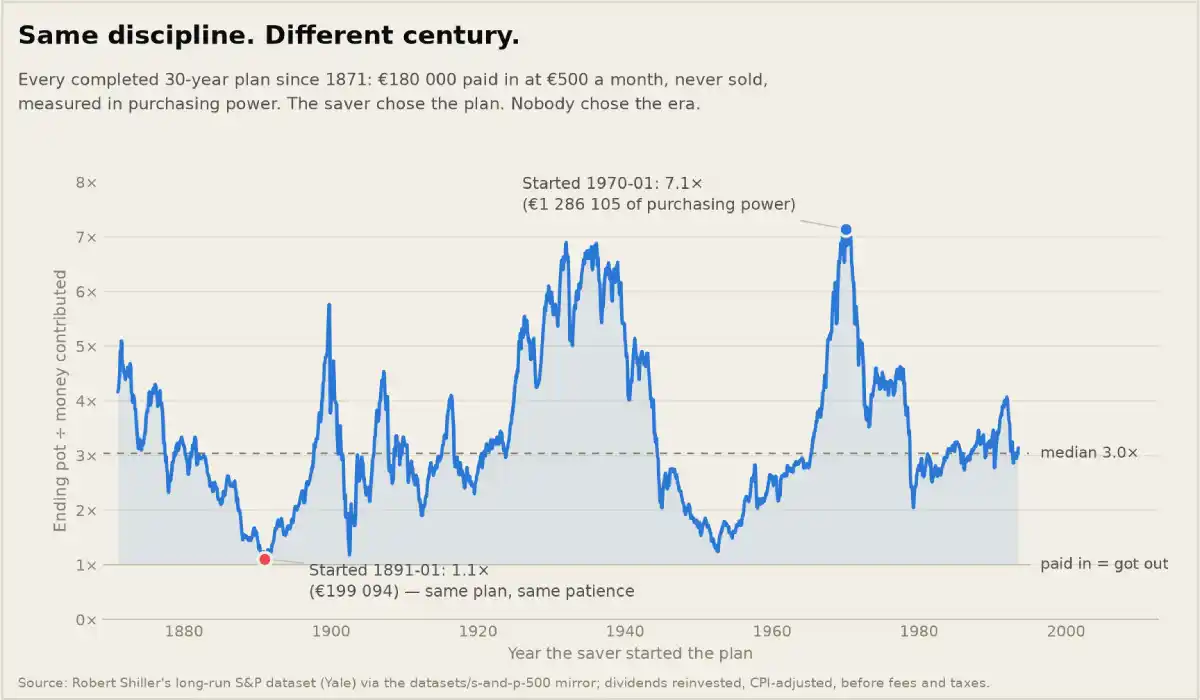
That’s 1,471 complete thirty-year plans, and the gap between the luckiest and the unluckiest is a factor of 6.5; same instrument, same behaviour, but different birth certificate.
Now the part that rearranged my thinking; look at when Saver B started: January 1970. Their first five years contained a 53% collapse in real prices, January 1973 to December 1974. Saver B spent the opening stretch of the best thirty-year run in recorded history watching their savings get shredded. Part of the reason it became such a good thirty-year run is that the ugly years came early, while Saver B was still accumulating. Falling prices felt terrible, but they also meant each new $500 bought more.
There’s a smaller consolation in the same chart. Of those 1,471 plans, exactly zero ended below what was paid in. The worst possible timing in a century and a half still returned the money, plus a little. Roughly one in seven, though, finished under 2×, which is a real outcome over thirty real years that no retirement projection you will ever be shown includes.
Remember: you don’t choose the era, and in this dataset the era was worth a factor of more than six. You choose
the plan, the amount, and whether you’re still there in year twenty. A philosophy is a set of rules about the second
list, written in advance, precisely because the first list will try to make you renegotiate.
That’s my working definition, and it’s the one thing I’d ask you to steal: an investing philosophy is a small set of decisions made in advance, in writing, by the calmest version of you, to be executed by the least calm version of you. It is not a predictions, neither a forecast of where the market goes only a pre-commitment.
That distinction matters, this phase “Stocks return 7%” isn’t an investing philosophy. Neither is “AI will change everything” or “the S&P always comes back.” Those are claims about the world, <span class=”hl-underline”a philosophy tells me what I will do when the world refuses to cooperate with the claim.
There’s another test I think matters: a philosophy that only works when I’m comfortable isn’t much of a philosophy. The rules earn their keep when following them feels stupid. Buying while the market is falling, refusing to chase something that doubled without me, holding cash when everyone else seems to be getting rich, selling a company I still like because the reason I bought it is no longer true, etc.
If I can rewrite the rule whenever the outcome becomes uncomfortable, I don’t have rules, instead I have explanations.
So these aren’t promises about what the market will do for me. They’re promises about what I’ll try not to do to myself.
Here’s mine, seven beliefs, in the order they’d survive if I had to start dropping them.
1. I am buying pieces of businesses, not tickers
If I own $4,000 of a company, somewhere in the world people are showing up to work and customers are paying them, and a sliver of that belongs to me. That is what a stock actually is, and it sounds obvious right up until the price falls 30% and the ticker starts feeling like the asset.
The value of this belief isn’t philosophical, it’s diagnostic. It gives me a question I can ask at 02:00 AM.: has the business changed, or has the mood changed? If earnings, margins and the competitive position are intact and only the price moved, then my reason for owning it is intact too, and selling is just paying a fee to make an uncomfortable feeling stop. If the business actually broke, I should sell whether the price is up or down.
Everything below depends on this one. It’s first because it’s the only belief here I’d defend without evidence.
Changes my mind: if I repeatedly find myself valuing stocks mainly from price action rather than from the underlying economics of the business, then this belief isn’t doing the job I wrote it to do. The principle may still be true; my process around it would have failed.
2. Time is the only edge I’m sure I have
I’m not faster than a trading desk, and I’m not better informed than an analyst who covers eight companies for a living. My “insight” about a company is usually something 40,000 other people read the same week.
I don’t need to know more than the market tomorrow. I need to be willing to do something I already know is difficult for me: hold something boring for twenty years. That’s an edge that doesn’t require me to be smart, only to be still. The market pays owners and gamblers from different tills, and the till I get paid from is chosen by my holding period, not by my IQ.
So most of my “strategy” is really just a list of ways to avoid being forced or tempted to sell early: savings buffer, automatic buys, a boring core, and position sizes small enough that no single one can make me act.
Changes my mind: evidence that long holding periods stopped working structurally, not one bad qurter, but something like twenty-plus years of listed businesses systematically failing to convert profits into shareholder returns.
3. For my first decade, I am the strategy
This is the belief that most changed what I actually do on a Tuesday.
Run that same $500-a-month plan through every thirty-year window since 1871 and look at where the money in the pot came from:
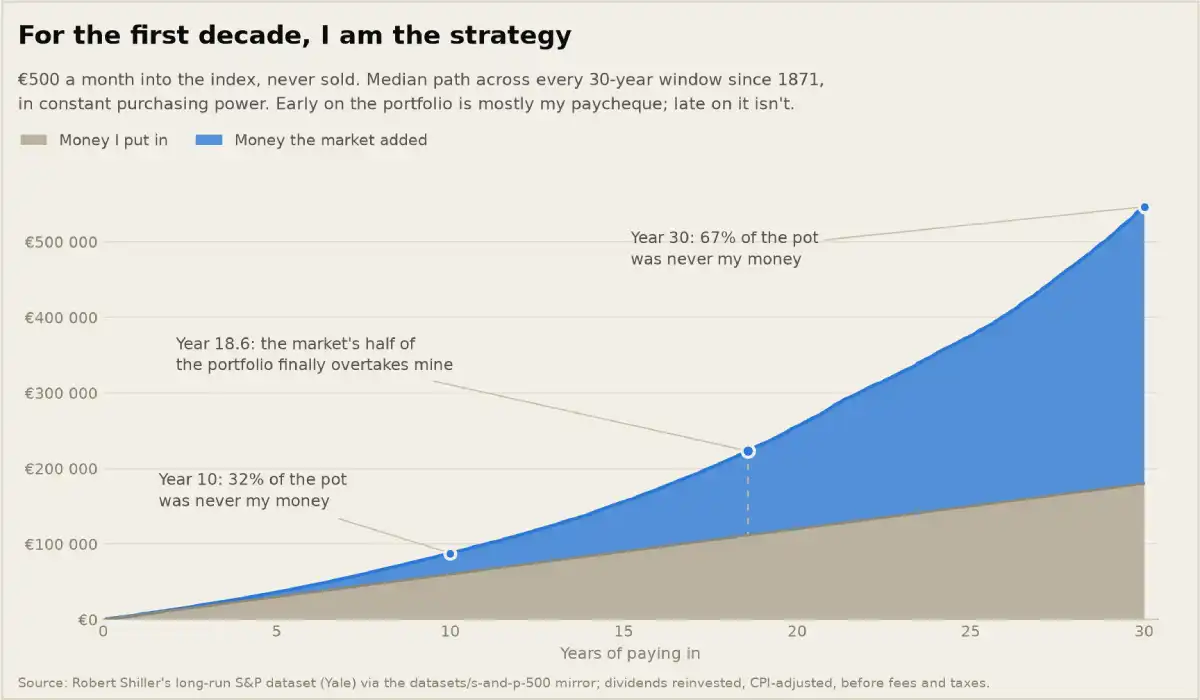
At year 10, the median pot is around $88,000, and about 68% of it is money I deposited myself. The market’s contribution only overtakes my own deposits in year 18.6. Then it runs away: by year 30 the pot is roughly $ 546,000 and two-thirds of it was never my money.
So compounding is real, and it’s also much slower to show up than the seminar slides suggest. Which means the first ten years of my investing life are driven heavily by two numbers I control completely: how much I put in, and how little I pay in fees.
Both are worth putting numbers on, because I used to argue about the wrong one. Add $100 a month to the median plan and year 10 comes out $17,564 better. Add a full percentage point to the annual return instead, and it’s $4,933. The savings decision is worth about three and a half times the investing decision, at exactly the age when every article I read was about the second one.
It expires, though. By year 20 the ratio is down to 1.5×, and at year 30 the extra percentage point finally wins: $119,523 against $109,267. The savings-rate argument has a shelf life. It happens to cover the years I’m living through now.
Fees run the same argument in reverse, which is why they irritate me more than they should. A 1% annual charge, an ordinary fund fee, invisible on any statement, costs the median plan $94,121, about 17% of the final pot, for nothing. Half a point costs $49,483. You make that choice once, sober, on a form, and it beats almost everything else you’ll ever do with a spreadsheet.
Early in the journey, my salary is a bigger financial asset than my portfolio. Improving what I earn and what I keep can matter more than improving what my portfolio earns.
That’s mildly annoying after spending an evening comparing ETFs to the second decimal place, but the arithmetic doesn’t care what I find interesting. (How to translate “adequate” into an actual monthly number is where a real process comes in, “Why I Need a Process Before I Need Stock Picks”, is the next lesson in this series.)
Changes my mind: the crossover above is the trigger, and it’s arithmetic rather than opinion. When my invested capital gets big enough that a percentage point of return outweighs a plausible increase in savings, this belief flips and my attention should move with it.
Remember: in the first decade you are not competing with the market. You’re competing with your own savings rate. In the third decade the roles reverse, and by then the biggest mistake may simply be interrupting it.
4. I plan for a bad era, not an average one
The chart at the top is why I refuse to build a plan around 7% a year.
The median thirty-year window returned 3.0× the money contributed, in real terms. But a saver who did everything right in the wrong era got 1.1×, and I have no way of knowing which one I’m in until it’s over. Anyone who tells you which one we’re in now is guessing with confidence, which is the most expensive product in finance.
So what do I plan around? Expressed as an annual real return on the money as it went in, those 1,471 plans run from 0.7% at the worst end to 11.1% at the best, median 6.6%. I build on roughly 3.5%, near the tenth percentile, and treat anything above it as weather rather than salary. If the era is generous I retire earlier or give more away. If it isn’t, I don’t have to redesign my life at fifty-five.
The rest of the plan has to survive the bad version too. No leverage, no borrowed money in the market, ever. A cash buffer that makes forced selling much less likely, because forced sellers get the gambler’s outcome with the owner’s intentions. Contributions sized so that I can keep making them during the bad decade, which is exactly when they’re worth the most. And expectations set low enough that an ordinary result feels fine rather than disappointing, because disappointment is what makes people reach for something stupid.
The bonus: if the era turns out kind, nothing bad happens to me. Plans built on optimism don’t have that symmetry.
Changes my mind: nothing much. This is a risk preference, not a forecast. The only thing that would loosen it is a much longer track record of my own behaviour under stress than I currently have.
5. I am the largest single risk in my portfolio
Not inflation, not a recession, not the company I picked badly. It’s, Me.
I know this because I’ve watched myself do it. My META position was bought as a bet on a story, with no analysis, and when it fell I didn’t sell, but not because of conviction. I relabelled it to feel good and it became a “long-term investment” somewhere around −40%, and the relabelling did no work except to make the loss unfeelable. A position that changes category after the price moves hasn’t been analysed, in reality it’s been anaesthetised.
So the rules that protect me from me are physical, not motivational: the buying is automatic, so the decision to invest isn’t re-made every month; nothing individual gets bought without a written thesis; no decision happens inside 24 hours of the impulse; speculation is capped and quarantined in its own account, sized like concert tickets. (The Investor’s Enemy: Impatience is going to be a whole post about the evidence that temperament, not intelligence, is what separates investors’ results from their funds’ results.)
Motivation isn’t a plan; a plan is what still works on the day you have no motivation.
Changes my mind: two or three full market cycles of evidence that I behave well without the guard rails. Ask me in 2040.
6. Not knowing is a position, and it should be sized like one
I understand maybe a dozen businesses well enough to have an opinion about their next five years, and I’m probably flattering myself with three of them. I almost bought NVIDIA once because I like data centres, which is roughly the analytical rigour of buying an airline because you enjoy airports.
The honest response to that isn’t to stay out of the market until I’ve read every 10-K ever filed. It’s to let structure do the analysis I can’t do yet: the boring index core is most of the portfolio precisely because it doesn’t require me to be right about anything in particular. Individual businesses get real money only where I can explain, in plain language, how the company makes money and what would stop it.
I like this belief because it makes ignorance operational rather than shameful. I don’t have to pretend I understand semiconductors to own a piece of the world’s semiconductor profits. I just have to be honest about which bucket the money goes in. (Position Sizing will be the post where I try to put actual numbers on “how much conviction is worth how many dollars.”)
Changes my mind: nothing about the principle, but the boundary should move outward every year. If my circle of competence is the same size in 2030 as it is today, I’ve been reading for entertainment rather than for work.
7. Every belief above has to be falsifiable, or it’s just a slogan
This is the rule that makes the article a living one, and it’s the one I’d defend hardest, because it’s the only protection against the specific failure I’ve already lived through: holding an opinion so vague that no fact can ever contradict it.
“Buy good companies long-term” survived my $28K loss completely intact. It survived because it means nothing. A belief that can’t be wrong can’t teach you anything, and it certainly can’t stop you at 2 a.m.
So each belief here carries the conditions under which I’d drop it, written before those conditions occur. A label, a thesis, a rule changes only through new written analysis. Never through a price move, and never at 2 a.m. That one meta-rule, applied a few years earlier, was worth about $28,000 to me.
Changes my mind: if I ever find myself unable to state what would falsify a belief, that belief comes off the page until I can.
What I control, and what I don’t
The whole philosophy compresses into two columns:
| I control this | I don’t control this |
|---|---|
| How much I save each month | What the market returns |
| What I pay in fees and taxes | The era I happened to be born into |
| How long I hold | Interest rates, elections, wars |
| Whether I’m forced to sell | Whether I’m right on schedule |
| Whether the reason is written down | Whether other people agree with me |
| The size of the position | Whether the story stays exciting |
| Which businesses I refuse to have opinions about | The next 12 months of anything |
Nearly all investing content is about the right-hand column, were nearly all of my results, for the next decade, come out of the left one.
“If the era matters so much, why not wait for a good one?”
Because you can’t tell which era you’re in from inside it, and the chart makes that point in the cruellest way available. The best thirty-year stretch in this dataset began in January 1970, the doorway to the worst decade for stocks in living memory. An investor waiting for clear skies in 1970 would have felt brilliantly vindicated for four years and then missed the whole thing.
The same logic runs the other way. Sitting on cash “until things calm down” isn’t neutral: it’s a bet against the businesses, paid for with the silent thief, and I already wrote about how badly waiting for the dip went for me. My conclusion isn’t “timing is hard.” It’s that timing shouldn’t drive the decision. My buys happen regardless of what the market is doing. Individual stocks are different: I buy those only after I’ve done the research and the business makes sense at the price I’m paying. The goal isn’t to remove decisions. It’s to stop making them because I’m scared of what the market might do next.
Where this philosophy is weak
Honesty section, because a philosophy with no known holes is a marketing document.
It hasn’t been taxed yet. I’ve never held a real portfolio through a real bear market. Every belief above is a hypothesis about how I’ll behave, and hypotheses about your own behaviour are the least reliable kind. Check back after the first −40%.
The data flatters itself. All 1,471 windows come from the United States, one of the great long-run market success stories, which is a bit like studying success by interviewing lottery winners. Romania’s interwar exchange closed for half a century. Japan’s price index took over three decades to reclaim its 1989 high. “The market always recovers” is a sentence about this market, in this history, and I hold it loosely and diversify globally because of that.
It’s priced in a currency I don’t live in. My rent and my salary are in euros and lei; the businesses in those charts earn dollars. Three decades of exchange-rate drift sit on top of every number above, in either direction, and I haven’t modelled any of it. (Currency Risk: Buying US Stocks With European Money is on the list precisely because I can’t yet say anything intelligent about it.)
It suits exactly one person: me. Thirty-year horizon, salary, no dependents relying on the portfolio, high tolerance for boredom, but also a genuine obsession with investing. I enjoy spending hours in financial reports, digging through numbers, comparing businesses and trying to understand what makes them work. For me, the research isn’t a chore I tolerate for a better return. It’s a hobby I’d probably be doing even if I never bought a stock. A retiree drawing income from the same pot needs a different set of rules, and someone who has no interest in spending Sunday afternoon inside a 10-K probably shouldn’t copy mine either. A philosophy borrowed from someone whose life and temperament don’t match yours is worse than no philosophy at all.
It’s a philosophy, not a process. Nothing above tells me what to actually do when I open a 10-K on a Sunday. Beliefs point; a checklist executes. That gap is deliberate, and it’s the next thing I have to build.
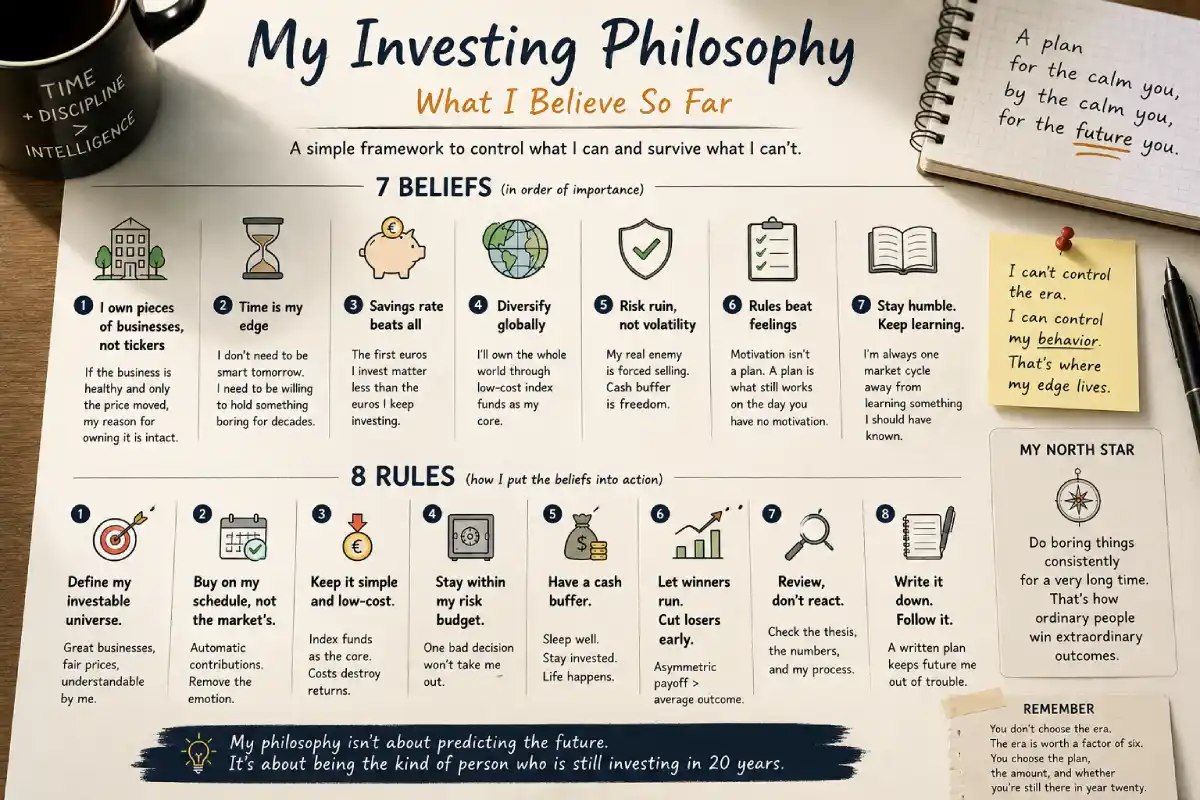
My current rules, in the form I actually keep them
The page in the notebook, verbatim, minus the coffee stain:
- Money I need inside five years never touches the market.
- I don’t buy because the market is up, down, cheap-looking or exciting, I buy after I’ve done the work.
- Nothing gets bought without a written thesis: why I want to own it, what I think it’s worth, and what would make me sell.
- Nothing I can’t explain to a friend in three sentences.
- Speculation is capped, labelled, and lives in its own account, expected value: zero.
- No leverage. Not clever leverage either.
- A label or a thesis changes only through new analysis. Never through a price move, and never at 2 a.m.
- Review this page twice a year, and after every decision I made under stress, write the date.
Eight lines. If a rule can’t survive being written in one line, I don’t understand it well enough yet.
In practice, from Romania, that “boring core” is a euro-denominated accumulating fund and the five-year money sits in deposits, not because it’s optimal, but because it’s what I can hold without adding complexity I don’t understand yet. A rule I can’t execute from my own kitchen table isn’t a rule.
What the rules have cost
I’d rather quote the price than pretend the list is free.
Rule 1 guarantees that a slice of my money loses to inflation, on purpose, every year. That’s the fee for never being a forced seller, and it’s charged monthly.
Rule 2 means I will miss opportunities while I’m still doing the work. Sometimes the price will move before I’ve finished the research, and I’ll either have to pay more or watch the opportunity disappear entirely. That’s the price of refusing to buy something before I understand why I want to own it.
Rule 5 means that when something I researched and skipped goes up five times, I own almost none of it, and I get to watch that happen with my own notes open in front of me.
Rule 6 means I will permanently underperform everyone whose leverage worked, and I’ll hear about it from all of them.
None of that is regret, for me it’s the invoice.
Remember: the value of a rule shows up in the trades you didn’t make, which is exactly why it never feels valuable at the time.
Your turn
Not a reading assignment. A writing one, and it takes twenty minutes.
- Write five sentences that begin “I believe.” Not what you’ve read, what you’d act on. Five is harder than it sounds, and the ones you can’t finish are the ones you were borrowing.
- Under each, write “I would drop this if ___.” Any belief where that blank stays empty is a slogan wearing a belief’s clothes. Delete it or sharpen it.
- Put a date at the top and a version number. Then diff it against yourself in six months.
Mine started as five defensive lines written after losing $28K. Today it’s seven beliefs and eight rules. In 2030, I hope at least part of this page embarrasses me.
Not because I want to have been wrong. Because if none of it changes after four more years of reading, investing and making mistakes, I probably haven’t been paying attention.
The document isn’t the education. The diff is!!
*Behind the scenes: what’s actually in those two charts
Both charts run the same plan through Robert Shiller’s long-run S&P dataset (Yale) via the free
datasets/s-and-p-500 mirror, the same source and local-cache setup as the earlier posts’
scripts. $500 buys the index every month at that month’s level, dividends are reinvested monthly, nothing is ever sold, and the series is deflated by CPI, so every euro quoted is a euro of purchasing power. The contribution is constant in real terms, meaning you raise the nominal amount with inflation: a stingier assumption than a flat $
500, and closer to how a salary behaves.
The side calculations work the same way. Fees and the “extra percentage point” are a smooth monthly drag or boost on the index itself, which is how an ongoing charge actually bites: a little every month, on everything, including the growth it already cost you. The returns quoted in belief #4 are money-weighted, the rate that turns 360 monthly $500 payments into the ending pot, because that’s the number a saver experiences, not the index’s own.
Honest wrinkles. Dividend data in the mirror ends mid-2023, so the last complete plan starts in July 1993; nothing here speaks to the last three decades’ starts. The 1,471 windows overlap heavily, so neighbouring points share most of their history and are not independent observations. Value is measured immediately after the final purchase, which slightly understates every ending. The headline figures carry no fees at all (the fee drag in belief #3 is a separate calculation on top), no taxes, no currency effects and no tracking error, all of which are real and all of which subtract. And the nominal cross-check, for anyone who prefers unadjusted numbers: worst 1.4×, median 5.0×, best 17.6×, the story is identical, the inflation just hides inside the bigger figures, which is exactly why I use real ones.
Companion code:
philosophy_math.py
fetches 150+ years of monthly S&P data, runs the $500-a-month plan through all 1,471 completed 30-year windows, prints
the fee drag, the savings-vs-returns comparison and the money-weighted returns quoted above, writes
philosophy_table.csv with every window’s ending value, and renders both charts. Figures are CPI-adjusted total
returns, 1871–2023, dividends reinvested, before fees and taxes. Past frequencies are not promises. This is education,
not investment advice, I’m a student of this, learning in public.
Version log
- v1.0 > 23 August 2026. First public version. Seven beliefs, eight rules, written down long after the loss that made me need them.
Planned review: February 2027, and immediately after any decision I make under stress. When a belief changes, the old wording stays in this log with the date and the reason. Beliefs that quietly disappear are how people convince themselves they were right all along.
Read next:
- Prerequisite: Saving, Trading, Speculating, Investing: The Difference — the four games this philosophy is trying to keep separate.
- Related: The Market Is Not a Casino — which side of the table pays owners and The Eighth Wonder > the arithmetic under belief #3.
- Next lesson: Why I Need a Process Before I Need Stock Picks (coming, beliefs point, checklists execute).
- Tool:
philosophy_math.py+philosophy_table.csv, every 30-year plan in history, in one file.
Comments
0