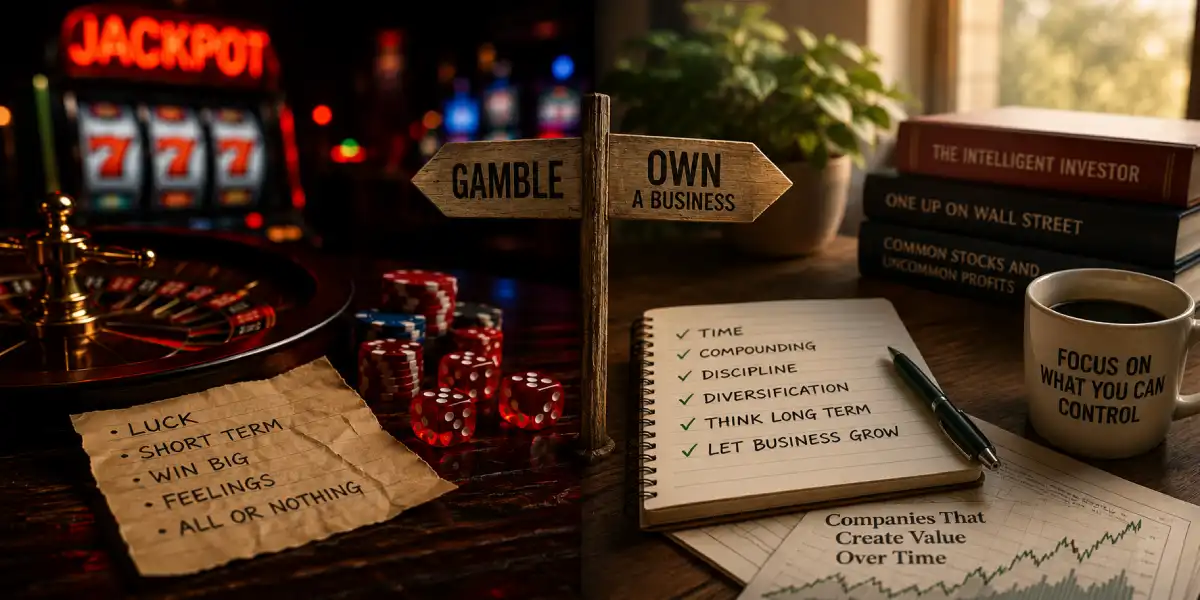
Just share with someone in Romania that you put your savings into stocks, and you’ll usually get one of two reactions: a polite change of subject, or the sentence I’ve heard a hundred times, delivered with the confidence of “old wisdom” ” so, gambling … right?”.
In the past, I used to argue, i’d mention inflation, ETFs, pension funds, Warren Buffett, the difference between owning a business and betting on a number. Haven’t been able to convince many, financial intelligence it’s still a new subject in my country and non-only.
Now, yeah … I do something more annoying, I agree.
Because for my first stretch in the market, the era that cost me $28K of tuition, story in the first post of this series it was, have to admit, pure gambling which worked till one point. I checked my portfolio the way people pull slot levers. I treated earnings nights like football matches I had money on, the market didn’t turn me into a gambler; I walked in as one, and the market served me exactly what casinos serve gamblers, at roughly the usual price.
What finally changed my mind wasn’t a comeback for the “barbecue” argument. It was deciding to take the insult seriously. A casino is not a mystery, it’s the most honest money machine ever built. The odds are printed on the felt, the profit margin is filed with regulators, and the whole business runs on two ideas that fit on a napkin; two ideas that also explain the stock market, including exactly when the “it’s just gambling” crowd is right.
So this post takes the comparison seriously, all the way: how the house wins, why the market is a different machine, how people rebuild the casino inside their brokerage account anyway, and how to sit down, deliberately, on the house’s side of the table.
Three bets
Before any definitions, a quiz. Three ways to put €1,000 at risk:
Bet A. Red, one spin, on the single-zero roulette wheel European casinos use.
Bet B. A diversified portfolio representing the broad U.S. stock market.
Bet C. The same fund, untouched, for twenty years.
Ranking them by the chance of ending up with a profit is easy: A, then B, then C, that’s not the quiz, actually the quiz is: write down the three probabilities actual numbers, before you scroll.
Here they are, the roulette number is exact math, the market numbers are every holding period in 155 years of US market history, dividends reinvested:
| Bet | Chance you end up ahead |
|---|---|
| A > one spin on red | 48.65% |
| B > one month in the market | 62.9% |
| C > twenty years in the market | 100% of the 1,590 windows since 1871 |
A (48.65%) is pure math, no data. A European wheel has 37 pockets, 18 of them red, so P (win) = 18/37 = 0.48649. The
script casino_vs_market.py also computes the multi-spin figures (16.7% after a year, 0.001% after 20 years) as exact binomial tail
probabilities, no simulation, no historical roulette data needed.
B The market numbers come from Robert Shiller’s long-run S&P dataset
Two of these surprise almost everyone, the first is how close option A sits to option B. One month of respectable, sensible, long-term investing is simply a coin flip with a lean: more than a 1/3 of all months since 1871 lost money. If you’ve ever felt like a genius or an idiot, after your first month of investing, that feeling was pure noise either way.
The second is C, not 95%, not “almost always.” Every single twenty-year stretch, including the ones that began at the worst tops of the twentieth century, ended higher (history, not a law of physics; the fine print gets its own section).
Now, hold both surprises; between 1 month and 20 years, the market stops behaving like a wheel and nothing about you changes in that time. No skill is added, no forecast made, only the number of rounds changes and to see why that’s enough, watch how the house does it.
How a casino actually makes money
A European roulette wheel has 37 pockets: 18 red, 18 black, one green zero. Bet €10 on red and you win 18 times out of 37 which is 48.65%, almost fair you tend to say. The trick is in the payout: red pays as if the wheel had 36 pockets, while the ball plays on all 37 and that green pocket is the whole business model.
Run the numbers on an “average” spin: 18 wins out of 37, 19 losses, and your €10 bet loses about €0.27 on average. That number, what a round costs you on average, across every way it could turn out, is called expected value, and it’s the single most useful concept this series will ever borrow from mathematics. The casino’s entire secret is that the expected value of every game on its floor is negative for you and positive for the house, that 2.7% is the house edge, and no bet sizing, streak management, or strategy played on the wheel can flip its sign.
But notice what the edge doesn’t do: it doesn’t win any particular spin. Any gambler can beat the house tonight, casinos hand out real jackpots weekly. The house doesn’t mind, because it isn’t playing tonight’s game. It’s playing all the games at once, and it has the second napkin idea working for it: the law of large numbers. Flip a slightly biased coin ten times and anything can happen, but flip it twenty-four thousand times and the bias is destiny.
Wynn Resorts tells investors that its Las Vegas table games typically win around 22–26% of the money customers bring to the tables. That’s not the same thing as roulette’s 2.7% house edge — the two percentages measure different things. The 2.7% is the casino’s expected advantage on each roulette bet; Wynn’s figure is table win compared with the money dropped at the tables. But that’s exactly where repetition matters. The same €100 can be bet, won, lost and bet again many times during a night. A small edge applied over and over can eventually eat a surprisingly large part of the original bankroll. The house doesn’t need to win every bet. It needs you to keep playing.
So the house’s method has exactly two parts: a small edge in its favor, and enough rounds for the edge to become fate. boom! No prediction anywhere, nobody in the back office is forecasting where the ball lands; prediction is the gambler’s tool. The house brings structure and lets time do the arithmetic.
Remember: the house never predicts the ball. It owns a small edge, repeats it thousands of times, and lets the law of large numbers do the collecting. Prediction is the gambler’s tool. Structure is the house’s.
The wheel with a motor
Now the real question is the stock market gambling? becomes precise. It becomes: when you put money in, what’s the sign of your edge, and where would winnings even come from?
Follow the money at the roulette table and it’s a closed room. Every dollar a winner collects walked in inside another player’s pocket, minus the house’s cut on the way through. Gambling is zero-sum before costs and negative-sum after them.
A share is a different object What Is a Stock, Really? is this series’ full treatment, actually it’s a claim on a business. When you own the 500 biggest American companies, your return doesn’t come from other players losing. It comes from billions of people buying iPhones and insurance and booking seaside apartments in Greece. Money enters the game from outside the table, every single day, through cash registers. Part of it is mailed to you as dividends; part is reinvested to make next year’s earnings bigger.
That’s the drift, and you can see it directly. The chart below is 155 years of the S&P composite on a log scale: the price line, and underneath it, the earnings of the companies in the index.
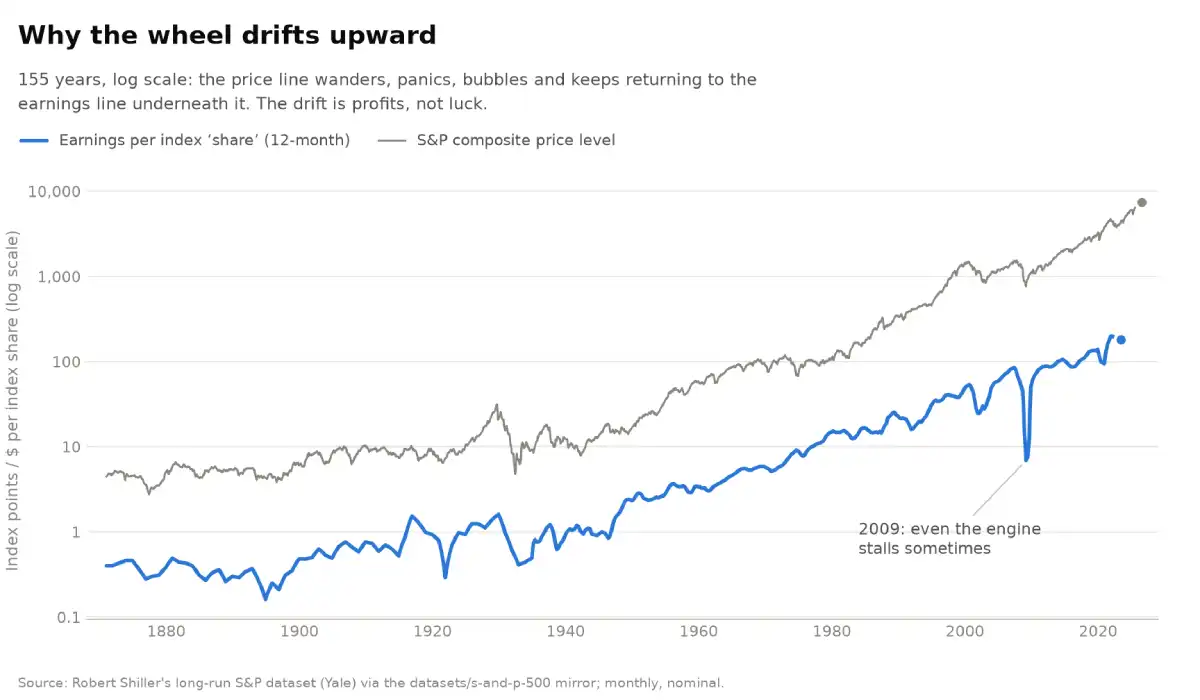
The price line does everything the “it’s a casino” crowd says: it panics, it bubbles, it halves. And then it keeps returning to the green line underneath, because since 1871 the price has multiplied roughly 979 times while the earnings underneath it multiplied 453 times and with dividends paid out in cash the whole way, which is how a boring index compounded at 9.2% a year for a century and a half. The wheel is real, the spins are real, but there’s a motor bolted under the felt, and the motor is profits.
A casino, remember, is a redistribution machine with a leak. The market is a production machine with a mood. On any given day the mood is 100% of what you see, across decades, the production is nearly all of it.
How to rebuild the casino in your brokerage app
Here’s the uncomfortable symmetry: if the motor is the only thing separating the market from the wheel, then the way to turn the market back into a casino is simply to use it on timescales where the motor doesn’t matter.
Businesses create value over quarters and years. Over a day or a week, earnings contribute approximately nothing to a stock’s move and what’s left is mood, headlines, and other people’s guesses about other people’s guesses and yeah, this day’s, we have also Trump. Trade at that frequency and you’re betting on nearly-fair coin flips. Then come the costs: the bid-ask spread, commissions, FX conversion, taxes. Every cost is a green pocket added to your personal wheel. Trade often enough, and you’ve rebuilt roulette, a negative-sum game against faster, better-equipped players, the rake collected by brokers instead of croupiers. The academic studies that track day traders over years arrive at casino-floor numbers: the small minority stay profitable after costs; but the crowd pays for the lights.
You don’t even have to take academia’s word for it, because in Europe the warning is printed on the product. EU regulators force CFD brokers, the leveraged “trade the markets!” apps in every YouTube ad, to publish what share of their own retail customers lose money. When ESMA reviewed those figures before restricting the products, they ran between 74% and 89%. It’s on every ad, in gray text, like the photos on cigarette packs. In a country like ours, where some streets have more betting agencies than pharmacies, I find it clarifying that the sports-betting shop and the CFD app are legally obliged to make the same confession.
That was my seat, by the way. My broker statement from the $28K era reads like a casino floor audit: positions held for days, doubled on red numbers, closed on green ones, a little rake paid on every pass. The market never once asked whether I thought I was investing. It paid me strictly according to the game I was actually playing (where exactly the lines run between saving, trading, speculating, and investing gets its own lesson Saving, Trading, Speculating, Investing: The Difference.)
Remember: the market doesn’t decide whether you’re gambling. Your holding period and your reason for buying decide. Same app, same button but a different game.
Taking the house’s seat
Time to flip it. Everything the casino does, the long-term owner can do, same napkin, opposite sign.
The house has an edge; so do you. Own productive businesses and the expected value of your year is positive, historically about 9% nominal on the US market with dividends reinvested. Not guaranteed like a wheel, but positive for a structural reason: it’s fed by earnings, not by other players’ pockets.
The house plays every night; you hold every year. This is everything “time in the market beats timing the market” has ever meant, and it’s the part almost nobody actually does, so look at what it’s worth. Below is the chance of being ahead for a €10-a-spin roulette regular who visits one evening a month, next to the owner of the US market, as the years of play stack up:
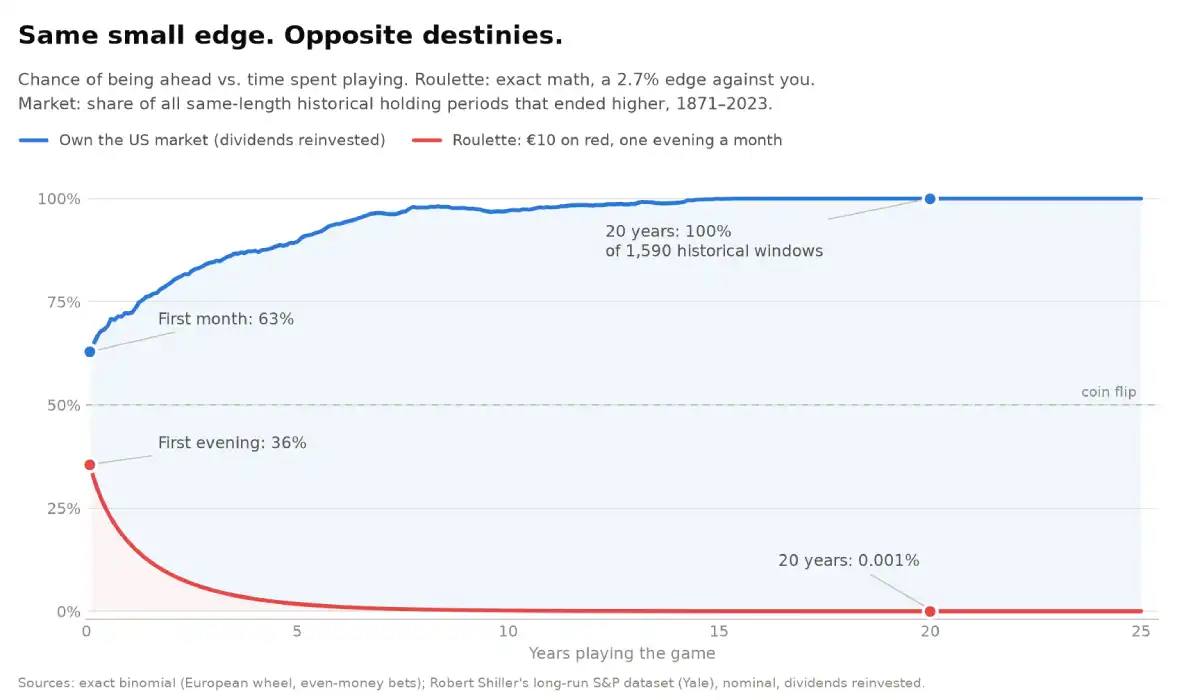
Both players start their first round barely off a coin flip, 48.65% and 62.9%. Same kind of object: a noisy bet with a small lean. Then repetition amplifies each lean toward its destiny:
| Time playing | Roulette regular ahead | Market owner ahead |
|---|---|---|
| First round | 48.65% (one spin) | 62.9% (one month) |
| 1 year | 16.7% | 72.2% |
| 5 years | 1.8% | 89.5% |
| 10 years | 0.15% | 97.0% |
| 15 years | 0.014% | 99.9% |
| 20 years | 0.001% | 100% (all 1,590 windows) |
After twenty loyal years and 24,000 spins, €240,000 fed across the felt, our regular’s expected result is a loss of about €6,486, give or take €1,549. Read that spread again: his luckiest realistic outcome is “only lost three and a half thousand”.Meanwhile, every twenty-year owner in a century and a half of market history finished ahead: the unluckiest one, who bought in September 1929, the single worst month to start in modern history, and then sat through the Great Depression, still turned €1,000 into €1,500 with dividends reinvested, so the median twenty-year owner turned it into €4,700.
The house runs many tables; you own many businesses. A casino with one table can be bankrupted by one lucky whale; a thousand tables make the math serene. The single-company version of that serenity is called diversification, and the cheapest way to get it is to own the whole market at once, that’s the entire idea behind index funds, and it gets a full lesson (Index Funds: Own the Market Without Picking Stocks). And compare rakes: roulette takes 2.7% of your stake per forty-second round; a broad UCITS index fund takes around 0.1–0.2% per year. The market will sell you the house’s seat for the smallest rake in the history of organized money.
The house writes its rules before the night starts. No pit boss wakes up at 2 a.m., sees black hit six times in a row, and decides it’s time for a new strategy. The limits were set beforehand. The procedures were set beforehand. The bankroll was set beforehand. The whole point is to keep emotions away from the edge.
Investors need the same thing. Automatic monthly buying. No leverage. No money in the market with a deadline attached.
The goal isn’t to look disciplined. It’s to stop the version of you that’s scared during a crash from firing the version that did the math. It’s to stop the version that’s bored after a year of sideways markets from suddenly deciding he’s a trader.
The house never has a crisis of confidence. It just keeps taking the next bet.
Boring is the business model.
So is picking individual stocks gambling?
The honest answer is that it’s whichever game you decide to play. One thing worth pointing out is that all the probabilities in the tables above refer to the market as a whole , not a single company. The reason those long-term odds look so good is that the market constantly refreshes itself. Winners can grow into giants, while losers eventually shrink, disappear, or get replaced.
Individual stocks don’t come with that safety net. Twenty years of patience wouldn’t have rescued Enron shareholders. It wouldn’t have helped Wirecard investors either. Even Nokia looked unstoppable at one point.
Buy a stock because of a story you heard online and hold it for twenty years, and you’re still gambling, just at a slower pace.
But buying a business you’ve actually studied is different. You’ve read the filings. You understand how it makes money. You know what could go wrong. You have a reason for owning it beyond “the price might go up.” At that point you’re no longer betting on a spin of the wheel. You’re making a judgment about a real business and its ability to keep producing value in the future.
Learning how to make that judgment is what the rest of this curriculum is about. Until then, the broad index is still the closest thing you’ll find to sitting in the house’s seat.
Why beginners get this wrong (I was this beginner)
They tend in most cases to judge the game by one round. Casinos ring bells for every jackpot precisely because winners are the marketing department. Your feed works the same way: the cousin who tripled on a meme stock is a jackpot bell, and nobody posts their losing slips. One outcome tells you nothing about the sign of an edge, the studies above do.
They use excitement as a signal. Excitement is variance, and variance is the product casinos sell, the house’s own chart is a flat, dull grind upward. Same rule here: if your portfolio is thrilling, you’ve probably bought variance, not returns. The best portfolio chart I own is the one I look at least.
They conclude “rigged” and stay in cash. Romanians have earned reasons for distrust, our parents watched Caritas and FNI vaporize entire salaries, and “don’t touch the bursă (romanian stock exchange)” was written in real losses. But the lesson curdled into something expensive: sitting at the one table where the long-run odds are reliably against you. Inflation rakes a cash pile every single year, no losing streaks, no lucky nights Inflation: The Silent Thief runs those numbers. Refusing to play is also a bet.
They try to win like a gambler instead of like the house. Streak-chasing, “systems,” doubling down to get back to even, the Martingale, the oldest broken system in gambling. I ran a Martingale on META without knowing the word for it: kept adding to a falling position I’d never analyzed, because being down felt like a reason. Structure would have saved me; conviction I hadn’t earned could not.
Where the casino math bends
Every honest analogy has a section like this, so here’s where this one creaks.
Roulette probabilities are laws of the game. Market probabilities are observations from history. The 48.65% chance of red on a European roulette wheel is true every time the ball spins. It doesn’t care about politics, technology, wars, or who happens to be running the country.
Markets are different. The 100%-of-twenty-year-windows result comes from looking at one historical record: the United States, during a period in which it became the world’s dominant economic power. An investor standing in 1900 didn’t know that. He could just as easily have believed Russia, Germany, or Britain would dominate the century ahead. Some of those bets ended very badly.
There’s another catch. The 1,590 twenty-year windows in the chart aren’t 1,590 independent experiments. Most overlap heavily with one another. In reality, 155 years of data only contain a handful of truly independent twenty-year periods.
None of this means the conclusion is wrong. It means we should be careful about what kind of evidence we’re looking at. The roulette edge is a mathematical certainty. The market edge is an inference drawn from more than a century of business profits, dividends, innovation, and economic growth.
That’s still a powerful argument. It’s just not a theorem.
*“Ahead” does a lot of work in that sentence. Measured in nominal dollars, every twenty-year window in the dataset finished positive. Measured in purchasing power, one twenty-year period starting in 1901 came up just short. Close enough to round to 100% in casual conversation, but not actually 100%.
Dividends matter even more. Remove them from the calculation and the percentage of winning twenty-year windows drops from 100% to about 93%. That’s a useful reminder that a large part of the market’s long-term edge comes from being paid while you wait. The house isn’t just counting on prices rising; it’s collecting cash along the way.
There’s another contributor hiding in the numbers. Investors today are generally willing to pay more for a euro of earnings than investors were willing to pay in 1871. The market traded around 11 times earnings back then; recently it has been closer to 25. Part of the return came from businesses becoming more profitable. Part came from the crowd becoming willing to pay a higher price for those profits.
That valuation expansion is not guaranteed, and it doesn’t move randomly. Interest rates, inflation, growth expectations and risk appetite all matter. That’s a topic for The Macro Map.
Twenty years of “certainty” contain nights that feel like ruin. The 1929 owner finished ahead only after watching more than 80% of his money vanish first. The house survives its bad nights because its bankroll rules were written to survive them; a forced seller mid-crash gets the gambler’s outcome with the owner’s intentions. Why a violent ride is not the same thing as a losing game, and when it becomes one, is its own lesson (Volatility vs. Risk).
And your seat is in euros. Everything above is measured in dollars, in US companies. Between you and that table sits an exchange rate that can add or eat several points a year Currency Risk: Buying US Stocks With European Money will do that math. None of it changes which seat is better. It changes how sure you’re allowed to feel and how long you should plan to sit.
My rules now
Three questions, asked before any money moves:
“Where would my winnings come from?” If the honest answer is “a business’s customers,” I’m investing. If it’s “someone paying more next week,” I’m at the table, and I should at least admit it and size it like entertainment.
“Am I fine holding this for a longer time” If the idea needs to be right by Friday, it’s a spin, whatever my app calls it.
“Would this survive me at my worst?” The plan has to run on rules, hopefully automatic buys, no leverage, no deadlines, because the house doesn’t rewrite procedures at 2 a.m., and 2 a.m. always comes.
Your turn
The companion script,
casino_vs_market.py,
rebuilds every number in this post, the exact roulette odds and 155 years of market win rates. Then, it prints them with
their sources, so give it a spin and type
python3 casino_vs_market.py, then do three things in your investing notebook:
- Compute your personal rake. Count your trades over the last twelve months. Multiply by round-trip costs (spread + commissions + FX). That dollar/euro figure is your green pocket. Is it closer to a fund fee or to a night out?
- Finish this sentence for everything you own: “my returns on ___ come from ___.” Any blank you can only fill with “someone paying more later” has told you which seat it’s in.
- Write down your twenty-year date. Mine is 2046. That’s the row of the table I’m actually playing for; everything shorter is commentary.
The market is not a casino. But it will happily become one if that’s how you choose to use it.
Bring the owner’s questions instead. Own productive assets, understand what you own, keep your costs low, write your rules before emotions arrive, and then give the machine the one ingredient it needs most: Time.
Behind the scenes: what the numbers are made of
The market series is Robert Shiller’s long-run S&P dataset (Yale), fetched from the free
datasets/s-and-p-500 mirror — monthly since 1871: price, dividends, earnings, CPI. Fine print that honest readers
deserve: Shiller’s monthly “price” is the average of that month’s daily closes, which smooths the series and flatters
the shortest horizons by a point or two; dividends and earnings are interpolated from quarterly reports and lag the
price column by a couple of years (total-return figures here run 1871–2023, price runs to mid-2026); and the win rates
use overlapping windows, so neighboring twenty-year periods share most of their history. The roulette side needs no
simulation at all the script computes exact binomial tail probabilities in log-space, because 24,000-spin probabilities
underflow ordinary floats. Wynn’s expected win percentages are quoted from its FY2025 10-K, filed 2026-03-02, straight
from SEC EDGAR.
Companion code: casino_vs_market.py
fetches 155 years of monthly market data, computes every win rate and roulette probability quoted above, writes a
verification CSV (odds_table.csv), and renders both charts.
Market figures are nominal USD total returns for the S&P composite, 1871–2023, with dividends reinvested, before fund fees and taxes. Past frequencies are not promises. This is education, not investment advice. I’m a student of this, learning in public.
Read next:
- Prerequisite: What Is a Stock, Really? > the motor under the wheel: what you actually own. - Related: Inflation: The Silent Thief > the table you’re forced to play The Dip I Kept Waiting For — why waiting for the perfect entry is its own bet and The Eighth Wonder > what that 9% edge quietly does over twenty years.
- Next lesson: Why Stock Price Alone Means Nothing > you know which game you’re playing; next, which price tag you’re even looking at.
- Tool:
casino_vs_market.py+odds_table.csv> your odds, by holding period, from primary data.
Comments
0