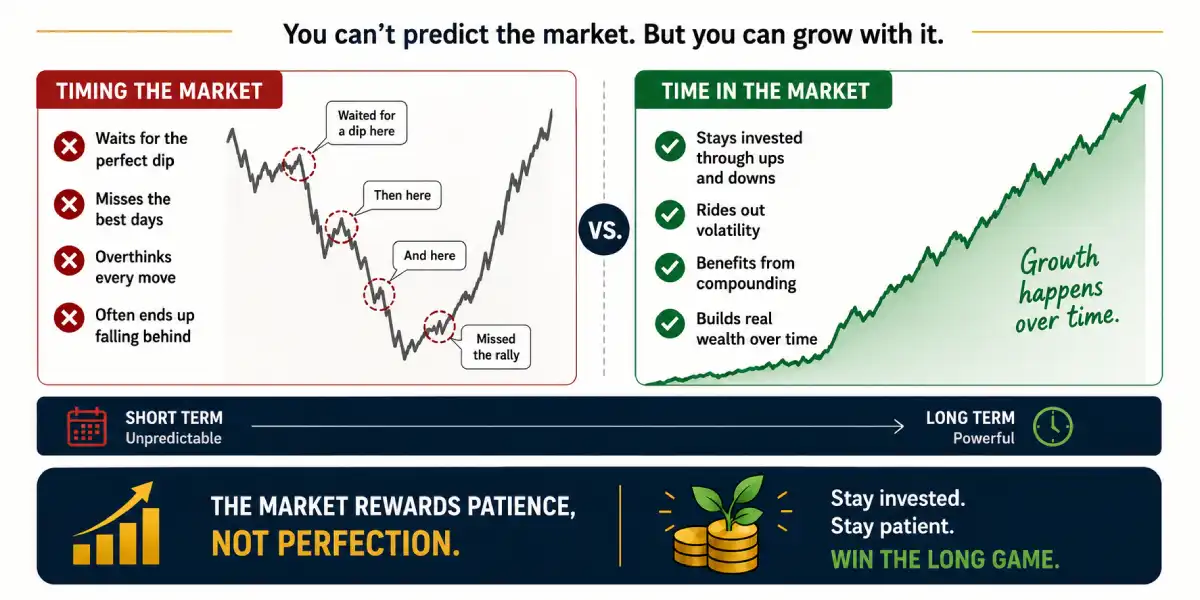
Small monthly amounts feel pointless until you give them time. Compounding looks boring in the early years and unstoppable in the later ones, and the beginner mistake is quitting before the curve has time to bend.
For two years I had money sitting in a savings account at 0.5% because investing felt like something ‘I’d ‘get to’. Then I ran the numbers and realized what that delay cost me. I used to think investing was mostly about finding the right moment. Buy before the stock goes up, avoid buying before it goes down. Wait for the crash, find the bottom, enter perfectly. That sounds smart on paper, but in real life, it is exhausting.
We all at some point in time went through this, in all fairness even with experience you sometimes tend to fall into this trap. You have some money sitting around in your trading account, ready to be invested. You look after a stock or an ETF and instead of hitting “BUY”, you froze.
The market was near an all-time high. Every financial headline was screaming about an impending correction.
So, you thought I’d play smart, you tell yourself “I’ll wait for a 10% dip, buy in at the absolute bottom, and maximize my gains”.
Then you spend the next few days staring at charts, stressing over 1% moves and pretending you can time the market like a hedge fund manager. And then you have the “aha” moment: “I have absolutely no idea what the market will do tomorrow”. No one does, I hope. By trying to be a genius timer, I was missing the entire point of what actually builds wealth.
The more I learn, the more I realize that beginners like me often obsess over timing because it feels active and intelligent. But the boring truth is probably more important: Time in the market matters more than perfect timing.
This article is my attempt to understand compounding without pretending I have mastered it. I am not writing this as an expert. I am writing this as someone who is trying to stop thinking like a short-term gambler and start thinking like a long-term investor.
The lesson is simple: Small amounts, invested consistently over a long period, can become surprisingly large. But only if I give them enough time to work.
The mistake or question
The question I had was: Does investing small amounts even matter?
Because honestly, when you are a beginner, investing small amounts can feel pointless. If I invest $100 and the market goes up 10%, I make $10. That does not feel life-changing, it barely feels worth opening the app.
This is where I think beginners get discouraged. We look at small starting amounts and think:
What is the point? I need a lot of money before investing matters.
But that thinking misses the main engine of investing: compounding.
The mistake is believing the early years are unimportant because the results look small, they are not unimportant, actually they are the foundation. The first years may look boring, but they are buying the most valuable asset in investing, time.
I thought the important question was:
When should I invest?
The better question turned out to be:
How long can I stay invested?
Answering that one requires a completely different mindset, which we are going to build in due time.
| Before | After |
|---|---|
| “I’ll wait for the dip” | “I’ll build a repeatable plan” |
| “Small amounts don’t matter” | “Small amounts need time” |
| “I need the perfect entry” | “I need consistency” |
| “Price movement is the game” | “Behavior is the game” |
That is the shift I am trying to make. Not from beginner to expert overnight. From guessing to building a process I can actually repeat.
The simple explanation
We’ve all heard the phrase “compound interest”, usually accompanied by some dry math textbook definition, so let’s strip the jargon away. Compounding is just growth on top of growth.
When you invest, your money earns a return, the formula for compound interest looks like this: $$A = P \left(1 + \frac{r}{n}\right)^{nt}$$ Where:
- A = the future value of the investment
- P = the principal investment amount
- r = the annual interest rate (decimal)
- n = the number of times interest is compounded per year
- t = the number of years the money is invested
For the sake of example, imagine I invest $1,000 and earn 7% per year for 30 years, compounded once per year. Using the compound interest formula from above and filling the variables:
- P = $1,000
- r = 0.07
- n = 1
- t = 30
So the calculation becomes:
A = 1,000 × (1 + 0.07/1)^(1 × 30)
A = 1,000 × (1.07)^30
A ≈ $7,612
Note: That is the power of compounding on a single deposit. The table later shows what happens when you add fresh money every mont, the formula is slightly different, but the principle is the same: growth on top of growth, year after year.
But you don’t need to memorize equations to understand the core truth of compounding: Time does the heavy lifting, not your initial deposit size, and certainly not your ability to guess market bottoms. The formula exists as you can see, but the idea is more important than the equation: compounding is growth on top of growth. If you give a snowball five minutes to roll down a hill, you get a bigger snowball. If you give it thirty years, you get an avalanche.
At first, the effect looks weak. If I invest $1,000 and earn 7%, I gain $70 in one year. Fine, but not exciting. But if I leave the money invested, the next year I am not earning on $1,000 anymore. I am earning on $1,070, then on $ 1,144.90, then on more. The snowball starts slowly, then it becomes harder to ignore.
A beginner often thinks investing is about making one brilliant decision. But compounding rewards repeated boring decisions:
- invest regularly
- avoid panic selling
- keep costs low
- avoid stupid risks
- stay invested long enough
- let time do the work
That last part is the hard one. Compounding is simple to understand but difficult to live with because it requires patience before the numbers become impressive. In the beginning, the progress looks almost disappointing. Later, the curve bends upward. That upward bend is the whole game.
A real example
Let’s use a simple ETF example, as we need to understand the concept in later posts we are also going to touch better on this strategy.
Imagine you invested in a broad stock market ETF, like an S&P 500 ETF. Examples could be VOO, SPY, or IVV in the U.S. market, these are not recommendations (and should not be interpreted that way). They are just useful examples because they represent a basket of large companies instead of one single stock.
I’m using 7% as a nominal planning number, roughly the long-term average of the S&P 500 minus a margin of safety. This is not a guarantee. Some years will be deeply negative; some will be very positive, you have to remember, the market does not move in a clean line. Over 30 years, inflation typically eats roughly half of the nominal value. I’ve written about that separately in Inflation: The Silent Thief and Why Cash Is Risky.
But 7% is a useful learning assumption. The table below shows both nominal future dollars on the left, real purchasing power in today’s money on the right. Here is what happens if you invested every month for 30 years:
| Monthly investment | Total contributed over 30 years | Nominal value at 7% | Value in today’s money after 3% inflation |
|---|---|---|---|
| $100/month | $36,000 | ~$122,700 | ~$50,500 |
| $200/month | $72,000 | ~$245,400 | ~$101,000 |
| $300/month | $108,000 | ~$368,000 | ~$151,392 |
| $500/month | $180,000 | ~$613,500 | ~$252,500 |
| $1,000/month | $360,000 | ~$1,227,000 | ~$505,000 |
This table is the part beginners should stare at. At $300/month, you would personally contribute $108,000 over 30 years. If the investment grows at 7% per year, it could become about $368,000. But after 30 years of 3% inflation, that future amount may feel more like about $151,392 in today’s purchasing power.
It does not make investing pointless, it makes investing more necessary. Because the goal is not just to build a bigger number, the goal is to protect and grow purchasing power.
That means about $260,000 of the final $368,000 would come from growth, not from your own contributions.
The uncomfortable lesson
The monthly amount matters, but the real engine is time. Let’s compare $300/month at 7%:
| Time invested | Total contributed | Approx. future value |
|---|---|---|
| 10 years | $36,000 | ~$52,300 |
| 20 years | $72,000 | ~$157,400 |
| 30 years | $108,000 | ~$368,000 |
The first 10 years do not look amazing, you contribute $36,000 and end with about $52,300. Good, but not shocking.
Compounding looks boring in the beginning because most of the visible growth happens later.
The beginner mistake is quitting before the curve has enough time to bend.
Why beginners get it wrong
Beginners fall into the “Predictor Trap”. We are hardwired to want control. Buying a stock or an ETF and watching it drop 3% the next day feels like a failure, so we try to optimize our entry points.
We get blinded by the desire for a “good deal” today, completely forgetting that a 5% difference in your buy-in price matters almost zero over a 30-year timeline. The real emotional enemy isn’t the market; it’s our own ego telling us we can predict the chaotic psychology of millions of global investors on any given Tuesday.
Beginners get compounding wrong because the market trains us to focus on short-term noise.
Every day we see:
- stock prices moving
- headlines screaming
- people predicting crashes
- people bragging about gains
- people sharing bubbles everywhere
- charts going up and down
- social media acting like every week is historic
This makes slow investing feel stupid. Putting $300 into an ETF this month does not feel exciting compared with someone claiming they made 40% on a stock in two weeks.
But here is the brutal truth that I’ve fallen into many times:
Most beginners are not losing because they failed to find the perfect stock. They are losing because they cannot behave consistently.
They jump in late.
They panic sell.
They wait forever for the perfect entry.
They chase what already went up.
They invest too much in one idea.
They stop investing when the market looks scary.
They confuse activity with progress.
Compounding punishes interruption. The “waiting for the crash” trap.
One common beginner thought is:
I’ll start investing after the market crashes.
This sounds logical. Buying cheaper is good. But the problem is that beginners rarely define the plan, what counts as a crash?
10%?
20%?
30%?
What if the market drops 15%, then recovers? What if it rises 25% before dropping 15%? What if the crash comes and I am too scared to buy? Waiting for a better price can become an excuse to never start. This is why dollar-cost averaging is useful for beginners.
Dollar-cost averaging means investing a fixed amount regularly, regardless of whether the market is up or down. It does not guarantee the best return. It does not protect against losses. But it solves a real human problem: It removes the pressure to perfectly time every purchase.
For a beginner, that may be more valuable than trying to be clever.
My current rule
I will not delay long-term investing just because I am waiting for a perfect entry point.
That does not mean you should throw money randomly into anything. It means for long-term broad-market investing, you should prioritize consistency over prediction.
My beginner rule is:
- For ETFs, the key habit is consistency.
- For individual stocks, the key habit is analysis.
The mistake most beginners make is doing the opposite, overthinking the ETF and gambling on the individual stock. That is backwards. With a broad ETF, I am betting on a diversified basket of companies and long-term economic growth, so I automate small, regular investments. With an individual stock, I am taking company-specific risk, which requires real work on the business first.
Personally, I sit in the second category: I want to understand what I own. But the discipline for each is different, and treating them the same is how beginners lose money.
What I would do differently next time
Next time I think, “I will start investing when the timing feels better,” I would challenge that thought. Better timing may never feel obvious. In a bull market, I will think prices are too high. In a bear market, I will think things are too scary. In a flat market, I will think nothing is happening. There will always be an excuse. So instead of waiting for confidence, I would build a system.
For example:
- choose a broad ETF to study or study a particular stock
- decide a monthly amount you can afford
- automate the investment if possible, else work it manually
- track contributions, not daily price movements
- review the plan once per quarter
- keep learning business analysis separately
That is much better than refreshing charts and pretending you are doing research.
I would also create a simple spreadsheet (your personal journal trading ledger) showing:
- monthly contribution
- assumed annual return
- total contributed
- estimated value after 10, 20, and 30 years
Not because the spreadsheet predicts the future perfectly. It does not. But because it trains my brain to think in decades instead of days.
Action step
After reading this, do one concrete thing:
Build your own 10, 20, 30-year compounding table.
Use three monthly investment amounts:
- a small amount you can definitely do
- a medium amount that would require discipline
- an ambitious amount for the future
For example:
| Scenario | Monthly amount | Why it matters |
|---|---|---|
| Easy | $100 | Builds the habit |
| Serious | $300 | Meaningful long-term progress |
| Ambitious | $500+ | Requires income growth and discipline |
Then calculate what each could become after 10, 20, and 30 years using a 5%, 7%, and 9% return assumption, during this calculation, don’t forget also about inflation, that would be required to be subtracted. Once the exercise is complete, open your brokerage account and set up an automatic monthly contribution, even if it is just $100. Remove your emotions and your decision-making from the equation entirely.
Do not use this to fantasize. Use it to understand the relationship between:
amount invested + return + time + behaviour
That is the lesson and the math matters, BUT the behaviour matters more. Simple checklist: Am I helping compounding or breaking it? Before making an investing decision, you should try working out a few questions:
- Am I investing regularly?
- Am I trying to time the perfect bottom?
- Do I understand what I am buying?
- Is this a broad ETF or an individual stock?
- Am I checking price too often?
- Would I keep investing if the market dropped 20%?
- Is my time horizon measured in days, weeks, years?
- Am I increasing contributions as my income grows?
- Are fees low?
- Am I being patient, or just bored?
The most important question: Am I building a system I can repeat for years?
Because a perfect plan I abandon is useless. A simple plan I follow is powerful.
Disclaimer: This blog is my personal learning journey. I share what I am reading, studying, testing, and how I currently understand investing. Nothing I write is financial advice, investment advice, or a recommendation to buy, sell, or hold any security.
In the future, I may share my own views, watchlists, valuations, or buy/sell decisions, but these are only my personal opinions and may be wrong. You should always do your own research, build your own valuation, and make your own decisions.
Nobody should make investment decisions for you. You are responsible for your own money, your own risk, your own outcome and of course for the entire journey in this field.
Comments
0