What Is a Stock, Really?
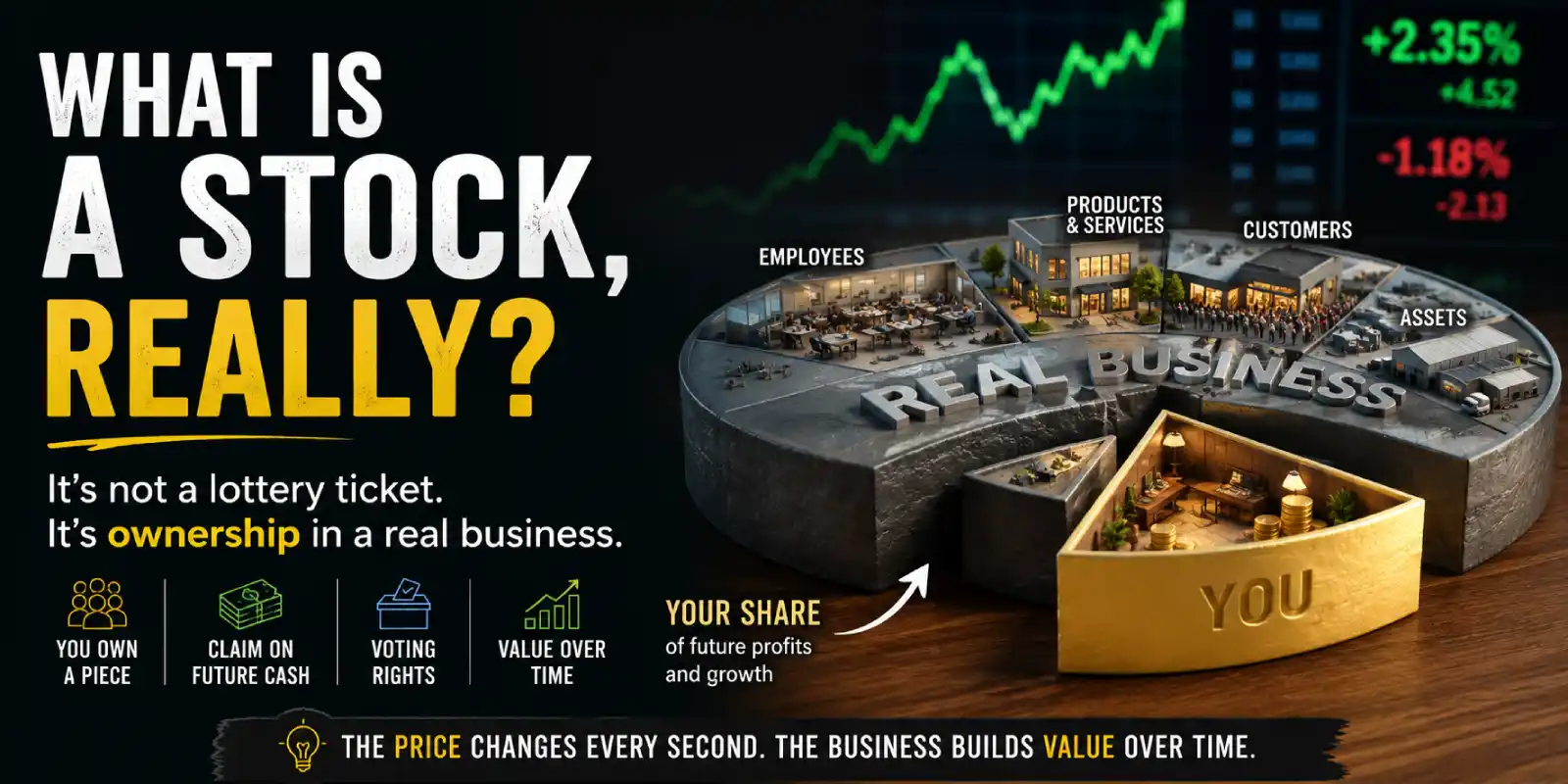
Stocks aren’t lottery tickets, they’re ownership in real businesses. Learn how they create value, why prices move, and how to invest with confidence.
Open any brokerage app and a stock looks like a ticker and a number twitching between green and red. Tap it and you get a jagged line, a large percentage, a chart moving up and down, and perhaps a cartoon rocket or a giant head and sholder if the app is trying too hard. None of that tells you what the thing actually is, it tells you what people were willing to pay for it a few seconds ago.
Apple is up 2%. NVIDIA is down 4%. Meta jumped after earnings. The S&P 500 reached another record and so on … Looking at stocks this way can make the market feel like a giant casino. You buy a symbol, stare at the chart, and hope somebody will pay you more for it later.
So let’s back all the way up and approach this as a proper zero-to-hero exercise: What are you actually buying when you buy a share?
A stock is not a flashing number on your phone, laptop, or PC, neither is not a chart and for sure it is not a lottery ticket.
A stock is a small piece of a real business. -> Once you understand that, investing starts to make much more sense.
Imagine We Start a Coffee Shop
Let’s say you and I decide to open of cource, what we all love … a coffee shop. In order to get this magic done, lets say for the sake of explanation, we need $400,000 to rent a location, buy equipment, hire employees, purchase inventory, and YES, survive until enough customers start coming through the door.
You invest $200,000, and I invest the other $200,000. For the sake of an easy example, we contributed equal amounts, so we agree that each of us owns 50% of the business. Our coffee shop has two ownership shares:
- You own one share.
- I own one share.
If the business earns $100,000 in profit, each of us has an economic claim on half of that profit.
If we sell the coffee shop for $1 million, we do not immediately split the full $1 million between us. The company must first pay its debts and other obligations and only after that, then we can divide whatever remains according to our ownership. If the coffee shop fails and has nothing left after paying its employees, suppliers, landlord, bank, and tax obligations, both of our shares may become worthless.
A publicly traded company works in roughly the same way and the main difference is scale. Instead of dividing the company into two shares, a public company may be divided into millions or billions of shares. When you buy one of those shares, you become one of the owners and yes, your ownership may be microscopic, but the principle is exactly the same.
A Share Is a Real Slice of a Company
A stock is a unit of ownership in a corporation tat is the core definition. If a company has divided itself into 2.4 billion shares and you own one, you own one 2.4-billionth of that company. You do not own a bet that merely tracks the company, you do not own a coupon linked to the company, you own a legal interest in the corporation itself.
However, you do not directly own one laptop from its office, part of a particular factory, or a chair from its headquarters, the corporation owns those assets, you own shares in the corporation. That ownership comes with two rights worth understanding.
A residual claim
As a common shareholder, you have a residual claim on the company’s assets and profits. “Residual” means you are near the end of the line.
Before common shareholders receive what remains, the business generally has to pay:
- Employees
- Suppliers
- Landlords
- Banks
- Bondholders
- Tax authorities
- Other creditors
Whatever is left after those obligations have been satisfied belongs economically to the shareholders. That leftover slice is why owning part of a successful business can be so valuable and why shares in a failed business can fall to zero. Shareholders participate in the upside after the other claims are paid, but they also absorb losses before many of those claimants do.
A vote
Shares may also provide voting rights. The familiar principle is “one share, one vote,” although not every company follows this structure. Some companies have multiple share classes, with founders or insiders holding shares that carry greater voting power. Other share classes may have limited or no voting rights.
Shareholders can usually vote on matters such as:
- Who sits on the board of directors
- Major corporate transactions
- Executive compensation proposals
- Certain changes to the company’s structure
For most small investors, this voting power is limited. You are unlikely to decide a board election with a handful of shares. But voting is still the mechanism through which shareholders, collectively, exercise control over the corporation. Ownership does not mean you can walk into the office and tell employees what to do. Shareholders elect the board, the board oversees management, and management runs the company.
A Real Company Exists Behind Every Ticker
It is easy to forget this when buying stocks takes only a few taps, but every ticker represents an operating business. Behind Apple’s ticker are phones, computers, services, stores, suppliers, engineers, customers, patents, cash, and debt. Behind Coca-Cola’s ticker are brands, bottling partners, distribution networks, advertising, retailers, and billions of drinks sold around the world. Behind NVIDIA’s ticker are chips, software, engineers, manufacturing partners, data-centre customers, contracts, revenue, expenses, and expectations about future computing demand.
The ticker is only the label we use to identify the company, the business is what you are actually buying. Here is the mental move that separates investing from simply gambling on ticker symbols:
Behind the ticker is a company, and behind the company are real people making a real product or service that real customers pay real money for.
NVDA is not a squiggle. It is NVIDIA, a company that designs computing platforms and chips, employs people, signs contracts, ships products, records expenses, and reports revenue every quarter. The squiggle is only the price other market participants are currently willing to accept. The company underneath continues to operate whether you are looking at the app or not.
That leads to a simple but powerful habit:
Before buying a stock, ask whether you understand how the company makes money.
I have said this in other posts, and I will continue to repeat it because it is quite frankly important. If you cannot explain the business in a few sentences, you may not yet understand what you are buying.
How Does a Shareholder Make Money?
There are two main ways.
1. The company returns money to shareholders
A profitable company can distribute part of its cash to shareholders through dividends.
Imagine our coffee shop earns $100,000 after paying all its expenses, we could:
- Keep all the money inside the business
- Use it to open another location
- Use it to train current employees and provide better services
- Upgrade equipment or improve the existing shop
- Do all the above or/and
- Distribute part of the cash to ourselves and reinvest the rest
Suppose we distribute $40,000. Because we each own 50%, you receive $20,000, and I receive the other $ 20,000.
Public companies can do the same thing. If a company declares a dividend of $2 per share and you own 100 shares, you receive $200 before taxes and any brokerage-related effects. Not every profitable company pays a dividend.
A growing company may prefer to reinvest its money into:
- New products
- Research and development
- Additional factories
- More employees
- New markets
- Acquisitions
- Better technology
Keeping the money is not automatically good or bad and should not be looked like this. The important question is whether management can reinvest it productively.
If a company retains $1 and eventually creates $3 of additional value, keeping the money may be a smart decision. But the opposite is also possible. If management wastes the money on poor acquisitions, unnecessary projects, or expansion that produces weak returns, shareholders may have been better off receiving a dividend.
A company can also return capital by buying back its own shares. Suppose a business has 100 shares outstanding and you own one, means you own 1% of the company. If the company repurchases and cancels 20 shares, only 80 remain, you still own one share, but your ownership has increased from 1% to 1.25%. Your slice became larger because the total number of slices became smaller.
Buybacks are not automatically good, however. If management repurchases shares when they are significantly overvalued or borrows too much money to finance those repurchases, it can destroy shareholder value instead of creating it. Like almost everything in investing, buybacks must be evaluated within the broader context of the business. Why is the company buying back shares? Is the stock undervalued? Is the balance sheet healthy? Could that capital generate a better return elsewhere? Without that context, a buyback tells you very little or nothing at all.
2. Your ownership becomes more valuable
You can also make money if the market price of your shares rises. But why would it rise? Usually because investors believe the underlying business has become more valuable and perhaps the company:
- Sells more products
- Gains customers
- Raises prices
- Improves profit margins
- Launches a successful product
- Enters a new market
- Reduces debt
- Generates more free cash flow
- Strengthens its competitive advantage
Lets get back to an example, suppose our coffee shop earns $50,000 a year. A few years later, it has five locations and earns $500,000 a year. Unless the risks have increased dramatically, the business is probably worth more than it was when we started. Because your share represents ownership in the business, your share is probably worth more too.
Where the Value Actually Comes From
If a share is a claim on a company’s future economic output, its value ultimately depends on one question:
How much cash will this business generate for its owners over its life, and how certain are those future cash flows?
That is the engine and everything else—the charts, hot takes, headlines, rumours, and the guy on the internet with a laser-eyes avatar is just noise layered on top of that question. Revenue matters! Earnings matter! Growth matters! But a business is ultimately valuable because of the cash it can generate for its owners.
That cash may reach shareholders through:
- Dividends
- Share repurchases
- Reinvestment that increases future earnings
- A takeover or sale of the company
- A later sale of the shares at a higher price
This is also why I look at more than one financial metric. Take two companies discussed in an earlier post in this series: NVIDIA and Arista Networks.
Strip away their share prices and look only at the businesses:
- Revenue shows how much money comes through the door and how quickly the company is growing.
- Gross margin shows how much of each revenue dollar remains after the direct cost of producing the product or service.
A company that keeps 70 cents from every dollar of revenue before operating expenses is playing a different economic game from one that keeps 20 cents.
The companion Python script used in my earlier Circle of Competence article pulls quarterly revenue and gross-profit data for NVIDIA and Arista from SEC EDGAR, derives quarterly gross margin, exports the data to CSV, and produces long-term charts. The purpose is not to automate thinking, the purpose is to automate data collection so there is more time to think. Long-term data also changes how you react emotionally.
A revenue chart may show that most of a company’s growth story is recent and that the business being valued today looks very different from the business of eight years ago. A gross-margin chart may show that a frightening one-quarter decline is much smaller when placed against a ten-year trend. Same company, two time horizons, two completely different emotional reactions but the numbers help keep us honest.
Price Is Not Value
Now we reach the part that trips up almost everyone. The number shown in your brokerage app is the price. It is the amount at which the latest buyer and seller agreed to exchange a share. The value is what the business is actually worth based on the cash it can generate, the risks surrounding those cash flows, and the return an investor requires. Price and value are related, over time, they pull on each other but on any given day, they can be far apart.
Why?
Because the stock market is a continuous auction that runs every second it is open. Every transaction requires both a buyer and a seller to agree on a price. That price isn’t determined solely by a company’s financial results; it also reflects what millions of investors collectively believe the business is worth at that particular moment. Those beliefs are influenced by both rational analysis and human emotion.
On any given day, the market price may be driven by:
- Fear
- Greed
- A frightening headline
- Rumours and speculation
- Earnings surprises
- Changes in interest rates
- Inflation expectations
- Geopolitical events
- A large institution being forced to buy or sell
- Changes in investor sentiment
- Investors becoming willing to pay a higher or lower valuation for the same business
Sometimes these factors are perfectly rational. Higher interest rates, for example, reduce the present value of future cash flows, so lower valuations often make sense.
Other times, prices move because of emotion. A scary headline, panic selling, or excessive optimism can push prices well away from what the underlying business is actually worth.
A good example is TSMC’s Q2 2026 earnings. The company reported outstanding results: revenue reached record levels, gross margins remained exceptionally high, and it generated enormous amounts of free cash flow. By almost any fundamental measure, the business had become stronger. Yet the stock fell about 2.3% after the earnings release because investors focused on valuation, expectations, and future risks rather than simply the quality of the quarter.
The business improved. The stock price fell.
That illustrates one of the most important lessons in investing: the market doesn’t reward good companies, it rewards companies that perform better than what investors had already expected. If expectations are already extremely high, even an excellent quarter may not be enough to push the stock higher.
The important point is this: the business and its stock price can diverge for a while. The business changes slowly—building products, serving customers, signing contracts, and generating cash. The stock price can change by 5%-8& before lunch. That’s why you, as an investors have to learn to distinguish between price and value.
The business did not necessarily become 8% worse because its stock fell 8% before lunch, the business may have changed very little; companies often move slowly while prices move quickly.
The market gives you a price. It does not automatically give you the truth.
Your job as an owner is to form your own view of the business and its value, then decide whether the current price makes sense. If you cannot distinguish price from value, you may end up buying something only because it is rising and selling it only because it is falling, that is not analysis, it is reacting to the auction.
The Share Price Does Not Tell You Whether a Stock Is Cheap
A $20 stock is not automatically cheaper than a $200 stock. The share price tells you only what one share costs, it does not tell you how many shares exist.
Consider two companies.
Company A
- Share price: $20
- Shares outstanding: 1 billion
Thus, its market capitalisation is:
$20 × 1 billion shares = $20 billion
Company B
- Share price: $200
- Shares outstanding: 50 million
Thus, its market capitalisation is:
$200 × 50 million shares = $10 billion
Company B has the higher share price, but its total equity value is lower.
The calculation is:
Market capitalisation = Share price × Shares outstanding
Lets extrapolate and think of a pizza. The price of one slice tells you very little unless you know how many slices exist. A company can perform a stock split and divide every existing share into several smaller shares. Each share then trades at a lower price, but the value of the entire business does not change merely because the pizza was cut into more pieces.
The opposite can happen through dilution. Suppose a company has 100 shares outstanding and you own ten. You own 10% of the business and then, the company issues another 100 shares. You still own ten shares, but there are now 200 in total and your ownership falls to 5%. Issuing new shares is not automatically bad. The company may raise capital and invest it in projects that create more value than the dilution costs existing owners.
But shareholders should always ask:
- Why is the company issuing shares?
- At what valuation are the shares being issued?
- How will management use the money?
- Is the share count rising faster than the value of the business?
A company can grow total revenue and total profit while creating very little value for existing owners if it keeps issuing too many new shares. That is why per-share results matter.
A Great Product Is Not Enough
One of the biggest mistakes beginner investors make is buying a stock simply because they love the company’s products or use its services every day.
I almost made the same mistake with NVIDIA. I follow semies and read about GPU/CPU and datanceter daily, so buying NVIDIA felt obvious. But liking a company’s products or even working with them, is not the same as understanding the business or knowing whether the stock is fairly valued.
A great product can help you discover an interesting company, but it is not enough to justify an investment.
You still need to ask:
- Is the company profitable?
- How much debt does it have?
- Is revenue growing?
- Are profit margins sustainable?
- Does it generate free cash flow?
- Is competition increasing?
- Is management allocating capital intelligently?
- Is the share count increasing or decreasing?
- What expectations are already reflected in the current share price?
A company can build an amazing product and still be a terrible investment because:
- It spends too much money.
Many streaming companies, including Roku, have built products that millions of people use, yet years of heavy spending meant profits lagged far behind revenue growth. A great product doesn’t automatically become a great business.
- It takes on excessive debt.
Intel invested heavily to rebuild its manufacturing leadership, but financing large capital projects while profits declined put significant pressure on its balance sheet. Even excellent technology can become a risky investment if debt grows faster than earnings.
- Stronger competitors erode its advantage.
BlackBerry once dominated the smartphone market, but Apple’s iPhone and Android devices rapidly took market share. Customers loved BlackBerry until they didn’t. Competitive advantages rarely last forever.
- It continuously dilutes shareholders by issuing new shares.
Many early-stage biotech and mining companies regularly issue new shares to fund operations because they generate little or no cash flow. The business may survive, but each existing shareholder owns a smaller piece of it. Plug Power (PLUG) – Frequently raised capital through secondary share offerings to fund operations and expansion while generating persistent losses. Virgin Galactic (SPCE) – Issued additional shares multiple times to finance development and operations before establishing a sustainable business. AMC Entertainment (AMC) – Raised billions of dollars by issuing new shares during and after the COVID-19 pandemic, the capital helped the company survive, but significantly diluted existing shareholders.
- Or the stock is simply priced far above what the business is worth.
During the dot-com bubble, companies like Cisco were fantastic businesses, but investors paid such extraordinary prices that many shareholders waited more than a decade to recover their investment, despite the company continuing to grow.
Remember, a great company does not automatically make a great investment.
The quality of the business matters and the price you pay matters just as much. A fantastic business bought at an unrealistic valuation can produce poor returns for years, while an average business bought at the right price can sometimes outperform. The company and the investment are connected, but they are not the same thing.
Good News Can Make a Stock Fall
A company reports record revenue,its stock falls 8%. How can good news make a stock fall? Because the market does not react only to whether the result is good or bad, it reacts to whether the result is better or worse than expected.
Imagine investors expected a company to earn $1 billion, but it reports $900 million. That may still be an excellent result, but it is below expectations, the stock can fall.
Now imagine another company was expected to lose $500 million, but it loses only $200 million. The company is still unprofitable, but the result is better than expected, the stock can rise.
The market constantly compares reality with expectations, that is why reading the headline is not enough. You also need to understand what the market had already priced into the shares.
You Can Read What You Own
Here is the part that still feels like a secret even though it is completely public. Public companies are required to report how their businesses are performing. In the United States, companies file detailed quarterly reports called 10-Qs and annual reports called 10-Ks. These filings are available for free through the SEC’s EDGAR system. These are not polished summaries written by a financial-data website, they are primary-source company filings containing financial statements, footnotes, risk disclosures, management commentary, and other information investors can inspect directly + lets not forget about the conference transcripts which contains valuble information combined with the above reports.
The numbers used in my SEC EDGAR articles do not come from screenshots or social-media posts, they come from those filings and from the SEC’s structured XBRL data.
In How I Use SEC EDGAR to Compare Companies Instead of Guessing, I use Python to collect company-reported data such as revenue, gross profit, operating income, net income, cash flow, assets, liabilities, and debt-related values. The scripts write the results to CSV so the numbers can be inspected and checked against the original filings.
The idea is simple:
Verify, do not blindly trust.
One wrinkle you encounter quickly is that companies do not file a standalone fourth quarter. The annual 10-K reports the full fiscal year, while the third-quarter 10-Q usually reports the first nine months. A quarterly Q4 value may therefore need to be derived by subtracting the nine-month figure from the full-year figure. That small detail is a useful lesson. A tidy data table may already contain many assumptions and processing decisions that were never shown to you.
Reading the primary source, or at least understanding how the data was produced, helps you identify those decisions. You do not have to become an accountant, but knowing these documents exist, and knowing you can read them, changes your relationship with investing. You are no longer staring at a squiggle and hoping, you are an owner reading the books.
Stop Asking Only Whether the Stock Will Go Up
The most common beginner question is:
“Will this stock go up?”
Nobody can answer that reliably in the short term.
A better set of questions is:
What does the business sell?
Who are its customers?
Why do customers choose it?
How does it make money?
What could damage the business?
Does it have a durable competitive advantage?
How much debt does it carry?
Does it generate real cash?
Is the number of shares increasing or decreasing?
What must happen for today’s valuation to make sense?
These questions move your attention away from the ticker and towards the business and that is where serious investing begins.
Think Like a Business Owner
Imagine the stock market closed for five years, you could not see a daily price, you could not sell your shares. Would you still be comfortable owning the business? Would you be happy to receive its profits and follow its progress? Or did you buy only because you hoped the chart would keep moving upward?
Thinking like an owner does not mean ignoring the stock price. Price is extremely important. But the price should be compared with the quality, performance, risks, and future cash-generating ability of the business.
A falling price can be an opportunity when the business remains strong and it can also be a warning that your original assumptions were wrong.
A rising price can reflect genuine business progress. It can also reflect excessive optimism. The chart alone cannot tell you which one is happening.
So, in the end, what Is a Stock, Really?
A stock is a small, legal, tradable ownership interest in a real company. It gives you a residual economic claim on the business after employees, suppliers, lenders, tax authorities, and other creditors have been paid. Depending on the share class, in most cases, it also gives you voting rights.
Its value is anchored to:
- The cash the company can generate
- How quickly that cash can grow
- The risks surrounding the business
- The amount of debt it carries
- The number of shares outstanding
- The price investors are willing to pay
But the simplest definition is still the best:
A stock is a small piece of a real business.
The ticker is only its nickname and the chart is only a record of the prices other investors were willing to accept. The daily price is only today’s opinion. The business underneath is what you actually own.
Get that distinction into your bones and much of the noise falls away. You stop reacting to the squiggle and start doing the real work:
Understanding the business. Reading the numbers. Estimating what the company may be worth. Waiting for the price to make sense.
The next time you consider buying a stock, do not begin with the chart. Begin with the company.
Disclaimer
This article is part of my investing learning process. It is for educational purposes only and is not financial advice or a recommendation to buy or sell any security. Always perform your own research and verify important figures against the original company filings.
Comments
0