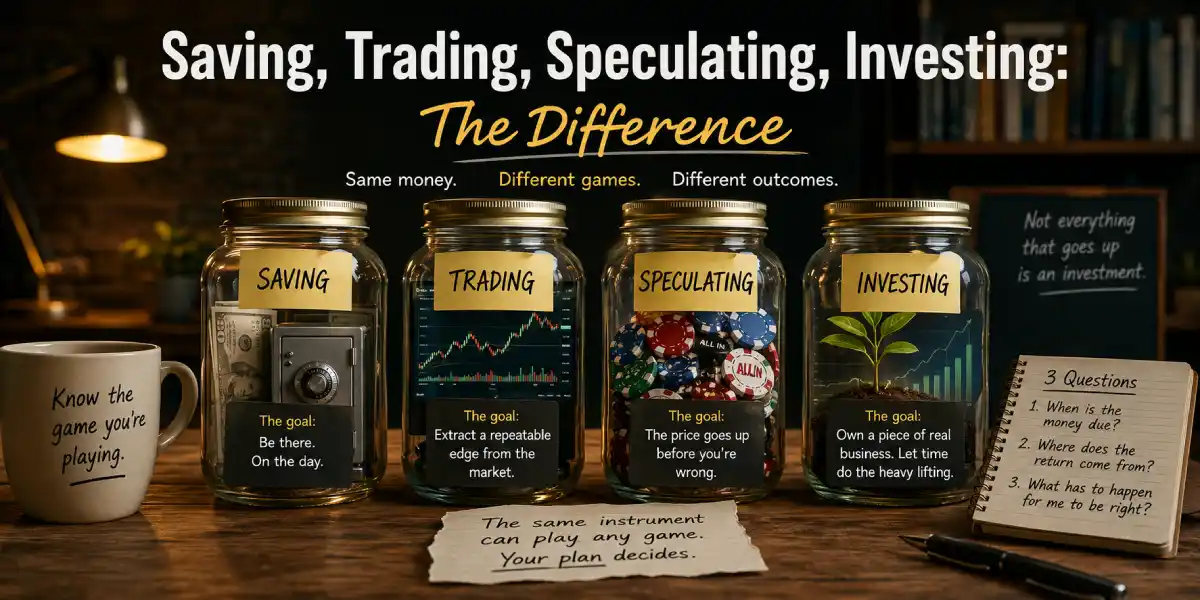
Romanian makes this post easy to justify. We say “I invested”, about phones, kitchen renovations, a cousin’s car wash, and, in the era that cost me $28K of tuition, about every position in my brokerage account. My bank app keeps a tab politely labeled savings, were my broker calls everything on its screen an investment. No app anywhere has a tab called Speculations, even though that’s where a healthy share of the world’s brokerage money actually lives.
One word, stretched over four different games.
The casino post ended with a promise that the lines between saving, trading, speculating, and investing would get their own lesson. This is it, and it matters more than it sounds. Nothing in my $28K era went wrong because I picked the wrong stock, when it went wrong because I was playing one game while keeping score in another, and the market always pays you according to the game you’re actually playing.
So: four words, the three questions that tell them apart, and 150 years of data showing that the market itself keeps separate books for two of them.
Four people, one Monday
Same morning, same €10,000, four plans:
Ana puts hers in a bank deposit. She’s buying an apartment next spring; this is part of the down payment.
Bogdan buys Apple shares, the new iPhone launches in six weeks, he’s sure it’ll be a hit, and he’ll sell into the pop.
Cristina buys a world-index ETF. It’s her emergency fund, she read that index funds beat deposits, and figured the money should earn something while it waits for a rainy day.
Dan buys Bitcoin and moves it to a hardware wallet. He will not touch it for ten years; he has a laser-eyes avatar and, to be fair, the patience of a monk.
Now the quiz: which of the four is investing?
Most people pick Cristina, maybe Cristina and Dan. The index fund is the responsible adult of financial products, and ten years of iron patience is what investing is supposed to feel like.
My answer: none of them is doing what I mean by clean, long-term investing with appropriately matched money.
Ana is saving, and she’s the only one of the four playing her game cleanly. Bogdan is speculating, though he’d probably tell you he trades. Dan is speculating too; ten years of patience doesn’t magically create an underlying cash-flow engine. And Cristina, the careful one, has made the quietest mistake on the list: she bought an investor’s instrument with money that has a saver’s job. The ETF isn’t the mistake, the mismatch is.
That distinction matters because financial products don’t come with moral labels attached. A world ETF can be a perfectly sensible twenty-year investment and a terrible six-month emergency fund. Bitcoin can be a consciously sized speculation or an accidental retirement plan. The instrument tells you what you own, it does not tell you what game you’re playing.
Remember: the label isn’t on the product. The same ETF can be an investment, a gamble, or a misplaced emergency fund. What names the game is your plan, where the money is due, and who’s supposed to pay you.
The three questions
Every position you’ll ever hold can be labeled with three questions.
When is this money due? A date, a decade, or “constantly”.
Where does the return come from? Interest paid by a borrower or bank? Cash flows generated by businesses? A future buyer willing to pay more? Or a repeatable trading edge like market making, arbitrage, trend, mean reversion, or something else, that survives costs? This question is less catchy than “who pays me?”, but it is harder to fool yourself with.
What has to happen for me to be right? Nothing? A business keeps operating? A crowd changes its mind? A statistical edge survives its costs?
Run the four games through those questions and they stop being synonyms.
Saving: the money with a job
Saving is money that must exist, whole, on a known date or on an unknown bad day. Ana’s down payment is due in the spring. The spring doesn’t care what the market did that winter.
Who pays her? The bank, a little. But interest isn’t really the product here. The product is certainty, the only thing on this list that pays out exactly when your life goes wrong. A deposit is the one financial arrangement where nothing has to go right for you.
Certainty charges rent, of course, and the landlord is, … inflation the silent thief already got its own post. Savings lose slowly. That’s the fee, and you pay it so that you never have to lose suddenly: no crash, layoff, or leaking roof can force you to sell an investment at the bottom. The casino post called a forced seller someone who gets the gambler’s outcome with the owner’s intentions. Saving is what makes forced selling impossible. Which is why the eternal “saving vs. investing” debate misses the point, they were never rivals, in my view one is the foundation the other stands on.
My working rule for the boundary: money with a date on it inside about five years, plus a runway of monthly expenses, never meets the market. It sits in the boring tab and does its one job, which is to be there.
Investing: buying the motor
Benjamin Graham, writing in 1934, needed one sentence: “An investment operation is one which, upon thorough analysis, promises safety of principal and an adequate return. Operations not meeting these requirements are speculative.”
Read it slowly, because all three legs carry weight. Analysis you did the work, or you deliberately bought the whole market and let the structure do it. Safety of principal you paid a price sensible enough that permanent loss is unlikely, which is about the price, not the company’s fame. Adequate my favorite word in the sentence, not maximal, not life-changing by Friday but adequate. Greed is how investments get disqualified on day one.
Where does the investor’s return ultimately come from? <span class=”hl-underline”From productive assets doing something useful. People who will never know you exist buy iPhones and insurance and seaside holidays, and a slice of that economic activity reaches you through a claim on a real business, dividends today, retained earnings reinvested for tomorrow, and compounding doing the heavy lifting in the back half.
That doesn’t mean every business is a good investment, or that every price is sensible. <span class=”hl-underline”A wonderful company bought at a ridiculous valuation can still produce a miserable return. The point is narrower: unlike a pure resale thesis, a productive asset has an internal economic engine. Your return does not have to depend entirely on finding someone more enthusiastic than you were.
What has to happen for the investor to be right? Businesses keep doing business. That’s the whole bet, nobody has to change their mind, nothing has to go viral, no crowd has to arrive; the edge in this game is time itself, the exact thing every other game on this list is fighting against.
Speculating: buying the mood
A speculation is a position where your thesis depends mainly on repricing rather than on the cash the asset can produce for you over the period you plan to own it. Sometimes there is no cash-flow engine at all. Sometimes there is one, but you barely care about it because you’re betting on an event, a narrative, a shortage, a launch, a rate cut, FOMO or somebody paying a higher multiple next month.
Gold, Bitcoin, collectibles, and every story stock bought on vibes make the distinction easy to see. But ordinary stocks can be speculations too. Apple doesn’t stop being a business because Bogdan bought it; Bogdan’s reason for buying it is what makes his position speculative.
That’s Bogdan, even though he’d call himself a trader. He has one opinion about one event and a plan to exit into someone else’s enthusiasm. It’s also Dan. And Dan’s ten years are the important lesson. Holding period doesn’t define the game; the source of the paycheck does. Time matures investments, it just makes speculations older. (A hard truth inside that one: Bogdan can be right about the iPhone and still lose money, because the crowd expected the same hit and paid for it in advance Being Right vs. Making Money is a whole future lesson).
What I won’t do, though, is sneer. Graham didn’t: “outright speculation is neither illegal, immoral, nor (for most people) fattening to the pocketbook”, he wrote, and the man was not famous for jokes (cant remember were I read it to share the link), so he kept only the true part. Speculation is not a sin; some of it finances new things before they have any cash flows to analyze. The sin is doing it unknowingly: with the rent money, at full size, under the word “investing,” with no written exit. Maybe Dan’s adoption thesis pays off. The word “speculation” actually does him a favor, because it tells him which till pays him and that his game needs a crowd to keep agreeing with him. So he should size it like a bet, not like a pension.
Trading: running a system
Trading is the word I used most carelessly when I started.
A trader isn’t defined by holding for three hours instead of three years. A trader is trying to extract a repeatable edge from price behaviour or market structure. Market making is one version: provide liquidity and earn the spread, arbitrage is another were trend following, mean reversion, relative value and event-driven systems are others. Different engines, same requirement: there has to be a process that can be repeated often enough to separate skill from a lucky story.
That is why I now think of trading less like “having a view” and more like running a small operating system for risk. You need a written entry, a written exit, position sizing, enough observations to estimate whether the edge is real, and records good enough to tell you when it has stopped working. Then you subtract spreads, slippage, commissions, financing, taxes and if you’re being painfully fair, the value of your own time.
Without that machinery, “I trade Apple around product launches” is not really a trading business. It’s a series of short-term speculations wearing a more professional shirt.
And the base rate deserves respect. ESMA’s analysis behind the EU’s CFD restrictions found that 74–89% of retail CFD accounts typically lost money. That statistic is specifically about leveraged CFDs, not every form of trading, so I don’t use it as proof that all trading is doomed. I use it as a warning about what happens when a difficult professional activity is packaged to look like a phone game.
I don’t currently allocate portfolio money to trading. Not because I think trading is fake, quite the opposite. I think a real trading process is demanding enough that it deserves to be treated as its own research project, with data, code, risk controls and an audited track record, rather than as something I improvise between meetings.
Four games, one table:
| Saving | Investing | Speculating | Trading | |
|---|---|---|---|---|
| Money is due | on a date you know | in a decade or three | whenever the crowd arrives | constantly |
| Return comes from | interest / safe yield | productive cash flows + growth | repricing / the next buyer | a repeatable market edge |
| You’re right if | the money is there when needed | the asset compounds value at a sensible price | the repricing thesis happens | the edge survives costs and regime changes |
| Main opponent | inflation | overpaying + your own patience | everyone holding the same story | costs, competition, overfitting, regime change |
| Wrong looks like | slow leak of purchasing power | a bad decade, survivable if diversified | −70% and a lesson | a thousand small cuts |
The market keeps two tills
At this point I could keep philosophizing, but I don’t have to, because the line between investing and speculating is arithmetic, and it has been sitting in 150 years of data this whole time.
For an equity index, price can be written as earnings × the earnings multiple. That gives us a useful accounting lens for long-run returns. In log terms, the companion script separates each window into what I’ll call two tills. The business till is earnings growth plus reinvested dividends. The mood till is the change in the market’s earnings multiple, what investors were willing to pay for the same unit of earnings at the end versus the beginning.
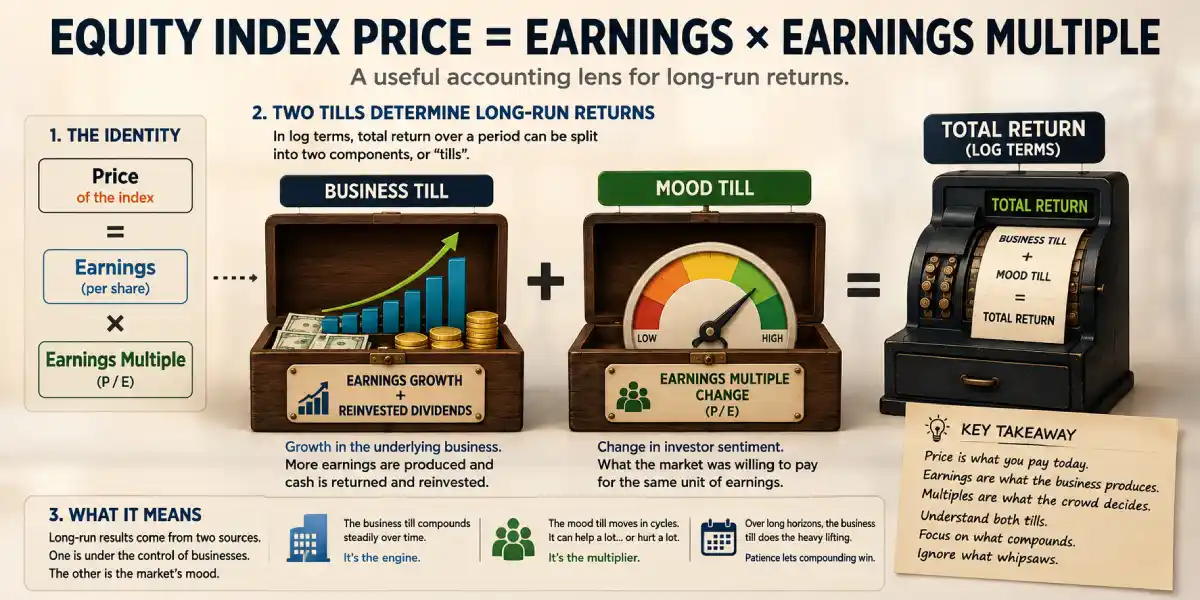
It isn’t a claim that earnings are the only possible measure of business value, and it isn’t a forecasting model. It’s an attribution exercise: after the decade is over, where did the return come from? Jack Bogle popularized a closely related distinction between investment return and speculative return; the companion script rebuilds the idea from Robert Shiller’s long-run U.S. market data, decade by decade:
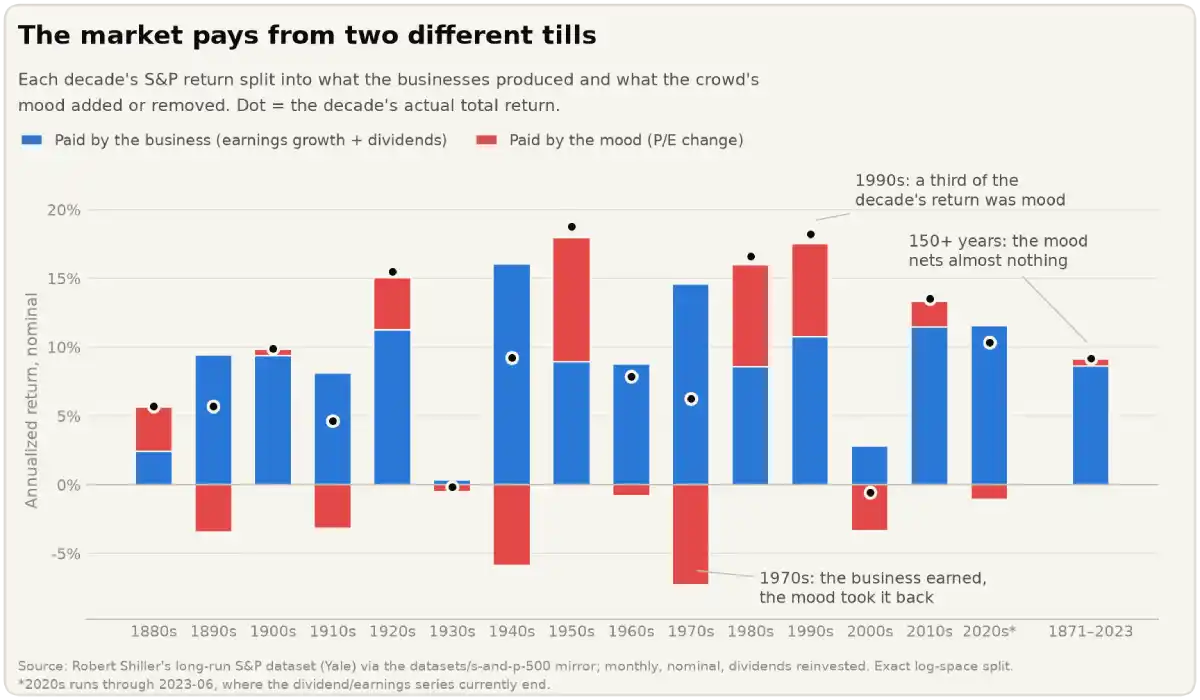
Read a few bars and the two tills stop being abstract. In the 1950s, the crowd’s mood contributed nine points a year, nearly half the decade’s famous 18.8%, as multiples recovered from postwar gloom. In the 1970s the businesses earned a spectacular 14.6% a year and shareholders kept 6.3%, because the mood took the rest back. The 1990s bubble: a third of the decade was mood. The 2000s: the businesses produced, the mood collapsed, owners finished [underwater] (https://internationalbanker.com/history-of-financial-crises/the-dotcom-bubble-burst-2000/.
Now the punchline, the bar on the far right. Across the whole sample, the script gets roughly 9.2% a year total, with the overwhelming majority attributable to earnings growth and dividends, while the annualized contribution from multiple expansion is tiny by comparison. One technical footnote matters here: the components are additive in log-return space. Once each component is converted back into an ordinary annual percentage, you shouldn’t literally add the displayed 4.1%, 4.3% and 0.5% and expect the total to match perfectly, compounding doesn’t work that way.
The economic point survives the bookkeeping detail. Over a century and a half of manias, panics, wars, recessions and financial television, valuation multiples moved enormously along the way but contributed surprisingly little to the full-period annualized return. Most of what the patient owner received came from the business side of the ledger.
So why does speculation feel like where the action is? Because over short periods, it is:
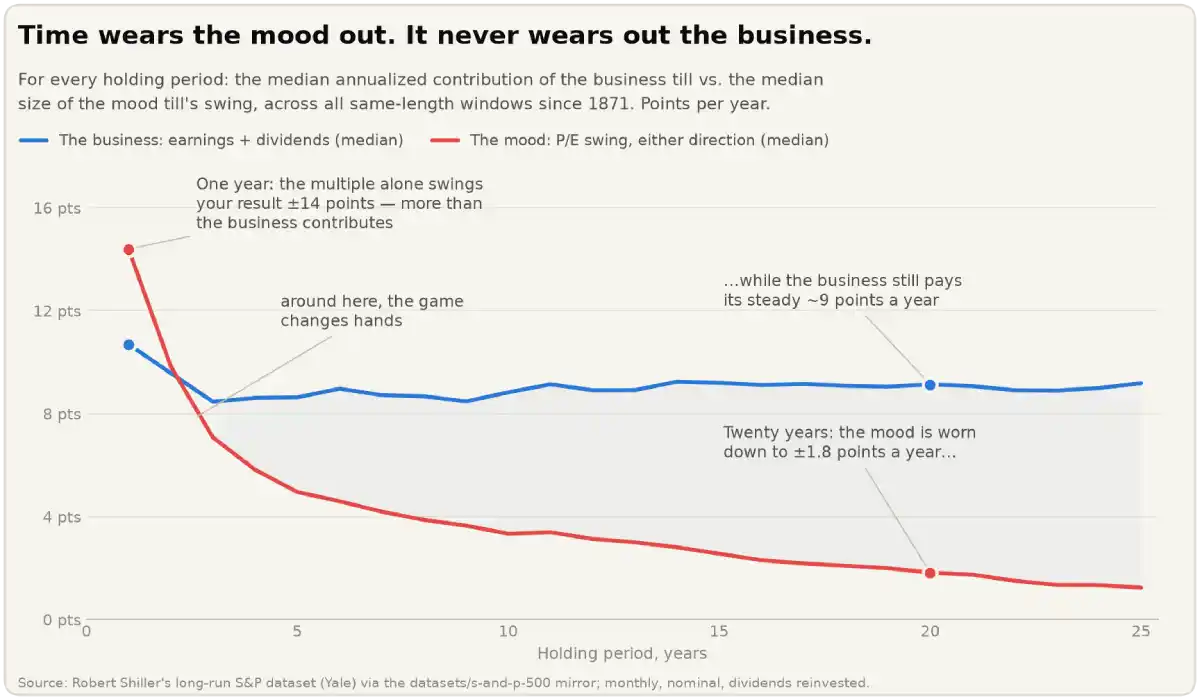
Over one-year windows, the mood till’s median swing is ±14 points a year, bigger than everything the businesses contribute. In any single year, even which till mattered more is close to a coin flip. Hold five years and the mood’s power is already cut to ±5 points against the business’s steady 8–9. At twenty years: ±1.8 against 9.1, and the business till dominated 96% of all windows in history. Somewhere around year three, the game changes hands.
I find this chart clarifying in a way no definition ever was. The market doesn’t know your name, your thesis, or what you typed in your journal. But your holding period changes which till has the power to dominate your result. Buy the index because you need the money in eight months and your outcome can be overwhelmed by repricing, even though the underlying businesses kept earning. Hold a diversified equity portfolio for decades and the cumulative business results have far more time to assert themselves, while the annualized effect of the entry and exit multiple tends to shrink.
Same ETF. Different job. Different risk.
Trading also lives mostly on the short-horizon side of this chart, but I wouldn’t say “mood is everything” there. A genuine trader may be exploiting liquidity, momentum, relative value or another systematic effect. The point is that short horizons don’t give business compounding much time to rescue a weak process, for this you need an edge of your own.
Remember: investors and speculators are paid from different tills. The business till has paid ~9% a year for 150 years. The mood till has paid half a percent, but it swings ±14 in any given year, which is why it gets all the attention.
Why beginners get this wrong (I was this beginner)
They label the instrument instead of the plan. Stocks = investing, deposits = for suckers, crypto = gambling. All three are wrong the moment the plan changes. Cristina’s “responsible” ETF is the sharpest version: an emergency fund has exactly one job, being there on the bad day, and bad days travel in packs. The recession that eats your job is the same one that has her fund down 30% when she needs it. She thinks she upgraded her savings, she actually gave her rainy-day money a boss with mood swings.
They rename the game after kickoff. The most expensive sentence in retail finance is “I’m a long-term investor now,” spoken about a position that’s down 40%. I know the price of that sentence personally. My META position was born a speculation, no analysis, a story about the metaverse, an unwritten plan to be right quickly. When it fell, I didn’t sell, because by then I had rebaptized it a long-term investment. No new analysis had happened, only the price had changed, and the new label’s job was to make the loss unfeelable. A speculation that drops 40% does not become a long-term investment, it becomes a 40% smaller speculation.
They keep all four jars on one shelf, unlabeled. One account, one blur. The emergency fund drifts into the ETF because deposits felt lazy; the “fun” position quietly grows into a third of the portfolio because nobody wrote a cap. Graham’s advice on this was physical, not psychological: wall the speculative money off in its own account, cap it, and never let the two mix, in your thinking or your bookkeeping.
They think it’s a ladder. Saving for beginners, investing for adults, trading at the top for the sharp ones. There is no ladder. There are four jobs, and the trading job has the worst pay-per-applicant in the building. Meanwhile, the people with the most durable money you’ll ever meet run the two boring jobs on autopilot and speculate, if at all, with pocket change.
Remember: labels get assigned when you buy, in writing. New analysis can change a label, a price move never can.
Where the lines blur
Honesty section, because clean categories exist in blog posts, not in the wild.
Every investment smuggles in a speculation. You can’t buy the business till without buying a position in the mood till too, whatever multiple the crowd charges on the day you enter is baked into your result, and part of Graham’s margin-of-safety idea is quietly a bet that moods mean-revert. The pure investor doesn’t exist. What exists is a dominant paycheck at your horizon, which is exactly what the second chart measures.
Some assets resist a single label. The apartment you live in, the national asset class of my country, is part shelter, part leveraged bet on one street in one city, part consumption. Gold is inflation insurance at 2% of a portfolio and a thesis-free speculation at 40%. Bonds are savings-like held to maturity and mood-surfing when traded. The three questions still work; they just return mixed answers, and mixed answers are information too.
The professional seats are real. Market makers genuinely earn the spread, the way grocers genuinely earn their margin, it’s a service, priced. The game is real, the seat is just expensive, the tooling industrial, and the ad reading “you, too, can run this shop from your phone” is selling you the customer side of the counter.
And index investing blurs the definition from the other side. Graham demanded “thorough analysis”; buying everything analyzes nothing in particular. I think of it as investing with borrowed analysis, the structure itself (a self-refreshing basket of real, earning businesses) does the work my circle of competence can’t yet. The casino post called the index the house’s seat, which in my view is the same idea wearing different clothes.
So which one should you be?
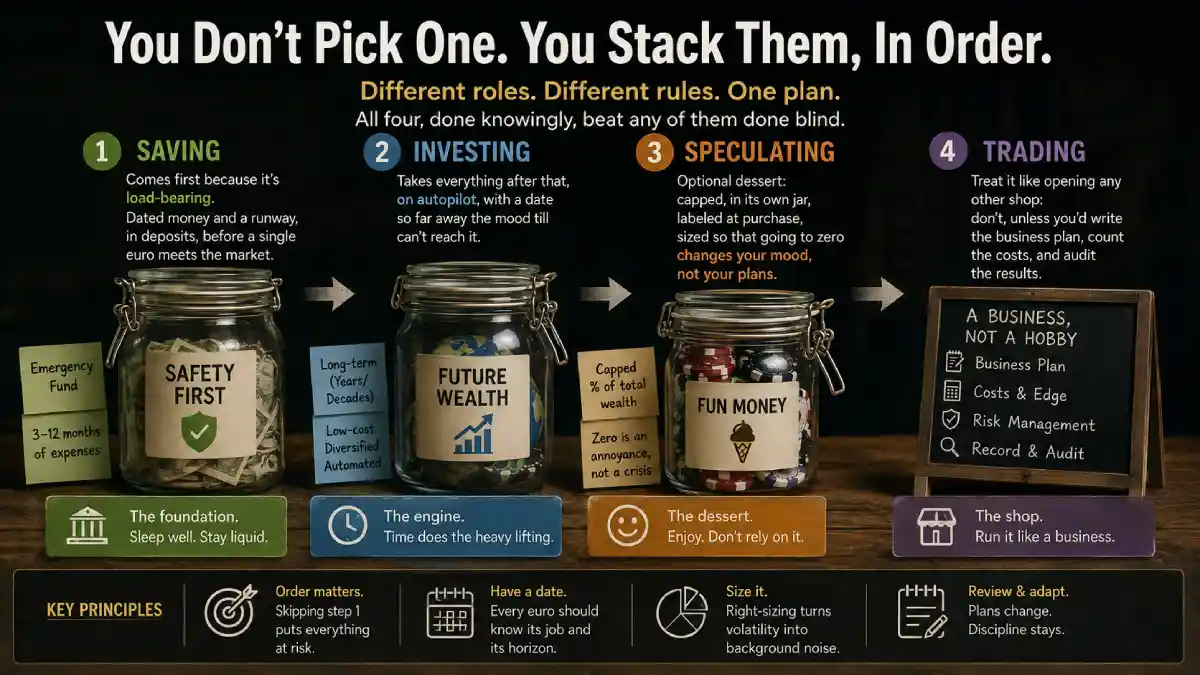
Slightly wrong question I must say, the four from above aren’t personality types, and, I’m afraid, you don’t pick one. You stack them, in order. Saving comes first because it’s load-bearing: dated money and a runway, in deposits, before a single dollar meets the market. Investing takes everything after that, on autopilot, with a date so far away the mood till can’t reach it. Speculating is optional dessert: capped, in its own jar, labeled at purchase, sized so that going to zero changes your mood and not your plans (how big that cap should be is a Position Sizing conversation for later in the curriculum; mine is small). And trading you should treat like opening any other shop: don’t, unless you’d write the business plan, count the costs, and audit the results, ohh … and if you would, you don’t need my permission. All four, done knowingly, beat any of them done blind.
My current rule
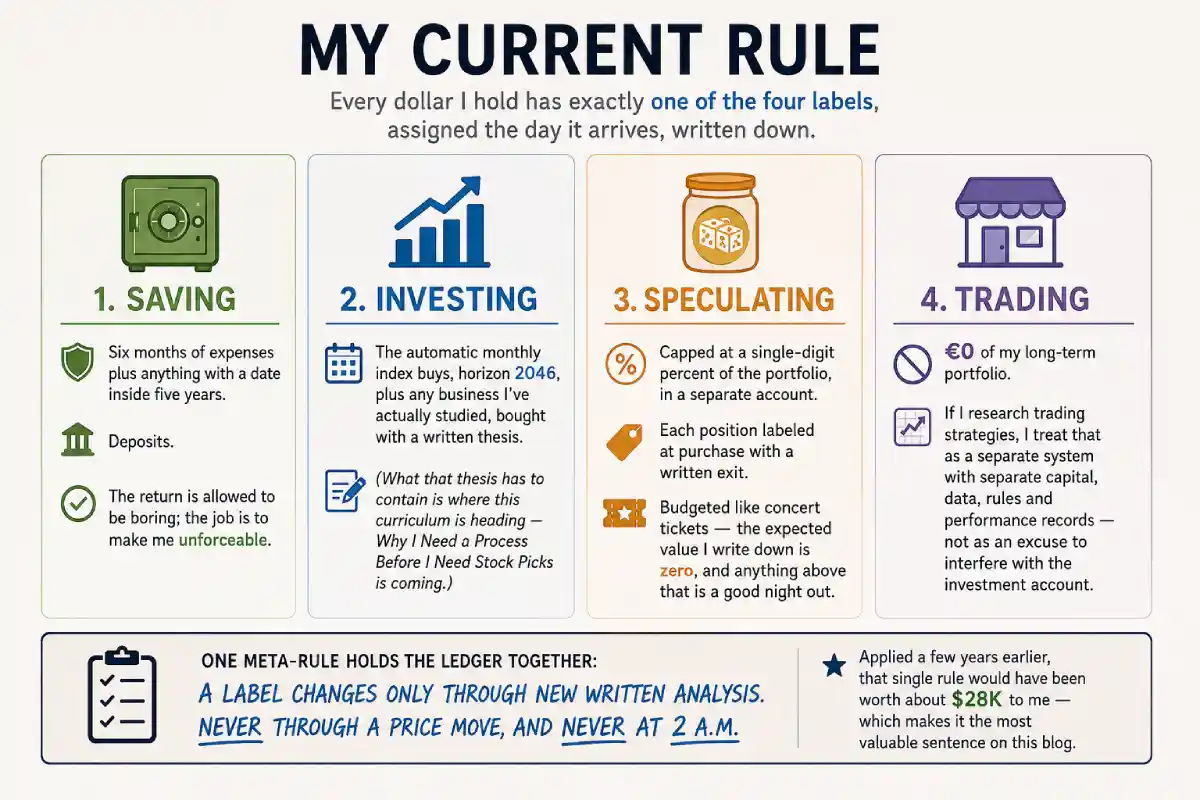
Every dollar I hold has exactly one of the four labels, assigned the day it arrives, written down. The ledger is short:
Saving: six months of expenses plus anything with a date inside five years. Deposits. The return is allowed to be boring; the job is to make me unforceable.
Investing: the automatic monthly index buys, horizon 2046, plus any business I’ve actually studied, bought with a written thesis. (What that thesis has to contain is where this curriculum is heading Why I Need a Process Before I Need Stock Picks is coming and then we are going to deep dive in thesis for each company, “it will be fun they said”).
Speculating: capped at a single-digit percent of the portfolio, in a separate account, each position labeled at purchase with a written exit, and budgeted like concert tickets, the expected value I write down is zero, and anything above that is a good night out (we all need some extra fun and some adrenaline from time to time).
Trading: €0 of my long-term portfolio. If I research trading strategies, I treat that as a separate system with separate capital, data, rules and performance records, not as an excuse to interfere with the investment account.
One meta-rule holds the ledger together: a label changes only through new written analysis. Never through a price move, and never at 2 a.m. Applied a few years earlier, that single rule would have been worth about $28K to me, which makes it the most valuable sentence on this blog, at least until I write down the full philosophy it belongs to (My Investing Philosophy: What I Believe So Far it’s next).
Your turn
The companion script,
investment_vs_speculation.py,
rebuilds both charts and every decade split from Shiller’s 150-year dataset, and writes the verification CSV:
python3 investment_vs_speculation.py
Then the audit, in your investing notebook. Three steps:
- Label every euro. Open every account > bank, broker, the exchange app you forgot about and write one of the four words next to every balance and position. The two tests: who pays me? and when is it due? Anything that needs two labels, or earns none, goes on the homework list. (My own first audit found an “investment” that was three speculations in a trench coat).
- Write your four numbers. Months of runway in actual savings; the monthly amount and the year you’re investing toward; your speculation cap as a percentage; your trading budget. If the last one isn’t zero, write the sentence that justifies the shop.
- Finish this sentence for everything you own: “This is ___ because I’m paid by , and I’m wrong if .” If any blank fights back, you’ve found the position the label was hiding.
The four words aren’t a ranking, and none of them is shameful. I save, I invest, I speculate a little, and I own every label in writing. The only losing move is the one I made through the whole $28K era: playing all four games with one word, and letting the word do my thinking.
Behind the scenes: what the split is made of
The decomposition leans on an accounting identity rather than a forecasting model: price = earnings × P/E. The script
then adds a reinvested-dividend component and performs the attribution in log space, where the components are additive.
When the chart converts those log contributions back into ordinary annual percentage rates, the displayed percentages
are best read as attributed annualized components, not numbers that can be arithmetically summed line by line. The data
is Robert Shiller’s long-run S&P series (Yale) via the free datasets/s-and-p-500 mirror the same source,
mirrors, and local cache as casino_vs_market.py. Honest wrinkles: dividends and earnings are interpolated
from quarterly reports and currently end mid-2023, so the “2020s” bar is a partial decade; monthly “prices” are averages
of daily closes, which smooths the shortest windows; decade bars are sensitive to their endpoint years (the 1940s
business till looks heroic partly because January 1940 earnings were still Depression-scarred); and same-length windows
overlap, so neighboring ones share most of their history. Everything is nominal and pre-fee, pre-tax. None of the
caveats move the headline: over the full sample, changes in valuation multiples contribute far less than the business
side of the return.
Companion code:
investment_vs_speculation.py
fetches 150+ years of monthly S&P data, splits every decade and every holding period into the business till and the mood
till (exact log-space decomposition), writes decomposition_table.csv for verification, and renders both charts.
Figures are nominal USD total returns, 1871–2023, dividends reinvested, before fees and taxes. Past frequencies are not
promises. This is education, not investment advice I’m a student of this, learning in public.
Read next:
- Prerequisite: The Market Is Not a Casino, but You Can Use It Like One — which side of the table you’re on; this post is which game you sat down to.
- Related: What Is a Stock, Really? > the engine that makes investing a different game Inflation: The Silent Thief the rent that saving pays for certainty and The Eighth Wonder what the business till does with twenty years.
- Next lesson: My Investing Philosophy: What I Believe So Far (coming, the rules above are the preview).
- Tool:
investment_vs_speculation.py+decomposition_table.csvthe two tills, decade by decade, from primary data.
Comments
0