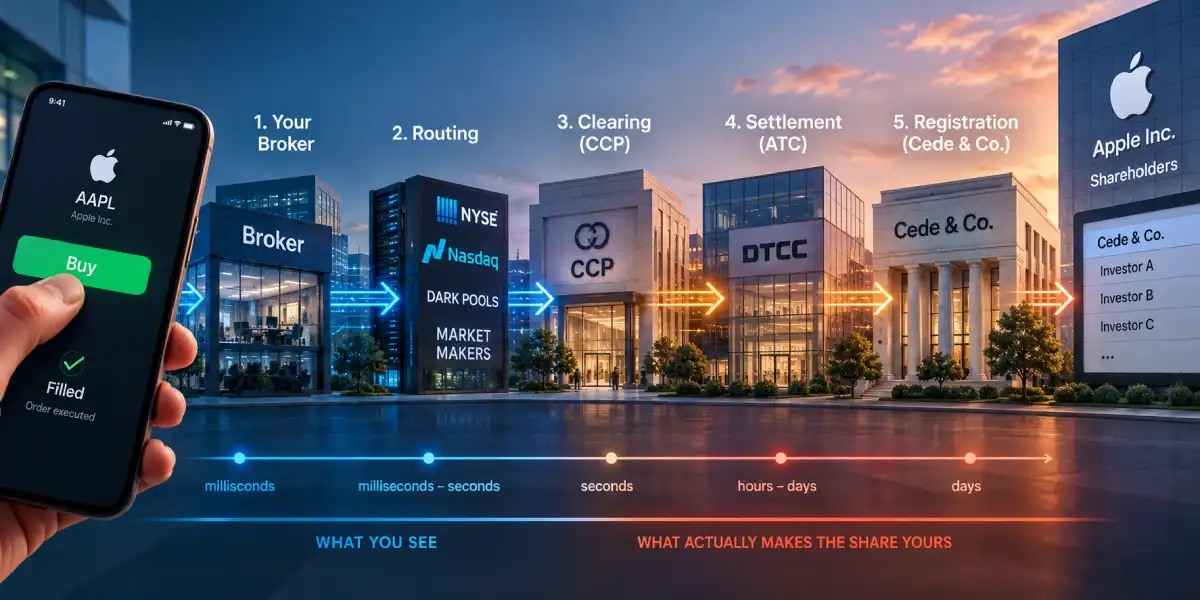
The first time I bought a stock, I did what I think most people starting with stocks do. I pressed the button, got a little green “Filled”, and then kept refreshing the positions tab for about ten minutes as if something else was supposed to happen.
Nothing else happened … the share was there, the cash was gone, done … or, at least, so I thought back then.
It took me an embarrassingly long time to observe that my broker statement had two date columns, not one: trade date and settlement date, and to my surprise, the values were never the same. At the time the 2nd one just looked like accounting noise, well it was not! It’s the date the thing you bought actually becomes yours, and the gap between the two dates hides a whole machine most investors never think about until something in the chain, breaks.
This blog post is about that machine. No stock picks today, no strategy debate, no other tehnical or fundamentals details today, only the plumbing. I think it’s worth one read for a simple reason: you are trusting a chain of five or six companies with your money every time you tap that button, and it’s hard to judge a risk you can’t see.
First, a quick question
Say you buy one share of Apple through your broker application on a Monday morning and the order fills in a fraction of a second. On Tuesday evening, somebody at Apple opens the official list of shareholders.
Whose name is on the line for your share?
- Yours
- Your broker’s
- Nobody’s yet, it’s still settling
- A company you have probably never heard of …
Back then, I would have said 1 or maybe 2 just as a pure guessing game, but …
The answer is 4. The name on Apple’s register is almost certainly Cede & Co., the nominee company of the Depository Trust Company in New York. Cede & Co. is the registered holder for the large majority of shares issued by US-listed companies. Not you, and not your broker either. You are, legally and practically, a line in your broker’s database, which is a line inside someone else’s database, which is a line inside Cede’s.
That sounds alarming, actually mostly it isn’t, and by the end of this post it should make sense why the system is built like this. But it’s a good sign of how different “I own a share” is from what most of us picture.
Remember: a stock purchase is two events, not one. The trade is an agreement on price. The settlement is the moment cash and shares actually change hands. Your app if the filshows you the first one and barely mentions the second.
The five stops
Here is the whole trip, on one picture. The horizontal axis is time since you tapped Buy, on a log scale, because the first half of the story happens in milliseconds and the second half takes, well … around a day.
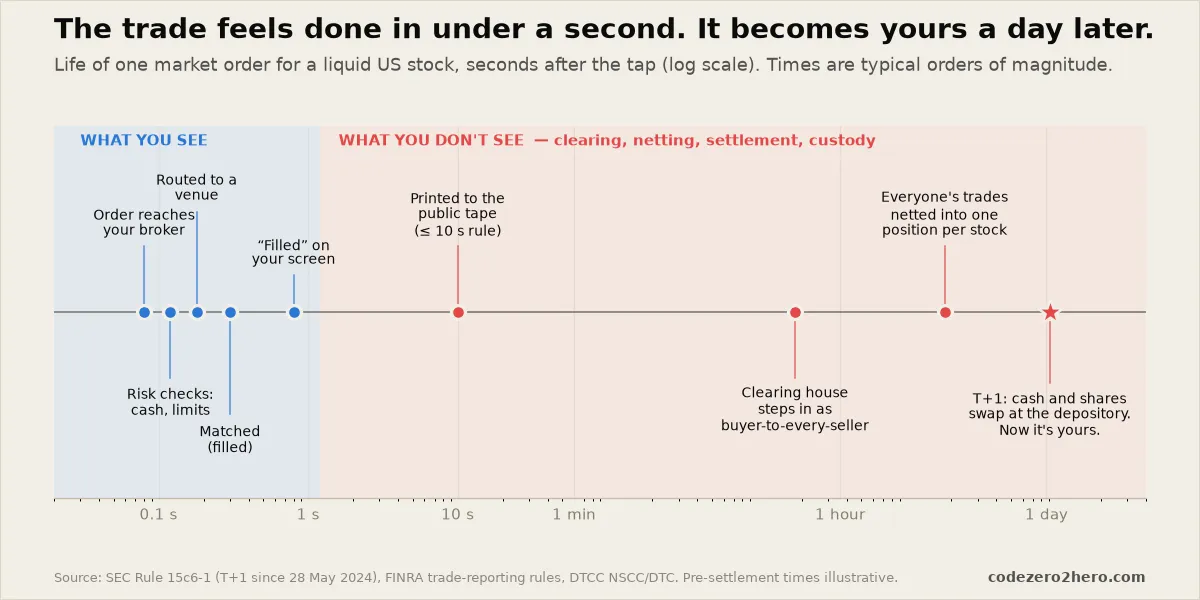
Everything in the blue zone is what you see. Everything in the red zone is what actually makes the share yours. Let’s walk together through it and bring some light to the flow of events.
Stop 1: your broker (the first ~100 milliseconds)
Your order doesn’t go to “the market”, in reality, it goes to your broker’s servers, and the first thing the broker does is decide whether to let you trade at all.
This is the boring part, and it’s also the part that protects everyone. The broker checks you have the cash or margin to pay, that the order isn’t obviously a fat-finger (buying 10,000 shares when you meant 10), that the stock is tradable right now, and that you are allowed to hold it. EU investors run into this last one when they try to buy a US-domiciled ETF and get rejected: no KID document another example of KID documentunder EU rules, so no purchase. That’s the broker doing this check, it’s not a bug.
If you’re buying a US stock with euros, there is also a currency step somewhere here: either the broker converts your cash on the spot, or it lends you dollars against your euros. Either way, somebody earns a spread on it, that’s for sure. (That is its own lesson, Currency Risk: Buying US Stocks With European Money, coming later in this series.)
Stop 2: routing (where your order actually goes)
This is the part I misunderstood the longest.
I used to picture one big exchange, one big order book, and my order sitting in it next to everyone else’s. In the US there are more than a dozen registered stock exchanges, plus dozens of alternative trading systems (the “dark pools”), plus large market-making firms called wholesalers that fill retail orders directly from their own inventory. In January 2025, according to data compiled by Bloomberg, off-exchange trading was on course for a record 51.8% of all US stock volume. More than half of shares traded in the US don’t change hands on anything you would call an exchange.
So your broker has to choose. In the US, rules require it to seek the best execution for you, and to never trade through a better publicly quoted price on another exchange (the national best bid and offer, NBBO for short). Within those rules there’s room to pick, and the choice is where money gets made.
That brings us to the controversial bit: payment for order flow details here and here. In the US, a wholesaler can pay your broker to send it your order. The wholesaler makes its money on the gap between buying and selling prices, and retail orders are cheap to fill because they are small and not “informed” (you and I don’t know something the market doesn’t). The broker gets paid, and that payment is what funds a lot of “commission-free” trading apps. The defence is that wholesalers often fill you at a slightly better price than the public quote. The criticism is that the broker has an incentive to route for its own payment instead of your price.
The EU took a side, payment for order flow has been banned under MiFIR since March 2024. Germany was the only member state that used a temporary exemption, and that exemption expired on 30 June 2026. Today, if you’re an EU retail client, your broker is not allowed to be paid for where it sends your order, BUT the US still allows it.
This doesn’t make EU brokers saints. They still earn money from FX conversion, from interest on your uninvested cash, from securities lending. But it removes one conflict, and well, at the end of the day, it’s worth knowing which side of it your broker sits on.
Stop 3: the match (the fill)
Somewhere, on some venue, your buy order meets a sell order at a price both accept and that’s the trade. For a liquid stock during market hours, from tap to fill is usually well under a second.
The price you get depends on the kind of order you placed. A market order says “fill me now at whatever the best available price is”. A limit order says “fill me at this price or better, or not at all”. For a large, busy stock in the middle of the day, the difference is often pennies. For a small stock, or at the open, or in a panic, it can be much more than that. (Market Order vs. Limit Order is the next lesson, and the cost hidden between the two prices gets its own post after that: The Bid-Ask Spread.)
After the fill, two things happen almost at once. You get your “Filled” notification. And the trade is reported to the public tape so the rest of the market can see a transaction happened at that price. For off-exchange trades in the US, FINRA rules require that report within 10 seconds.
… and your part is over at this point, from your side, you bought a share, congrats I do hope you made your thesis before you decided to bought it.
From the system’s side, all that exists now is a promise: you promised to pay, someone promised to deliver and neither has happened yet.
Stop 4: clearing (the part where nobody has to trust anybody)
Here’s the problem the rest of the machine solves. Your broker agreed to buy a share from some other broker you have never heard of. What if that broker goes bust tonight? Should your broker have to check the credit of every counterparty on every trade?
The answer is very simple, NO. In the US, trades flow into the National Securities Clearing Corporation (NSCC), part of DTCC. The clearing house steps into the middle of every trade: it becomes the buyer to every seller and the seller to every buyer. Your broker’s counterparty is no longer some random firm, it’s the clearing house, which holds margin from all its members for exactly this reason. In Europe the equivalent role is played by central counterparties like Eurex Clearing, LCH or Euronext Clearing, depending on where the trade happened.
Then comes the step I personally think, is quietly brilliant: netting. Over a trading day, one broker might buy 2 million shares of Apple for its clients and sell 1.9 million, and it doesn’t need to move 3.9 million shares. It needs to receive 100,000 of them. The clearing house collapses all of a member’s trades in each security into one net position per stock. DTCC puts the netting rate of its continuous net settlement system at about 98.6%. The vast majority of what trades never needs to physically move at all.
Remember: most of the market’s safety doesn’t come from any one company being trustworthy. It comes from a clearing house standing in the middle so nobody has to be.
Stop 5: settlement and custody (where it becomes yours)
Settlement is where cash and securities finally move, and they move together. The system is called delivery versus payment: shares only leave the seller if the cash leaves the buyer at the same time. Neither side can be left holding nothing.
In the US this happens at the Depository Trust Company (DTC), the central securities depository. For EU stocks it happens at the CSD of each market: Clearstream in Germany, Euroclear in France, Belgium and the Netherlands, and here in Romania, Depozitarul Central for trades on the Bucharest Stock Exchange.
How long all this takes is the settlement cycle, and it’s been getting shorter for thirty years:
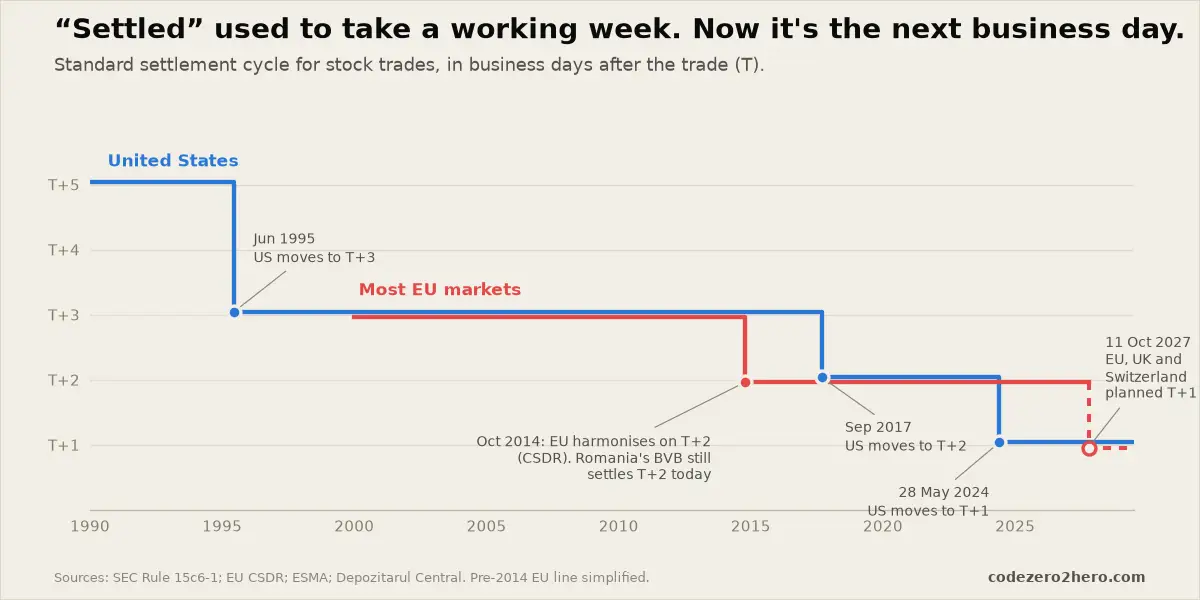
Not that long ago, a US trade took five business days to settle, a relic of the time when paper certificates physically travelled between offices. It went to T+3 in 1995, to T+2 in 2017, and on 28 May 2024 to T+1: trade on Monday, settled Tuesday. The EU harmonized on T+2 in October 2014 and is scheduled to move to T+1 on 11 October 2027, together with the UK and Switzerland. The BVB still settles T+2 today.
Once settlement is done, your share sits in the custody chain, this is where the quiz answer comes from:
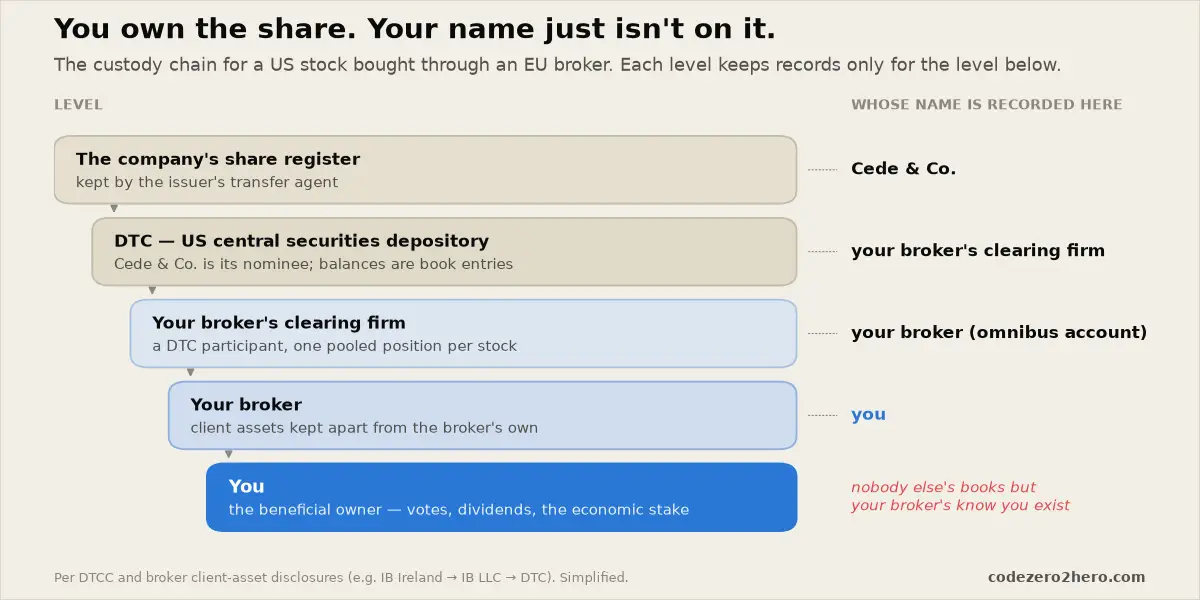
Every level only knows about the level directly below it. Apple’s register knows Cede & Co. DTC knows your broker’s clearing firm, because that firm is a DTC participant. The clearing firm knows your broker’s pooled “omnibus” account. And only your broker knows that some of those shares are yours.
For my own account the chain looks like this: I’m a client of Interactive Brokers Ireland, whose US shares are held through its US affiliate Interactive Brokers LLC, which is a DTC participant. Some European brokers add one more layer, a sub-custodian bank, or hold US shares through Clearstream or Euroclear instead. The number of links changes. The principle doesn’t.
Legally, you are the beneficial owner. You get the dividends, the votes (forwarded through the chain), and the economic value, you just don’t appear on the register. It’s the same way you don’t personally appear in the vault of the bank that holds your deposit.
Where this stops being trivia
All of that might sound like it doesn’t matter as long as the number on the screen goes up. A few places where it does.
Dividends. To receive a dividend you must be on the record (via the chain) by the record date. Because settlement now takes one day in the US, the ex-dividend date and the record date are the same day. Buy on the ex-date or later and the dividend goes to the seller. Buying “for the dividend” on the ex-date is one of the most common beginner surprises, and this is the whole reason.
Selling and buying again quickly. Cash from a sale isn’t settled cash until the sale settles. In a cash account, some brokers will let you use it straight away but restrict the account if you sell the new position before the first sale has settled. It’s a rule built entirely on the gap between the two date columns.
What happens if your broker fails. This is the one people worry about, and the answer is mostly reassuring for a reason I didn’t understand until I drew the chart above. Your shares aren’t your broker’s money. They sit in a segregated client account, and in a failure they are supposed to be returned to clients, not used to pay the broker’s creditors. On top of that, there are compensation schemes for the case where something is missing (fraud, bad records, a hole in the books):
- in Romania, the Fondul de Compensare a Investitorilor covers up to the lei equivalent of €20,000 per investor
- in Ireland, which covers clients of Interactive Brokers Ireland, the Investor Compensation Scheme pays 90% of the loss up to €20,000
- in the US, SIPC covers up to $500,000 per customer, of which up to $250,000 in cash
Those numbers are small next to a real portfolio, and they cover missing assets, not market losses. Segregation is what’s doing the heavy lifting; compensation is the backup to the backup. (Broker Safety: What If My Broker Fails? will go through segregation, what the schemes cover and what they don’t, one broker structure at a time.)
Why beginners get this wrong (I did)
“Filled” feels like the end. It’s the end of the part designed for you to see. Most of what can go wrong in the system, a counterparty default or a failed delivery, happens after that notification and is handled without you ever knowing. That’s the point of the design, but it also means most investors have no mental model of where their shares actually are.
“Free” trading feels free. Someone is paying for the machinery above: clearing houses, depositories, exchange fees, market makers’ capital. If it isn’t a commission, it’s a spread, an FX markup, interest kept on your cash, or, in the US, payment for your orders. I don’t think that’s a scandal, I just think you should know which of those your broker uses, because the cheapest-looking broker isn’t always the cheapest one. (Picking a platform with an EU lens is The Brokerage Jungle, coming in this block of lessons.)
“My name isn’t on it” feels scary. It feels like you don’t really own anything. The fear is understandable and mostly misplaced. The nominee system is the reason a trade can settle in a day instead of weeks. The risk isn’t that Cede & Co. owns your Apple share. The risk sits one level up the chain, at the broker whose books are the only proof that it’s yours. That’s why choosing a regulated broker in a jurisdiction with real segregation rules is a bigger decision than picking the app with the nicest charts.
The obvious question: why not settle instantly?
If the trade happens in milliseconds, why does settlement need a day? Crypto settles in minutes, so why can’t stocks?
Because netting needs time. If every trade settled the instant it happened, every broker would need the full cash for every buy immediately, trade by trade. The 98.6% compression disappears, and the system would need enormously more cash and shares sitting around just to keep moving. There are also real-world steps that don’t happen in milliseconds: currency conversions across time zones, securities lending recalls, a fund in Tokyo confirming its allocations with a broker in New York. The move from T+2 to T+1 in the US took years of preparation for exactly these reasons, and the EU is spending three years on the same step. Instant settlement exists in pilots, but for now, a day is the compromise between speed and not needing a mountain of idle collateral.
Where this post is weak
It’s mostly the US path. I described the US machinery in the most detail because that’s where most of my shares are and where the data is published most openly. A BVB trade, or a Xetra trade through a German broker, uses different names at every stop but the same five-stop logic.
The timeline is illustrative. The milliseconds in the first chart are typical orders of magnitude for a liquid US stock during market hours, not measurements. Your order may take longer, especially a limit order that waits in the book for hours, or an order sent while the market is closed.
Brokers differ in the details. Some EU brokers hold US shares through a sub-custodian bank; some hold them through Clearstream or Euroclear; some route via a US partner firm rather than their own affiliate. Above I’ve shown one simplified chain. Your broker’s client-assets document tells you the real one, and it’s worth twenty minutes of your time to find it and get an ideea about it.
I’m not a market-structure professional. I learned this from the rulebooks and from staring at my own statements. If you work in clearing and spot something wrong, tell me and I’ll fix it with a dated note.
My current rule
Three small ones:
- I know which legal entity holds my account, which country regulates it, and which compensation scheme applies. Not the app’s name, the entity’s name.
- I read the settlement date, not the trade date, whenever timing matters: dividends, selling and re-buying, moving money out.
- I use limit orders by default for anything that isn’t a large, liquid stock during regular hours. The market order has its place. The first five minutes after the open isn’t it.
Changes my mind: if EU T+1 in 2027 or the next US step shows the plumbing can move faster without new failures, rule 2 matters less, but rule 1 won’t change.
Your turn
Three things, about twenty minutes in total.
- Open your last trade confirmation and find both dates. Check the gap between trade date and settlement date. If you traded US stocks after May 2024, it should be one business day.
- Find your broker’s client-assets or investor-protection page and write down, in one line: the legal entity you are a client of, its regulator, and the compensation scheme with its limit. If you can’t find it in twenty minutes, that’s information too (hint, use LLM’s, should help you with guidance).
- If you trade through a US broker, look up its Rule 606 report example. It’s a public document that lists where your broker sent client orders and what it was paid for them. It’s dry, and it’s the most honest thing your broker publishes about itself.
None of this will make you a better stock picker. It will make you better informed, a slightly better owner, which is the whole point of this series. You can’t judge a risk you can’t see, and now you can see a little more of it.
The charts are built by click_buy_charts.py with matplotlib. No data download needed: every date on them is a
documented rule change, and every time on the first chart is an order-of-magnitude illustration labelled as such.
Settlement dates. US: SEC Rule 15c6-1 set T+3 from 7 June 1995; amended to T+2 from 5 September 2017 and to T+1 from 28 May 2024. The pre-1995 “T+5” is the market convention of the time. EU: the Central Securities Depositories Regulation (Regulation (EU) No 909/2014) harmonised on T+2, which most EU markets adopted on 6 October 2014; some, Germany among them, were already on T+2, so the pre-2014 “T+3” line is a simplification. EU T+1 on 11 October 2027 is ESMA’s published go-live date, coordinated with the UK and Switzerland. Depozitarul Central states BVB settlement as DVP at T+2.
Off-exchange share. 51.8% of US volume for January 2025, from data compiled by Bloomberg (published 24 January 2025). The share moves month to month; it has hovered around half in recent years.
Payment for order flow. MiFIR Article 39a, introduced by Regulation (EU) 2024/791, in force from 28 March 2024. Member states could exempt their own residents until 30 June 2026; Germany was the only one that did.
Netting. DTCC describes its Continuous Net Settlement (CNS) netting rate as 98.6%.
Trade reporting. FINRA requires off-exchange trades in NMS stocks to be reported as soon as practicable and no later than 10 seconds after execution.
Compensation schemes. Romania: Law 88/2021 on the Investor Compensation Fund, up to the lei equivalent of €20,000 per investor. Ireland: Investor Compensation Scheme, 90% of the loss up to €20,000, as disclosed by Interactive Brokers Ireland. US: SIPC, $500,000 per customer including a $250,000 cash limit. All cover missing client assets after a firm fails, not losses from falling prices.
Custody chain. Simplified from DTCC’s description of the nominee (Cede & Co.) structure and from Interactive Brokers Ireland’s client-asset disclosures. Real chains vary by broker and by market.
Companion code:
click_buy_charts.py
draws the three figures in this post. This is education, not investment advice. I’m a student of this, learning in
public.
Read next:
- Prerequisite: What Is a Stock? What you’re actually buying before you worry about how it gets delivered.
-
Related: Why Stock Price Alone Means Nothing and The Market Is Not a Casino, on why the price you see at the fill is only the start of the question.
-
Next lesson: Market Order vs. Limit Order (coming: the one choice you make at stop 3, and what it can cost you).
- Tool:
click_buy_charts.py: the three charts above, reproducible.
Comments
0