
The first small-cap I ever bought, I bought the second the US market opened, late afternoon, my time. I’d been reading about the company all weekend, I was sure, and I didn’t want to “miss the move”. So I hit Buy, left the order type on whatever the app had pre-selected, and got filled.
The fill was almost 2% above the last price I’d looked at before the bell.
I remember staring at it and assuming the app was broken, but well, it wasn’t. The app did exactly what I told it to do, with the information I had about this process at that particular time, and well, I just didn’t know what I’d told it.
That’s what this blog post is about. Two order types, one choice you make every single time you trade, and the only one of the two that comes with a price you actually agreed to, so lets jump into it.
A quick question first
A stock is quoted at $20.00. You place a market order to buy 100 shares.
What’s the highest price you can end up paying?
- $20.00
- $20.00 plus a small spread
- Whatever the broker’s price protection allows
- There’s no number written anywhere in your order
Most people pick 1 or 2 and in a normal, calm market, 2 is what will usually happen.
But the honest answer is 4. A market order has no price on it. It’s an instruction to trade now, at whatever price is available now. Usually that’s fine, and sometimes it really, really isn’t, and the order itself won’t save you. (Some brokers do add a hidden cap, which is option 3. That’s the broker protecting you, not the order type, don’t count on it).
The two orders in one line each
- Market order: “Fill me now. I don’t care about the exact price.”
- Limit order: “Fill me at this price or better and if you can’t, don’t fill me, period.”
That’s really it. Everything else in this post is about what those two sentences cost you in practice.
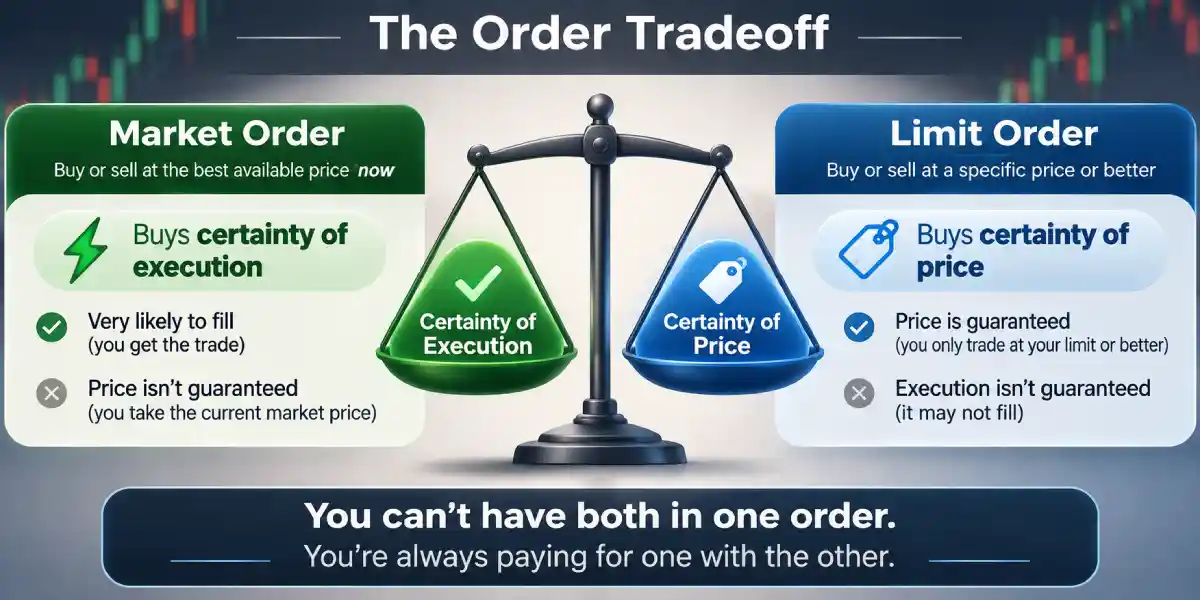
One way I think about it: a market order buys certainty of execution. A limit order buys certainty of price. You can’t have both in one order, you’re always paying for one with the other.
What a market order actually does
To understand why “no price” matters, you need to picture what’s on the other side of your order. It’s not a single price. It’s a queue of buyers and sellers, each willing to trade at a different price.
That queue is called an order book. On one side are the bids, orders from people willing to buy. On the other are the asks, orders from people willing to sell. Each price level has a certain number of shares available.
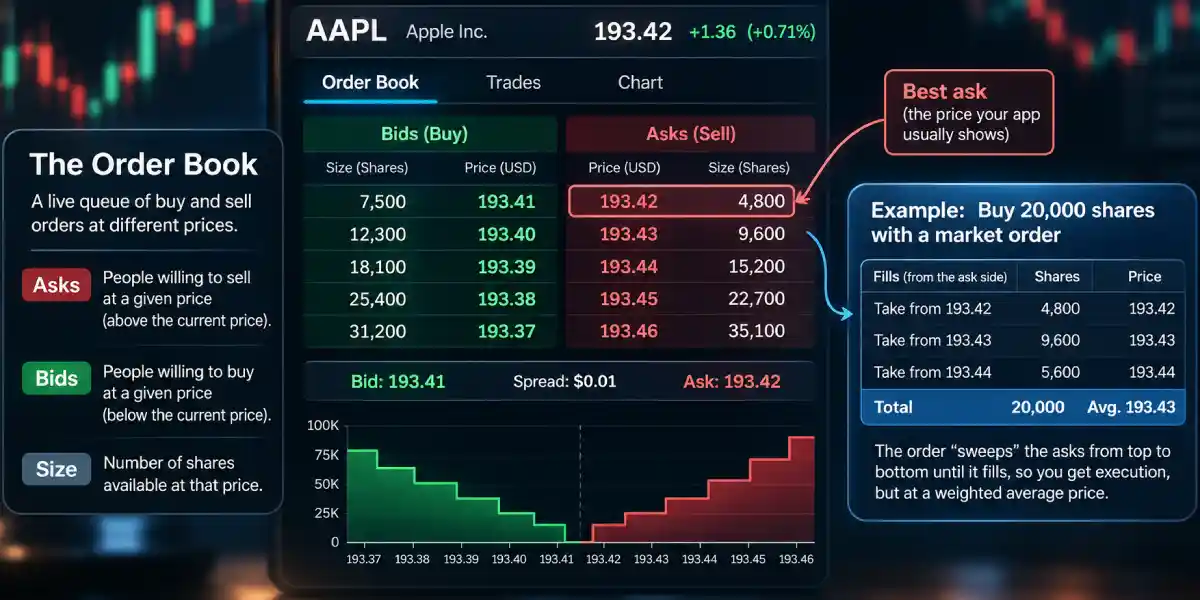
What you’re looking at is a simulated Level 2 order book, also known as Market Depth or Depth of Market (DOM). It shows the displayed buying and selling interest at different price levels. The above numbers are made up, but the mechanics are real.
Look at the sellers on the right, the red side. The cheapest seller is asking $193.42, but there are only 4,800 shares available at that price. Now imagine I or you, place a market order to buy 20,000 shares. The order doesn’t magically get all 20,000 shares at $193.42, instead, it starts consuming the available shares:
- 4,800 shares at $193.42
- 9,600 shares at $193.43
- 5,600 shares at $193.44
I’ve bought my 20,000 shares, but at an average price of approximately $193.43, slightly above the best ask when I placed the order. That difference is a simple example of slippage. The order had to move through several price levels because there wasn’t enough liquidity at the cheapest one.
And here’s the important bit: nobody stole anything. Every seller in this example got the price they were asking for. I was the one who told the market I’d accept whatever prices were available to fill my order.
There’s another detail worth understanding. The stock price displayed prominently in your trading app is usually the last traded price, not necessarily the price at which you can buy right now. The best bid and best ask are separate quotes, and those are what matter when your order reaches the market and even those quotes aren’t promises.
The order book isn’t frozen in time. Orders arrive, disappear, get cancelled, or get filled constantly. The liquidity you saw a fraction of a second ago might no longer be there when your order arrives.
That’s the trade you’re making with a market order. You’re effectively telling the market: I want to buy now, and I’m willing to accept the prices available when my order gets there.
You prioritize execution, but you give up control over the exact price.
When those few cents start to matter
The first example might not look particularly alarming, a cent here, another cent there. But let’s look at a thinner order book, where even a relatively small order can make a noticeable difference.
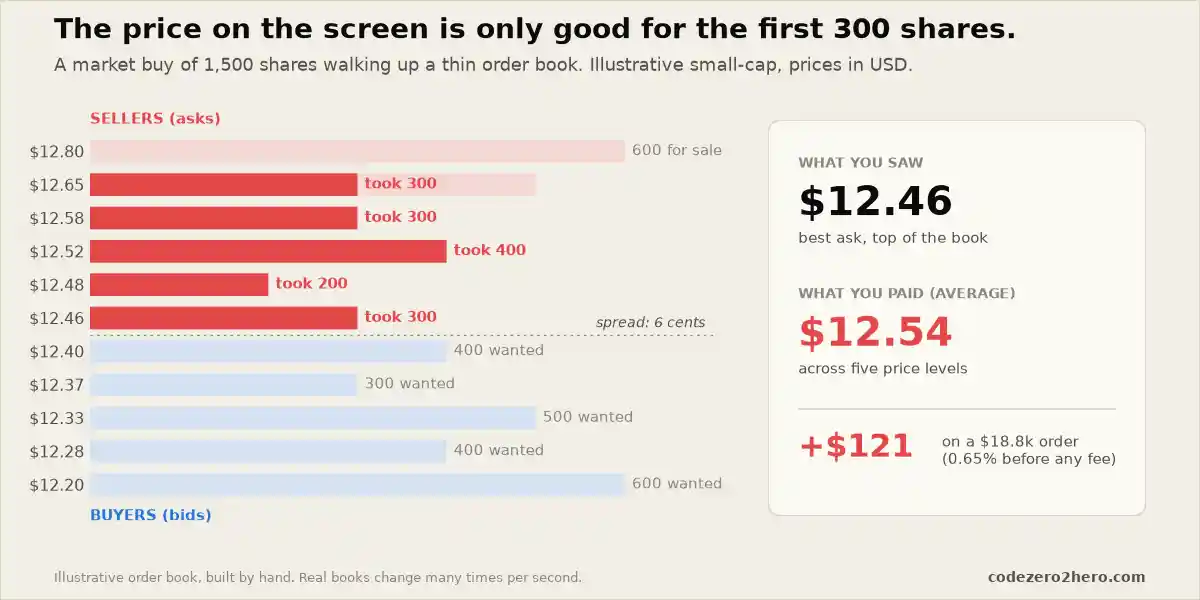
In this simulated example, the best ask is $12.46. There are only 300 shares available at that price, but I want to buy 1,500. So my order starts walking up the book:
- 300 shares at $12.46
- 200 shares at $12.48
- 400 shares at $12.52
- 500 shares at $12.56
- 100 shares at $12.58
By the time the order is filled, I’ve paid $18,780 instead of the $18,690 I would have paid if all 1,500 shares had been available at $12.46. That’s $90 more, or roughly 0.48%, before any commission or FX conversion fee. On a stock I plan to hold for years, that might be annoying but survivable. On a trade where I’m hoping to make 3%, I’ve just given up roughly a sixth of my target return before the price has even moved in my favor and I’ll face execution costs again when I sell.
This is where market orders can become expensive, particularly in thinly traded stocks, during volatile sessions, or outside regular trading hours when available liquidity can be much lower.
But I also want to be fair here.
I deliberately made these order books thin to demonstrate the problem. If I’m buying 10 shares of Apple during regular trading hours, there’s often more than enough liquidity at the best ask to fill my entire order without sweeping through multiple price levels. The spread might be a cent, and the execution price might be almost exactly what I expected. That’s the part people tend to skip in those “never use market orders!” videos.
For highly liquid stocks, during normal market hours, a small market order can be perfectly reasonable. I’m not arguing that market orders are inherently bad. My concern is that people tend to use them everywhere, without considering how much liquidity is actually available or what price they might end up paying.
There’s a difference between buying 10 shares of Apple on a quiet Tuesday afternoon and trying to buy 5,000 shares of a small company immediately after unexpected earnings news. Same order type with a very different potential outcome.
And there’s one more cost I haven’t really explored yet: the gap between the best bid and the best ask. Even when there’s plenty of liquidity and almost no slippage, buying at the ask and selling at the bid can still cost you money but this one, deserves a discussion of its own “The Bid-Ask Spread: The Hidden Cost”.
What a limit order actually does
A limit order flips the deal, actually you name the price. The order sits in the book (now you’re one of those bars on the chart) and waits for someone to meet you there, now we can call this perfect match :). If the market comes to your price, you get filled at your price or better. If it doesn’t, nothing happens. No trade, no loss, no gain, the order just expires, or sits there until you cancel it.
That second outcome is the cost nobody puts in the brochure:
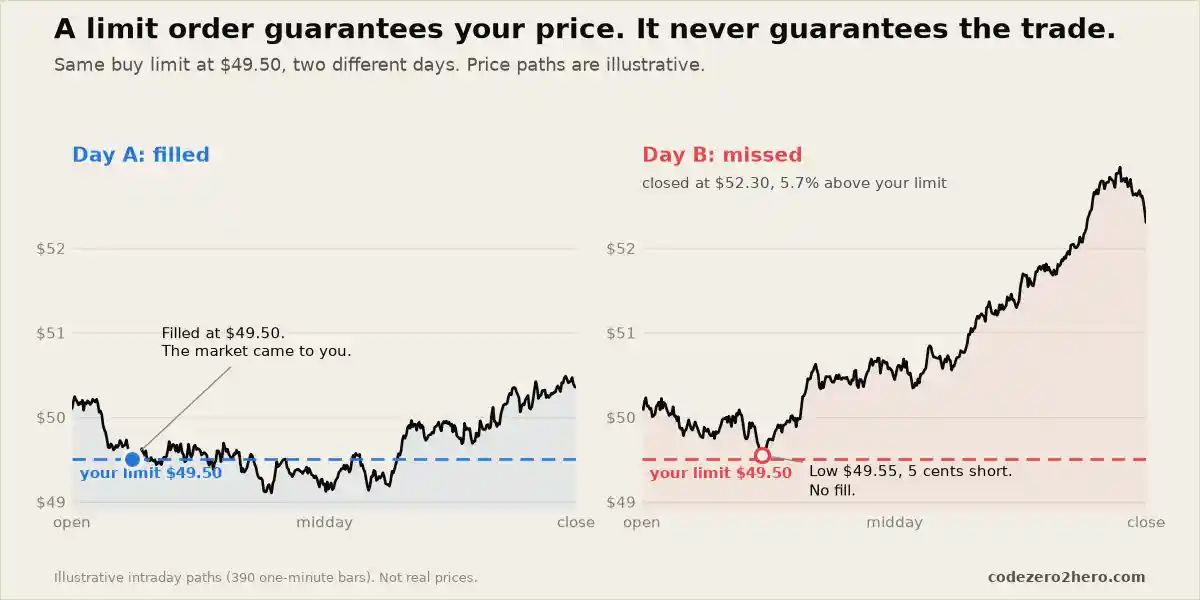
On day A the stock drifted down, touched $49.50, and you got exactly the price you wanted. (Notice it then kept falling to around $49.10. A limit order gets you your price, it doesn’t promise your price was a good one.)
On day B the low of the day was $49.55, five cents short so no fill. The stock closed at $52.30, 5.7% above your limit, and you own nothing.
Whether day B is a disaster depends entirely on why you were buying. If you’re building a position in a company you plan to hold for nth years, missing by five cents today and buying a bit higher next week is noise. If you were greedy about a nickel on a stock you were sure about, it stings, and yeah, I’ve done both.
Remember: a market order risks a bad price. A limit order risks no trade at all. Pick which risk you’d rather carry, every time.
Where market orders really bite
The order book chart is the everyday version. These are the moments it gets ugly.
The open. In the first minutes after the bell, market makers are still figuring out where the price should be, and the book is thin and jumpy. Spreads are wider than they’ll be an hour later. My 2% “slippage” above was mostly this. Same thing on European exchanges: if you’re buying a UCITS ETF that holds US stocks, like CSPX/SXR8 or VWCE, the spread is often wider in the European morning, before the US market opens and the market makers can hedge cleanly against live US prices.
Small and thin stocks. US small caps, niche ETFs, most names outside the big indexes. The book on those can be a few hundred shares deep. Any market order bigger than “tiny” walks it. How to judge whether a book is deep enough for your size is a lesson of its own “Liquidity and Why It Matters”.
News. Earnings, a profit warning, a central bank surprise. Everyone hits the button at once and the people who normally provide liquidity step back.
Outside regular hours. Pre-market and after-hours trading exist, and the books there are much thinner. Many brokers don’t even accept market orders in those sessions, which tells you something.
Stop-loss orders. This one surprises people. A standard stop-loss is a market order with a trigger. When the price hits your stop, it becomes a plain market order and sells at whatever it can get. In a calm decline that’s fine, in a crash, “whatever it can get” can be awful.
The textbook case is 6 May 2010, the Flash Crash. In about fifteen minutes the Dow fell roughly a thousand points and then mostly bounced back. In that window, Accenture shares that had been trading around $40 printed trades at one cent. Part of the reason was “stub quotes”: placeholder bids market makers left absurdly far from the real price, never expecting anyone to hit them. Market sell orders, including triggered stops, hit them.
It happened again, smaller, on 24 August 2015. US markets opened into chaos after a sell-off in Asia, many stocks were slow to open, and a number of ETFs traded far below the value of what they held. Some fell by more than 30% in the first minutes. Investors who had stop-losses on those ETFs got sold at the bottom of a hole that closed within the hour. After that day, more than one ETF issuer put out guidance that boiled down to: don’t use market orders in volatility, and remember that stop-loss orders become market orders.
Market structure has changed since then (the US added per-stock trading pauses, “limit up-limit down”, after 2010, and tweaked them after 2015). But the logic of the order type hasn’t changed. A market order with no price can still fill at a price you’d never have agreed to.
If you want a stop, look at whether your broker offers a stop-limit: it triggers like a stop, but turns into a limit order instead of a market order. You might not get out in a crash, and you also won’t get out at one cent.
Remember: a standard stop-loss is a market order with a trigger. Whatever a market order can do in a panic, your stop-loss can do automatically, while you sleep.
The middle ground I actually use: the marketable limit
Here’s the trick that solved most of this for me, and I wish someone had told me on day one.
You don’t have to choose between “any price” and “wait for my price”. You can place a limit order at or slightly beyond the current price. On a buy, that means a limit at or a bit above the ask, it’s called a marketable limit order.
It fills immediately, like a market order, as long as there are sellers within your limit. But it has a ceiling. If the book is thinner than you thought, the order fills what it can up to your limit and stops there, instead of walking all the way up to $12.80.
In the order book chart above, a buy limit at $12.52 would have filled 900 shares at an average around $12.49 and left the other 600 waiting. You’d then decide, calmly, whether the rest is worth chasing and that decision is the whole point. A market order makes it for you, in a fraction of a second, without asking.
Remember: a marketable limit behaves like a market order while the book holds, and stops when it doesn’t. Speed, with a ceiling.
The mistakes I’ve made with limit orders
Limit orders aren’t magic either. A few ways they go wrong:
Setting the limit to save a cent. On a liquid stock with a one-cent spread, putting your buy limit a cent below the bid to “save money” mostly means you sit there while the price moves away. Saving $1 on 100 shares isn’t worth missing a stock you’ve decided to own. If you’ve done the work and want the company, the marketable limit is fine.
Chasing. The order doesn’t fill, so you move the limit up … then up again … then up again. At that point you’re placing a slow, emotional market order. Pick your price before you open the app, not while you’re watching the ticks.
Forgetting a good-‘til-cancelled order. Most brokers let you choose how long the order lives: DAY (expires at the close) or GTC (good ‘til cancelled, which often means weeks or months). A GTC buy limit sitting 10% below the price feels like a clever bargain trap. Then bad earnings come out overnight, the stock opens 15% lower, and your order fills instantly, at your limit, into the news you didn’t read. The order did what you told it. The world changed between “told” and “filled” and these days I use DAY by default and re-enter orders on purpose.
Partial fills. A limit order can fill 37 of your 100 shares and sit on the rest. Check whether your broker charges a minimum commission per execution. On some fee schedules, a trade split into pieces across days costs more than you planned.
Fractional shares. Some apps only allow market orders for fractional shares. If that’s your setup, it’s one more reason to buy only liquid stocks and ETFs during their busy hours.
So, which one?
This is the rule of thumb I’ve ended up with, it isn’t from a rulebook. It’s what’s left after making most of the mistakes above ohh and I did a lot and sometimes still do…
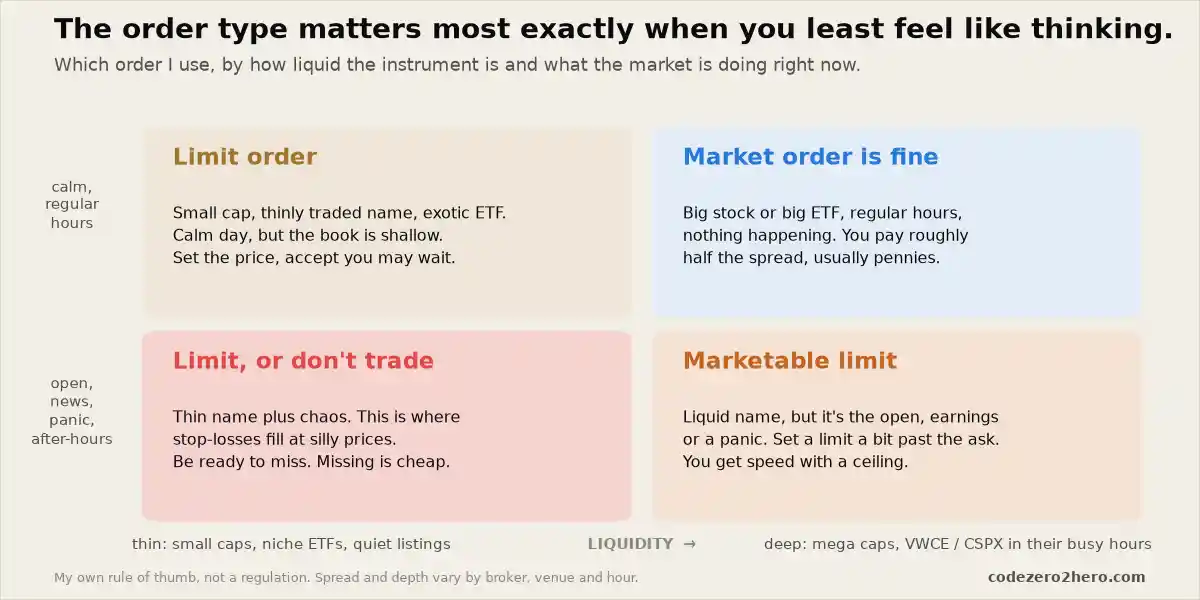
The top-right box is where most long-term investing actually happens: buying a big ETF or a big company on a normal afternoon. There, a market order is fine and you shouldn’t stress about it. The more you move left (thinner) or down (more chaos), the more a price on your order starts to matter.
And the bottom-left box is the honest one. Sometimes the right order is no order. A thin stock in a panic will still be there tomorrow and missing a trade costs you nothing BUT being filled at a silly price costs real money.
Why beginners get this wrong (I did)
The app picks for you. A lot of apps pre-select “Market” because it always fills, which makes the experience feel smooth. Smooth for the app isn’t the same as cheap for you.
The price on the screen feels like a promise. It’s a snapshot of the best price for a limited number of shares, a moment ago. For a liquid stock that’s close enough. For a thin one it’s a rough suggestion.
Fear of missing out beats fear of overpaying. Market orders feel safe because you “get in”. But if you’re investing for years, being in today versus tomorrow almost never matters. Overpaying by 2% because you couldn’t wait is a cost you pay for certain.
“Never use market orders” is also wrong. It’s repeated a lot, and it’s too strong. For a liquid ETF in regular hours, fussing over a limit can cost you more in missed fills than it saves. The answer depends on the stock and the moment, which is less satisfying than a slogan but more useful.
Where this post is weak
The charts are illustrative. The order book and both price paths are built by hand to show the mechanism. Real books are deeper or shallower than mine, and they change many times per second. The $121 figure is arithmetic on a made-up book, not a measurement of any real stock.
Brokers behave differently. Some quietly add price protection to market orders. Some don’t accept market orders on certain venues or outside regular hours. Some route your order in ways that change what you get. Your broker’s order-type and execution policy documents are the real answer for your account. (How to compare platforms on execution and custody rather than just commissions is a future lesson The Brokerage Jungle: Picking a Platform.)
I’ve simplified the order types. There are many more: stop-limits, trailing stops, auction orders, iceberg orders, “market on close”. For a long-term investor, market and limit cover 95% of what matters. If you trade more actively, you’ll need to go further than this post.
I’m not a trader by profession. This is what I learned from my own fills, from my broker’s documentation, and from the post-mortems on 2010 and 2015. If you work on a trading desk and something here is wrong, tell me, and I’ll fix it with a dated note.
My current rule
- Liquid stock or big ETF, regular hours, calm day: market order is fine. I don’t overthink it.
- Everything else gets a limit. Thin names, the first 15 to 30 minutes after the open, earnings days, anything after-hours.
- When I want “now”, I use a marketable limit, a bit past the ask, not a plain market order. Speed with a ceiling.
- DAY orders by default. No forgotten GTC orders waiting for bad news.
- No plain stop-losses on ETFs or thin stocks. If I want an exit price, it’s a stop-limit or an alert that makes me look at it.
Changes my mind: if I ever start trading size in thin names, rule 1 shrinks and rule 3 becomes the default for everything.
Your turn
Three small things, maybe fifteen minutes.
- Open your broker’s order ticket and check the default. Is it market or limit? Is the time-in-force DAY or GTC? I recommend changing the defaults if the app lets you.
- Look at the spread on something you own, twice. Once in the first minutes after its market opens, once in the middle of the session and write both down. That gap is what a market order at the open costs you, before slippage.
- Check your open orders. If there’s a GTC order you forgot about, decide today whether you’d still want it filled tomorrow morning after bad news and if not, cancel it.
None of this will help you pick better companies. It’ll just stop you from paying extra for the ones you already picked, which, over enough trades, adds up to real money.
Behind the scenes: sources and simplifications
The charts are built by market_vs_limit_charts.py with matplotlib, no data download needed.
Order book chart. A hand-built book: asks at $12.46 (300), $12.48 (200), $12.52 (400), $12.58 (300), $12.65 (500), $ 12.80 (600). A 1,500-share market buy fills 300 + 200 + 400 + 300 + 300 shares across the first five levels, for $18,811 total, an average of $12.5407, versus $18,690 at the top-of-book price. Difference: $121, or 0.65%. The script prints these figures when it runs. The marketable-limit example in the text (limit at $12.52) fills 900 shares for $11,242, an average of about $12.49.
Limit order chart. Two illustrative 390-minute intraday paths (seeded random noise around hand-picked anchor points), not real prices.
Flash Crash, 6 May 2010. Joint CFTC-SEC staff report, Findings Regarding the Market Events of May 6, 2010 (30 September 2010). The Dow fell roughly 1,000 points in minutes before largely recovering; some stocks, Accenture among them, traded at one cent. The role of stub quotes and market orders is discussed in the report and in coverage of it at the time.
24 August 2015. WisdomTree, ETFs: Reflecting on August 24 One Year On (2016), and ICI commentary on the day: many ETFs traded well below the value of their holdings at the open, and market and triggered stop-loss orders added to the declines. Reported ETF drops of 30% or more in the first minutes come from contemporary coverage of the day.
Market structure changes. The US Limit Up-Limit Down mechanism was introduced after 2010 and amended after August 2015.
ETF spreads in the European morning. A common pattern for UCITS ETFs holding US stocks, not a rule. Check the live spread on your own venue and broker.
Companion code:
market_vs_limit_charts.py
draws the three figures in this post. Remember this is education, not investment advice. I’m a student of this, learning in
public.
Read next:
-
Prerequisite: What Happens After I Click Buy?, The whole trip your order takes; this post zooms into stop 3, the match.
-
Related: Why Stock Price Alone Means Nothing, on why the number on the screen is only the start of the question.
-
Next lesson: The Bid-Ask Spread (coming: the cost hidden between the two prices, and why it’s never zero).
-
Tool:
market_vs_limit_charts.py: the three charts above, reproducible.
Comments
0