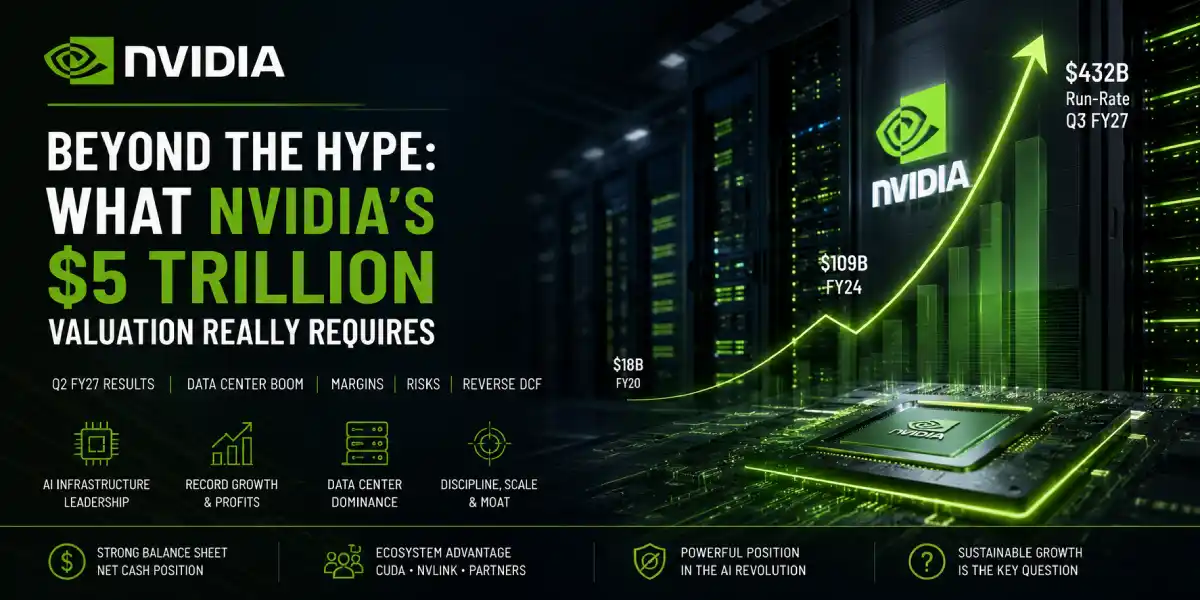
Comparing NVIDIA Q2 FY2026 with Q2 FY2027, what changed in twelve months, what the numbers say about the moat, and what could still break the thesis.
A year ago, NVIDIA reported $46.7 billion of quarterly revenue. This quarter it reported $96.2 billion.
I had to read that twice.
And to add some sauce to those numbers, management now expects approximately 70% revenue growth in FY2028 — an outlook NVIDIA says is constrained more by supply than by demand.
That last part may actually be more important than the 106% growth NVIDIA just reported. The company isn’t telling investors, “We hope demand remains strong.” It is saying that, based on what it can currently see, demand is running ahead of the infrastructure required to satisfy it.
At this scale, that’s a remarkable claim 🚀.
Not because 106% year-over-year growth is unusual for NVIDIA anymore. We have almost become numb to NVIDIA printing ridiculous growth numbers. What caught my attention is the starting point, growing 100% when you’re doing $5 billion a quarter is one thing, adding almost $50 billion of quarterly revenue in twelve months is something completely different.
So rather than looking only at whether NVIDIA beat Wall Street estimates by a few billion dollars, I wanted to compare the company with itself exactly one year ago.
The result tells a much more interesting story.
Q2 FY2026 vs Q2 FY2027
| Metric | Q2 FY26 | Q2 FY27 | Change |
|---|---|---|---|
| Revenue | $46.7B | $96.2B | +106% |
| Data Center revenue | $41.1B | $89.0B | ~+117% |
| GAAP gross margin | 72.4% | 75.0% | +2.6 pts |
| GAAP operating expenses | $5.4B | $8.4B | ~+55% |
| GAAP operating income | $28.4B | $63.7B | ~+124% |
| GAAP net income | $26.4B | $59.7B | ~+126% |
| GAAP diluted EPS | $1.08 | $2.46 | ~+128% |
| Free cash flow | $13.5B | $21.3B | ~+59% |
There is an important accounting note before going further.
NVIDIA changed parts of its reporting framework in FY2027, including the newer Data Center categories Hyperscale and AI Clouds, Industrial and Enterprise (ACIE). NVIDIA also changed its non-GAAP presentation beginning in Q1 FY2027 to include stock-based compensation. I therefore don’t want to manufacture historical comparisons for categories NVIDIA didn’t report the same way last year. Where possible, I use GAAP numbers for the year-over-year comparison, and with that out of the way, the numbers are extraordinary.
NVIDIA Didn’t Just Double Revenue
Revenue increased from: $46.7B → → → → $96.2B, that’s approximately 106% growth.
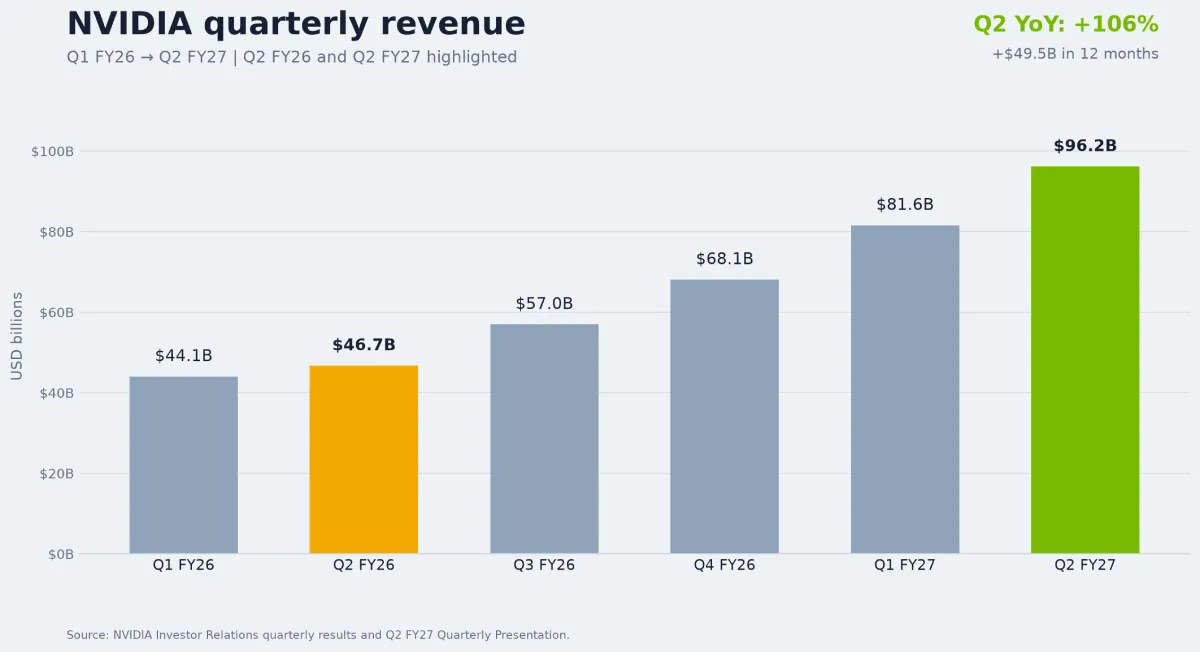
But operating income grew even faster: $28.4B → → → → $63.7B, or roughly 124% … that distinction matters.
A company can double revenue by throwing money at growth. Hire aggressively, discount products, acquire competitors, accept lower margins and worry about profitability later, in our case NVIDIA did almost the opposite.
Revenue increased 106%, operating expenses increased roughly 55%, operating income increased roughly 124%. That’s operating leverage on an enormous scale, using the reported numbers, GAAP operating margin moved from roughly: 60.8% → → → → 66.2%, now think about that for a second.
NVIDIA more than doubled quarterly revenue while becoming more profitable at the operating level, that’s not normal semiconductor economics.
The Gross Margin Number May Be Even More Important
Q2 FY2026 GAAP gross margin was: 72.4%. and Q2 FY2027: 75.0%.
Normally I would expect a hardware company growing this quickly to sacrifice something, somewhere. New products need ramping, supply chains need expanding, capacity has to be secured, new systems need to move into production, customers gain bargaining power as purchases become enormous … yet NVIDIA’s gross margin increased.
This tells me that, at least today, NVIDIA still has extraordinary pricing power, the market is not treating its products like interchangeable silicon. Customers appear willing to pay for the entire NVIDIA platform: accelerators, networking, interconnect, CPUs, software and the surrounding ecosystem.
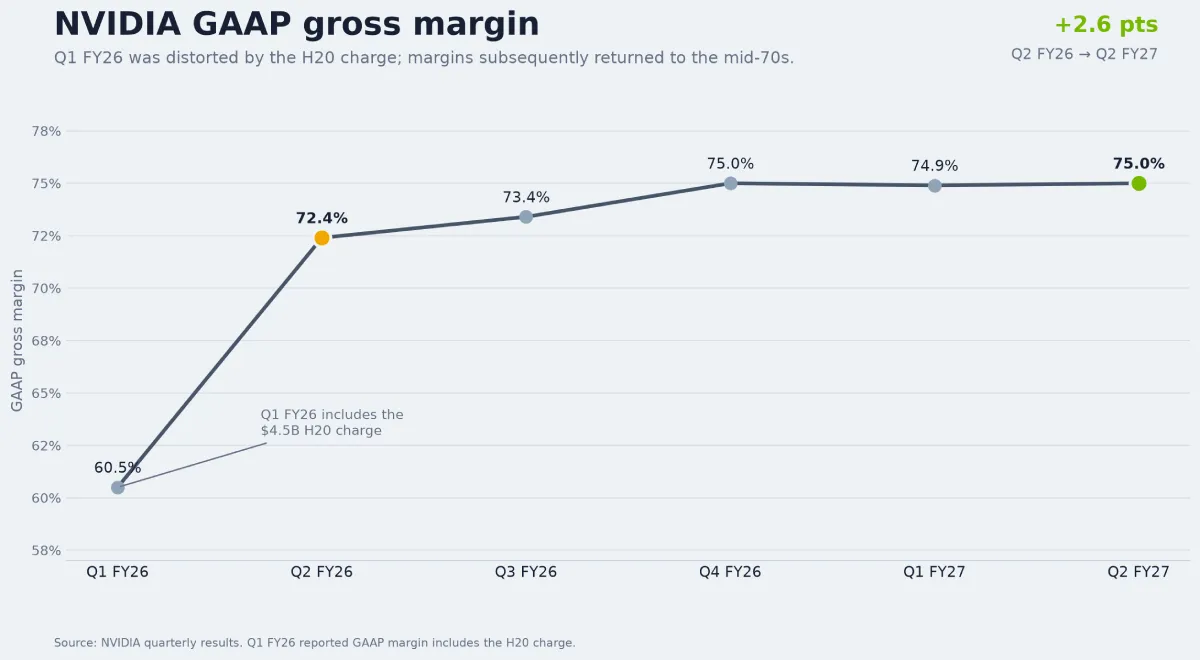
There is one number I would watch closely, though. NVIDIA guided Q3 FY2027 gross margin to approximately 74%, down around one percentage point from Q2. One quarter doesn’t concern me, but if the path eventually becomes: 75% → 74% → 72% → 70% → 67% → lower%, then something important has changed.
That would potentially tell us that competition is increasing, product mix is becoming less favorable, system costs are rising or NVIDIA’s pricing power is weakening. For a company valued on extraordinary economics, margin normalization matters enormously.
Data Center Has Become NVIDIA
The biggest transformation becomes obvious when looking at Data Center.
Q2 FY2026: $41.1B, Q2 FY2027: approximately $89.0B
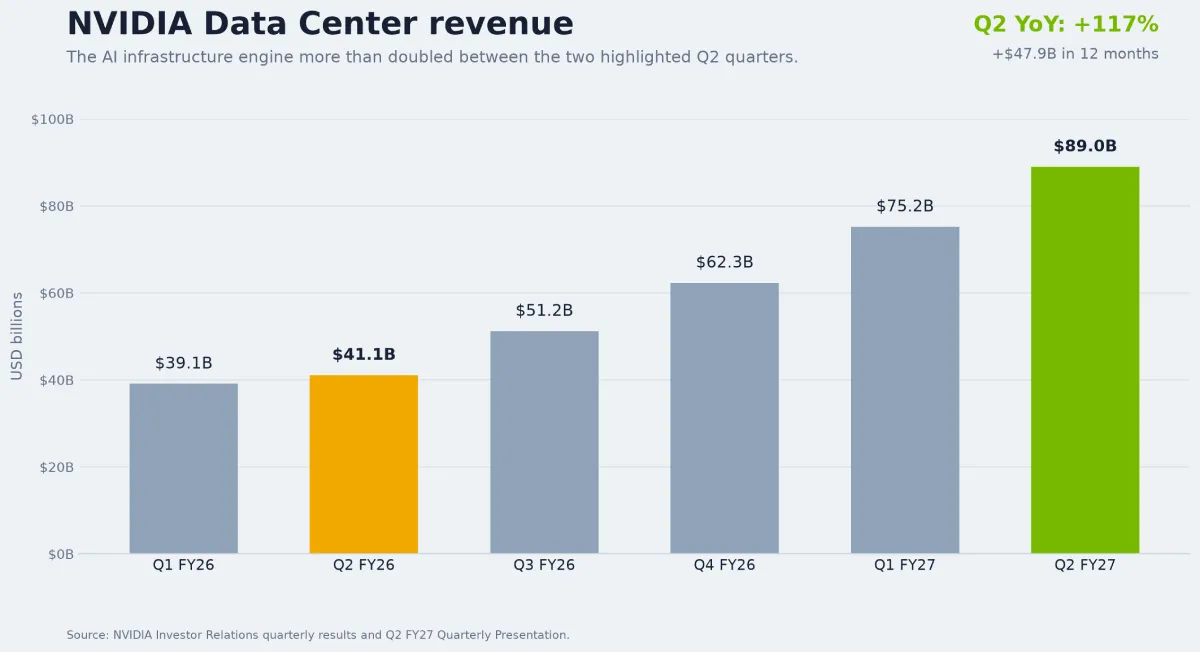
That means Data Center alone is now almost twice the size of NVIDIA’s entire company one year earlier. Even more striking, Data Center represents more than 92% of total quarterly revenue.
NVIDIA still talks about gaming, automotive, robotics, professional visualization and edge computing, and those businesses may eventually matter much more, but financially, NVIDIA today, is overwhelmingly an AI infrastructure company.
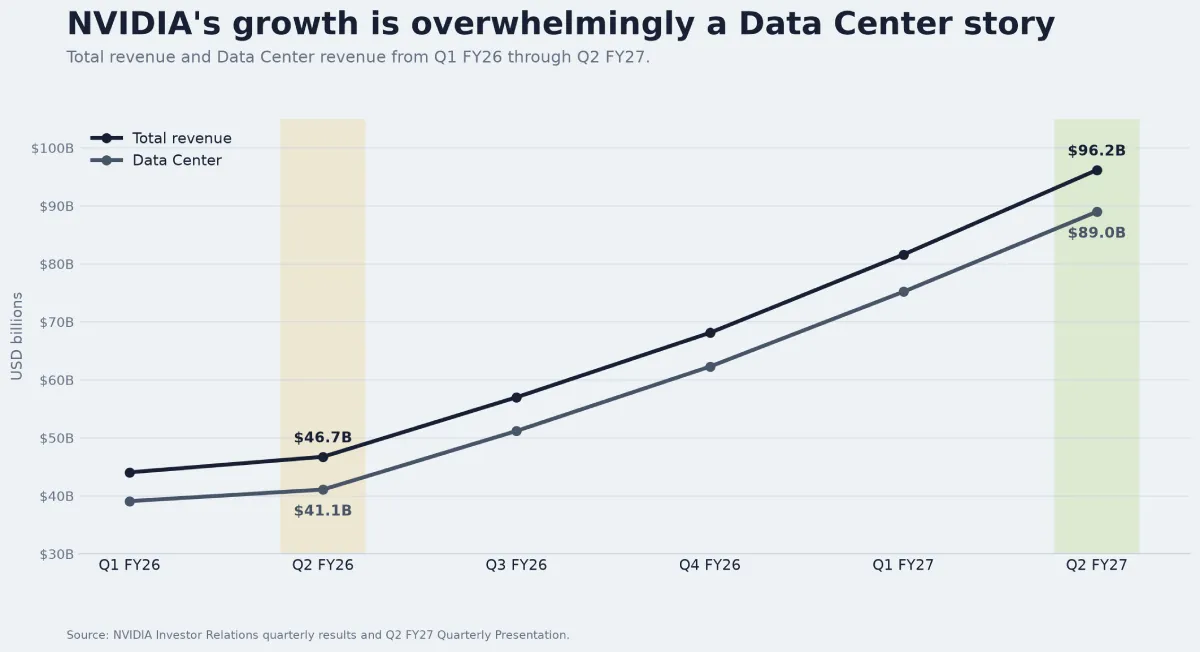
That means the investment thesis is increasingly tied to one fundamental question:
How durable is global AI infrastructure spending?
If AI infrastructure continues becoming a new computing layer, NVIDIA has positioned itself in the middle of one of the largest capital investment cycles in technology history. If those investments eventually fail to generate acceptable economic returns, the concentration works in the opposite direction.
NVIDIA Is No Longer Just Selling GPUs
This is probably the biggest change in how I think about NVIDIA, the simplistic version of the company is:
NVIDIA makes the best AI GPUs.
I think that description is becoming increasingly obsolete. NVIDIA now wants to provide the architecture of the AI factory, and that includes:
- GPUs
- CPUs
- NVLink
- networking
- switches
- optics
- storage acceleration
- CUDA
- inference software
- AI models
- security
- reference architectures
The competitive question therefore isn’t simply:
Can AMD build a GPU as fast as NVIDIA’s?
The competition is real, and it is getting broader. AMD’s Instinct MI400 family is becoming a serious alternative for large-scale AI workloads. Google continues to develop its own TPUs, while Amazon is pushing Trainium3 deeper into training and inference. Microsoft now has its own Maia 200 inference accelerator. OpenAI’s Jalapeño, developed with Broadcom, adds another serious custom-silicon effort. Meta is building its own MTIA family, and Cerebras has just introduced the CS-4, taking a radically different wafer-scale approach to AI compute.
So I don’t think NVIDIA can assume that the GPU itself will remain untouchable. There are simply too many well-funded companies attacking that part of the stack. But replacing a GPU is not the same thing as replacing the full stack.
NVIDIA’s advantage increasingly sits in the system around the accelerator: GPUs, CPUs, NVLink, networking, switches, storage acceleration, CUDA, inference software, libraries and rack-scale architectures that have been built to work together. A competitor can produce a faster or cheaper chip for a particular workload without automatically replacing everything surrounding it.
That is why I think the more important competitive question is no longer “Who can build a better GPU?” It is “Who can offer a better AI infrastructure stack?”, and that is a considerably harder problem. AMD is clearly moving in that direction with Helios, while Cerebras is attacking the same problem from a radically different direction with its CS-4 wafer-scale systems.
If customers increasingly design entire AI data centers around NVIDIA’s compute, networking, interconnect and software stack, the moat becomes much wider than CUDA alone. That’s the part of Q2 I find strategically more important than another EPS beat.
Rubin Makes the Product-Cycle Question More Interesting
NVIDIA says Vera Rubin is now in full production, with systems already running at major infrastructure partners. This matters because one of the risks I have been watching is product-transition risk, semiconductor companies can stumble when moving between generations. Customers delay purchases, old inventory becomes less attractive, manufacturing yields disappoint, supply chains need to change, the new architecture arrives late.
NVIDIA appears to be moving from Blackwell toward Rubin while quarterly revenue is still growing at an extraordinary rate. If NVIDIA can maintain something close to an annual platform cadence, competitors, in my view, face an unpleasant problem. They don’t merely have to catch the current NVIDIA product, they have to catch the product NVIDIA is already replacing.
The Storage Story Is Becoming Part of the Compute Story
Another part of NVIDIA’s strategy caught my attention: BlueField-4 STX and NVIDIA’s positioning around storage infrastructure for agentic AI. This connects to something I think will become increasingly important. AI inference, particularly agents, doesn’t just consume GPU cycles.
Agents repeatedly move data between:
- memory
- storage
- databases
- vector stores
- KV caches
- networks
- retrieval systems
- model context

As AI systems become more autonomous, data movement increasingly becomes part of the performance bottleneck. NVIDIA clearly doesn’t intend to leave all of that economic value to storage and networking vendors. It wants NVIDIA technology sitting between the data and the compute as well, and that makes the AI infrastructure investment thesis much broader than simply asking who sells the GPU.
But There Is Something I Am Watching Much More Carefully
The income statement looks fantastic. The balance sheet is becoming more interesting. Inventory has risen substantially as NVIDIA prepares for enormous future demand. Receivables have also increased rapidly alongside revenue, neither automatically means something is wrong.
If you’re doubling sales and ramping a new architecture, both should increase. But these are exactly the numbers I want to watch when everyone agrees that demand is unstoppable, because NVIDIA isn’t simply responding to demand anymore, it is making enormous commitments based on what it believes future demand will be.
That’s fine while the AI infrastructure cycle keeps accelerating, BUT it becomes painful if customers suddenly discover that the economics of AI infrastructure don’t justify the capital being deployed.
NVIDIA Is Also Becoming an Investor in Its Own Ecosystem
This is where the story gets particularly interesting, especially for everyone who has spent the last three years shouting that we’re in an AI bubble. NVIDIA increasingly invests across the AI ecosystem while also partnering with large pools of infrastructure capital. The company says it has invested nearly $50 billion in frontier AI labs and has partnered with Apollo, BlackRock, Blackstone, Brookfield, Goldman Sachs and KKR to establish financing platforms intended to raise more than $ 500 billion of third-party capital for AI infrastructure.
There are two ways to interpret this in my view.
The bullish interpretation is straightforward: the next bottleneck for AI may not be GPUs. It may be:
power + land + data centers + financing.
NVIDIA is helping remove those bottlenecks so the ecosystem can continue expanding. If demand is real and the compute generates attractive returns, that strengthens demand for NVIDIA systems and extends the company’s moat beyond the hardware itself.
But there is another side, and this is where I become much more uncomfortable.
Circular Financing Is the Question I Find Much More Uncomfortable
NVIDIA is no longer standing at one end of the transaction selling GPUs to customers that independently raise capital and build data centers. It is increasingly helping build the financial machinery that allows some of those customers to buy more compute in the first place.
The basic idea makes sense.
Some frontier AI labs have enormous demand for compute but don’t yet have the balance sheets, credit ratings or decades-long infrastructure contracts normally required to finance tens of billions of dollars of infrastructure. NVIDIA has something they don’t: an enormous balance sheet and extraordinary cash generation.
So NVIDIA can help bridge the gap and the flywheel can look something like this:
↓ NVIDIA generates enormous cash flow
↓ NVIDIA invests in AI labs and helps arrange infrastructure financing
↓ AI labs and neoclouds gain access to more capital
↓ more AI factories get built
↓ those AI factories buy NVIDIA systems
↓ NVIDIA records more revenue and cash flow
↓ NVIDIA has even more capital available to support the ecosystem
↓ “rinse” and repeat
There can be perfectly legitimate economics at every step of that chain, but you can probably see why it makes me uncomfortable.
The question isn’t whether the revenue is “fake”
I don’t think that’s the right way to look at it. NVIDIA ships real hardware. The data centers are real. The GPUs perform real computation. The AI labs have real users. And the financing platforms are intended to bring third-party institutional capital into AI infrastructure rather than simply having NVIDIA finance everything itself.
So calling the entire system “circular revenue” would be lazy, the more interesting question is:
Where does the money ultimately come from?
Imagine an AI company raises $20 billion, it spends a large part of that money renting compute. The cloud or neocloud provider uses that demand to finance another data center. That data center purchases NVIDIA infrastructure. NVIDIA then invests in the AI company, supports another infrastructure project or helps create financing that allows the next data center to be built, nothing necessarily improper happened. But the same pool of capital has now touched several companies in the ecosystem and generated economic activity at several points along the way.
That means gross AI infrastructure spending becomes less useful as evidence of independent final demand.
What I ultimately want to know is whether customers outside this financing loop are generating enough economic value from AI to support everything sitting above them.
Are enterprises paying enough for AI products?
Are consumers paying for subscriptions?
Are advertisers generating better returns?
Are coding agents improving developer productivity enough to justify their cost?
Are AI-native companies eventually producing sustainable cash flows?
Because somebody, somewhere, eventually has to generate the cash that services the debt and produces a return on all this infrastructure.
And NVIDIA just gave us a number worth watching
This is where the issue stops being purely theoretical. During the Q2 earnings call, management said demand from AI labs for which NVIDIA expects to leverage its balance sheet could contribute roughly one-quarter of its business next year. That does not mean 25% of NVIDIA’s revenue is circular, it does not mean NVIDIA is simply lending customers money and immediately booking it back as revenue and it certainly doesn’t prove those customers aren’t economically viable.
But it tells me the relationship between NVIDIA’s balance sheet and the customers buying its infrastructure is now large enough that I want to track it explicitly. For me, that belongs on the NVIDIA dashboard every quarter.
There is a very strong bullish interpretation
NVIDIA may simply have found another bottleneck. First the bottleneck was GPUs, then advanced packaging, then networking, then power (ongoing) … now, for some customers, the bottleneck is capital.
If NVIDIA compute really is fungible across customers and workloads, AI infrastructure could increasingly be financed like other productive infrastructure.
Institutional capital finances the asset, customers rent the compute, the infrastructure generates recurring revenue.
NVIDIA sells the systems and may participate economically in the infrastructure surrounding them.
If AI demand continues exploding, NVIDIA hasn’t manufactured demand. It has removed another constraint preventing that demand from being satisfied and alone, would be an extraordinary extension of the moat.
But there is also a bear case I don’t want to ignore
Now imagine the opposite.
AI labs continue spending aggressively but their own revenue doesn’t grow fast enough, they need another equity round, which means more debt, then infrastructure financing, then guarantees or other forms of credit support.
AI factories continue getting built because capital remains available, those factories keep purchasing GPUs.
NVIDIA’s revenue can therefore continue looking fantastic even while the financial health of some ultimate compute buyers is deteriorating.
Eventually the financing becomes harder, and if that happens, NVIDIA may not simply face fewer GPU orders.
The chain could reverse:
↓ hardware demand slows
↓ AI infrastructure utilization weakens
↓ financed customers become weaker credits
↓ NVIDIA-backed investments lose value
↓ guarantees and commitments matter more
↓ inventory and supply commitments become harder to absorb
↓ gross margins come under pressure
↓ the valuation multiple contracts
That is a much more interesting NVIDIA bear case to me than:
AMD, Cerebras, OpenAI etc. builds a faster chip.
NVIDIA is becoming more powerful and more complicated
NVIDIA increasingly sits in the middle of the system as:
supplier → platform provider → investor → ecosystem builder → infrastructure enabler → financial backstop
That is incredibly powerful, but every additional role creates another connection between NVIDIA’s own financial strength and the growth of the ecosystem buying its products. The deeper those connections become, the more I want to separate organic end-demand from financing-enabled demand.
And this is where I think the “AI bubble” argument becomes much more interesting.
The question isn’t:
Are companies spending ridiculous amounts of money on AI?
Obviously they are … it’s a confirmed fact, actually.
The question is:
Does the economic value eventually created by AI justify the capital structure being built underneath it?
If the answer is yes, today’s spending may look much less crazy five years from now.
If the answer is no, circular financing won’t necessarily have caused the problem. It may simply have been one of the mechanisms that allowed the infrastructure cycle to run much further before the economics were finally tested.
Q3 Guidance Might Be the Most Impressive Number
After reporting $96.2B of Q2 revenue, NVIDIA guided Q3 FY2027 revenue to a whopping $108B ±2%, and the guide assumes no Data Center compute revenue from China.
Look at the progression:
| Quarter | Revenue |
|---|---|
| Q2 FY26 | $46.7B |
| Q4 FY26 | ~$68.1B |
| Q1 FY27 | ~$81.6B |
| Q2 FY27 | $96.2B |
| Q3 FY27 (guide) | $108B |
This is where the law-of-large-numbers argument keeps getting uncomfortable, the base is getting enormous. But NVIDIA continues adding billions of dollars of incremental quarterly revenue. If NVIDIA hits the Q3 midpoint, it will be operating at an annualized revenue run-rate of approximately: $432 billion., that’s where valuation becomes interesting, have created nvidia_q1fy26_to_q2fy27_charts.py to genereate some visualizations which had been used in this article.
What Does a ~$5 Trillion Valuation Actually Require?
Rather than saying NVIDIA is “expensive” because the market capitalization is huge, I prefer turning the valuation around. What must NVIDIA actually become for today’s valuation to make sense?
Using roughly the Q3 revenue run-rate of $432B, a simple five-year reverse DCF produces an interesting result.
At approximately a 50% sustainable free-cash-flow margin, a ~$5 trillion enterprise valuation requires something around high-single-digit annual revenue growth over the next five years under reasonable-but-still-demanding discount and terminal assumptions.
In rough terms, that means something like: $432B → ~$650B annual revenue over five years while preserving extraordinary cash generation and that surprised me. I expected the reverse DCF to say NVIDIA needs ridiculous revenue growth forever. It doesn’t, the more important assumption is margins.
The market doesn’t necessarily require NVIDIA to grow 50% forever, it requires NVIDIA to avoid becoming a normal semiconductor company, and that’s a very different bet.
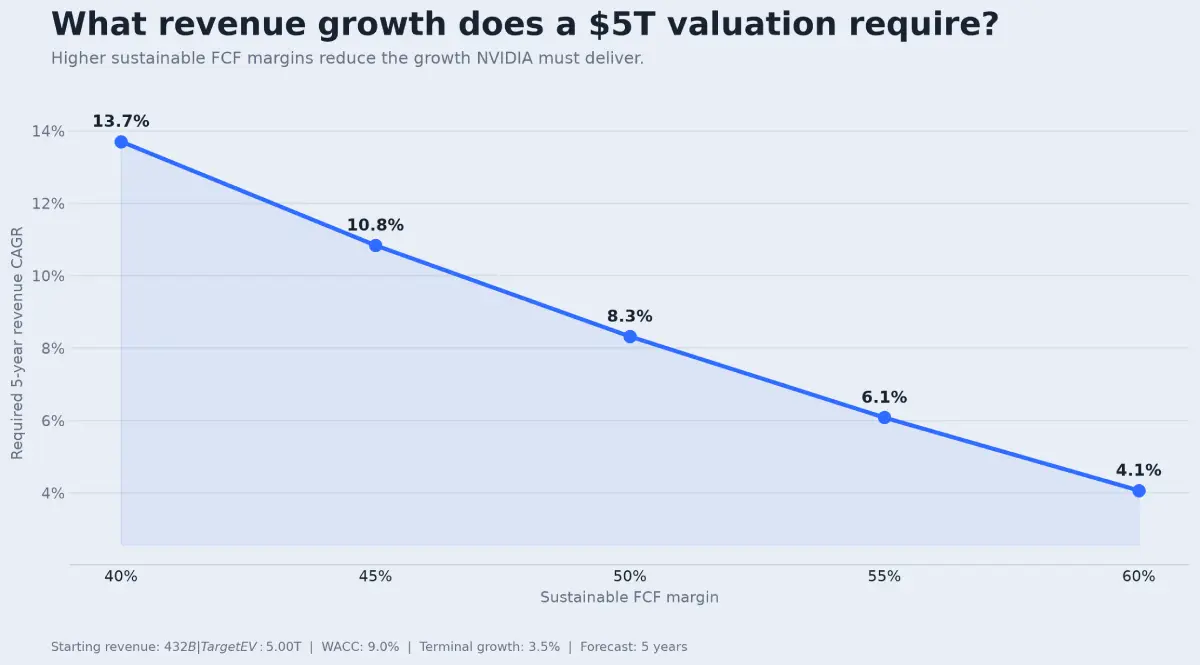
This is why I think NVIDIA’s margins matter more than the headline growth rate. If the company can preserve something close to today’s cash-generation economics, the growth embedded in the valuation is demanding, but not ridiculous.
The Real Question Is the FCF Margin
Suppose NVIDIA continues growing but competition eventually normalizes the economics. If sustainable FCF margins remain around 50%, today’s valuation becomes much easier to defend, if they eventually fall toward 35–40%, the calculation changes dramatically.
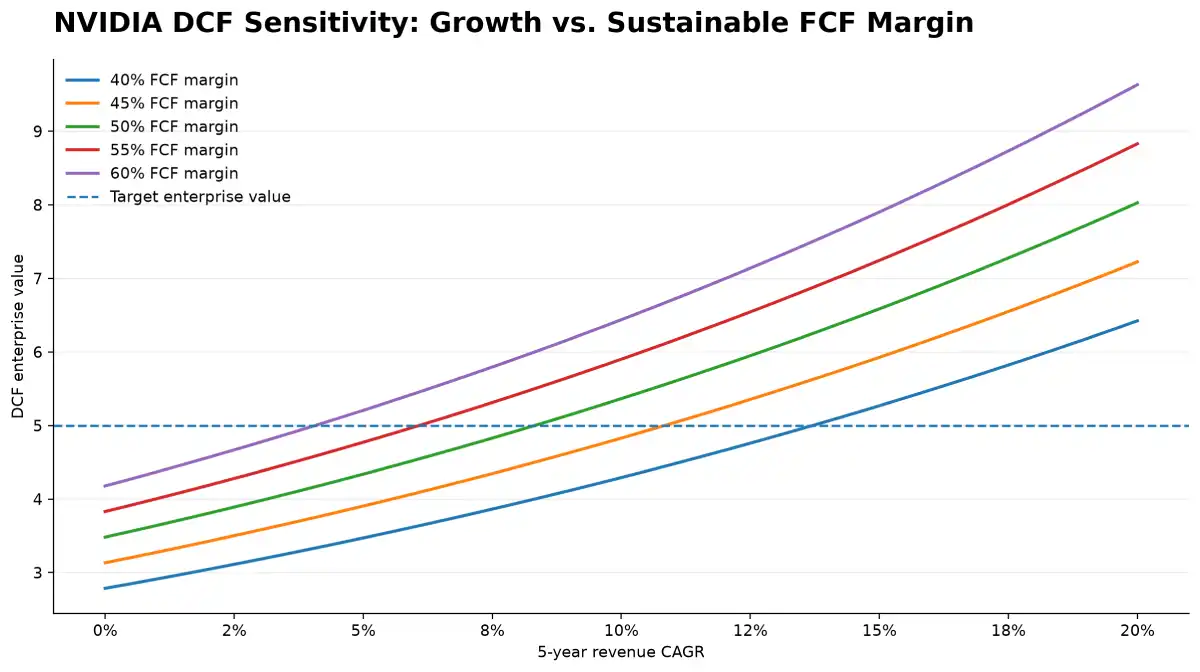
That’s why I increasingly think NVIDIA investors should spend less time obsessing over quarterly EPS beats and more time watching:
- gross margin
- normalized FCF margin
- Data Center sequential growth
- inventory relative to revenue
- receivables relative to revenue
- hyperscaler versus broader AI infrastructure demand
- customer financing
- custom silicon adoption
- Rubin execution
Those numbers tell us whether NVIDIA’s extraordinary economics are durable… or, not!
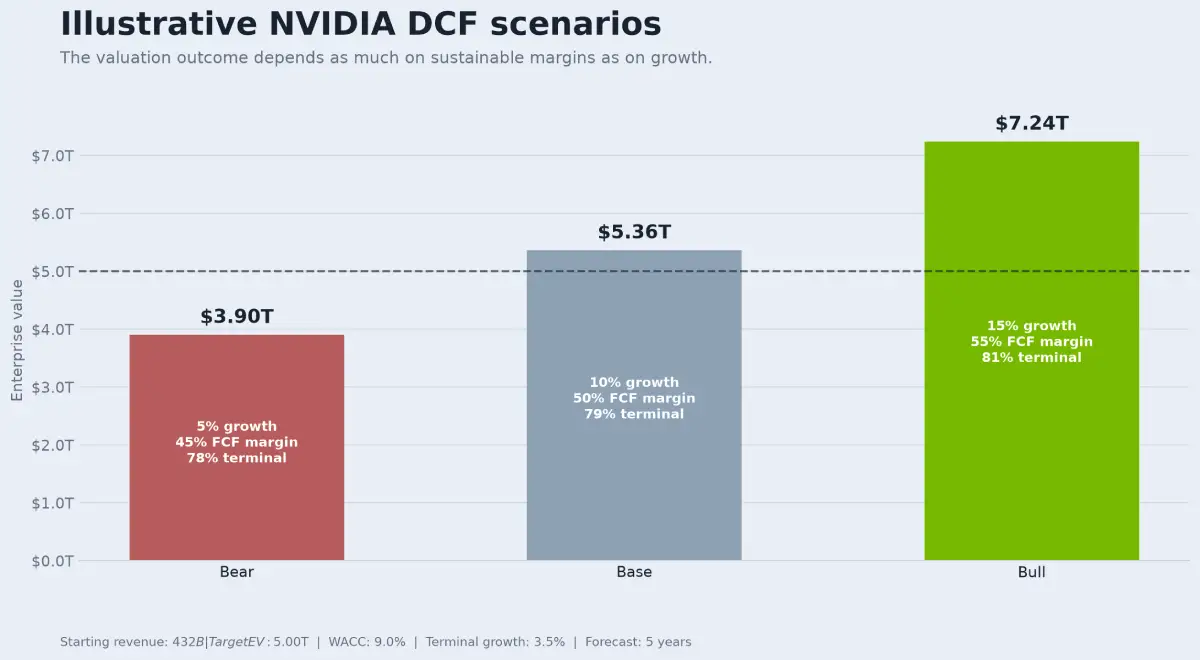
The Bear Case Isn’t “‘Someone else’ Builds a Faster GPU”
I don’t think that’s the strongest bear case anymore, the more serious bear case is this:
AI infrastructure investment grows faster than the economic value generated by AI.
Then:
↓ AI capex explodes
↓ data-center capacity grows faster than profitable AI demand
↓ utilization and returns disappoint
↓ AI labs and neoclouds face financing pressure
↓ hyperscalers slow capex growth
↓ NVIDIA orders normalize
↓ inventory and supply commitments become exposed
↓ pricing power weakens
↓ gross margins fall
↓ operating leverage reverses
↓ earnings decline much faster than revenue
↓ the valuation multiple contracts at exactly the same time.
That is the NVIDIA bear case I take seriously, not whether ‘Someone else’ wins one benchmark.
I Don’t Want an Earnings Spreadsheet Anymore
After looking at Q2, I realized that simply comparing revenue, EPS and guidance every three months isn’t enough for NVIDIA case anymore. The numbers I want to track are the ones that could tell me the thesis is deteriorating before that deterioration becomes obvious in revenue.
So from this quarter onward, I’m building a small NVIDIA thesis dashboard, not thirty numbers that all deserve equal attention, actually five groups of indicators answering five different questions, please see below:
1. Is AI demand still expanding?
| Indicator | What I’m watching | Warning sign |
|---|---|---|
| Data Center revenue | QoQ and YoY growth | 2–3 quarters of flat or negative sequential growth |
| Hyperscale vs ACIE | Whether growth is broadening beyond hyperscalers | ACIE weakens while hyperscalers increasingly carry growth |
| Networking | Growth relative to compute | Compute grows while networking materially lags |
| Hyperscaler AI capex | Microsoft, Amazon, Google and Meta capex/guidance | Customer capex begins diverging from NVIDIA’s growth assumptions |
| AI demand elasticity | Tokens, inference volumes and agent workloads | Usage fails to compensate for falling compute cost per task |
2. Is NVIDIA still keeping the economics?
| Indicator | What I’m watching | Warning sign |
|---|---|---|
| GAAP gross margin | Pricing power and product economics | Sustained movement toward or below ~70% |
| Normalized FCF margin | Cash actually generated from revenue | Sustained movement toward 35–40% |
| Operating margin | Operating leverage | Revenue grows while operating margin consistently contracts |
| Buybacks vs SBC | Actual per-share capital return | Buybacks mainly offset dilution |
| Reverse DCF | What the new share price requires | Required growth/margins move increasingly beyond operating reality |
3. Is supply being built faster than demand?
| Indicator | What I’m watching | Warning sign |
|---|---|---|
| Inventory | Growth relative to revenue | Inventory repeatedly outgrows revenue |
| Receivables / DSO | Revenue quality | Receivables materially outrun sales |
| Supply commitments | NVIDIA’s forward capacity bet | Commitments remain huge while growth slows |
| Cloud commitments | NVIDIA’s own compute obligations | Commitments rise much faster than internal requirements |
| Rubin cadence | Production, deployment and adoption | Delays, yield problems or customer deferrals |
4. How circular is the financing becoming?
This is the section I’m going to watch most carefully.
| Indicator | What I’m watching | Warning sign |
|---|---|---|
| AI-lab investments | New investment plus cumulative exposure | Exposure grows materially faster than NVIDIA’s FCF |
| Infrastructure financing | Funds, JVs and financing platforms | Financing grows faster than independent end-demand |
| Credit enhancement / guarantees | NVIDIA’s actual downside exposure | NVIDIA increasingly assumes customer credit risk |
| Revenue tied to supported customers | Revenue from labs/neoclouds using NVIDIA-supported structures | The percentage keeps rising |
| Neocloud economics | Utilization, leverage, FCF and capex | Debt rises while utilization or FCF deteriorates |
| AI-lab economics | Revenue, cash burn and funding requirements | Compute spending persistently outruns monetization |
And the question sitting above all six is:
Where does the cash ultimately come from?
If the answer increasingly becomes enterprise customers and consumers paying for productive AI, I’m comfortable.
If the answer increasingly becomes the next financing round, I become much less comfortable.
5. Is the moat actually weakening?
| Indicator | What I’m watching | Warning sign |
|---|---|---|
| Custom silicon | TPU, Trainium, Maia, MTIA, OpenAI/Broadcom and others | ASICs capture a meaningful share of incremental AI workloads |
| AMD / Cerebras alternatives | Actual deployments, not benchmarks | Major customers materially diversify away from NVIDIA |
| Product cadence | Rubin and the generations after it | NVIDIA loses its rapid platform cadence |
| China | Restrictions and domestic alternatives | The lost market becomes a durable competing ecosystem |
| Full-stack attach | Networking, CPUs, storage acceleration and software | Customers increasingly buy compute without the surrounding NVIDIA stack |
I don’t expect all of these indicators to flash red at the same time, that’s exactly the point. If the thesis eventually breaks, I want to see where it starts breaking first, revenue is a lagging indicator. By the time NVIDIA reports declining Data Center revenue, the underlying problem may have been visible for several quarters in margins, inventories, customer financing, utilization or capex behavior.
That is what I want this dashboard to catch, and every quarter, I can come back to the same question:
What changed, not just in NVIDIA’s numbers, but in the assumptions that make me willing to own the business?
One Year Changed the Scale of the Question
Q2 FY2026 already looked extraordinary, NVIDIA had $46.7B of quarterly revenue and more than $41B of Data Center sales. Twelve months later, those numbers almost look small, revenue is now $96.2B, Data Center is around $89B, Operating income is $63.7B, and management is guiding toward $108B next quarter.
The easy conclusion would be:
NVIDIA is an incredible company.
I don’t think that tells us much anymore then we already know, so the more useful question would be:
What has to remain true for NVIDIA to justify what investors are paying for it?
My answer after Q2 FY2027 is becoming clearer, NVIDIA does not need 100% growth forever. It does need AI infrastructure spending to remain enormous, it needs its platform advantage to survive custom silicon and competing accelerators.
And perhaps most importantly, it needs today’s extraordinary margins to remain much closer to platform-company economics than ordinary semiconductor economics, that’s the part of the NVIDIA story I’m watching now.
Because at this scale, the question is no longer whether NVIDIA can sell more GPUs, it’s whether NVIDIA can remain the economic center of the AI infrastructure stack.
Tools:
nvidia_q1fy26_to_q2fy27_charts.py +
nvidia_reverse_dcf.py >>>
the numbers behind the charts and valuation work in this article.
Companion code: nvidia_q1fy26_to_q2fy27_charts.py tracks NVIDIA’s quarterly revenue, Data Center revenue and gross
margins from Q1 FY2026 through Q2 FY2027 and renders the comparison charts used above.
nvidia_reverse_dcf.py turns the valuation question around: starting from NVIDIA’s revenue run-rate and enterprise
value, it tests different revenue-growth, sustainable FCF-margin, WACC and terminal-growth assumptions, generates the
sensitivity and bear/base/bull scenarios, and solves for what today’s valuation actually requires.
The assumptions are deliberately exposed at the top of the scripts so they can be changed rather than treated as facts. The DCF is a model, not a prediction. Source financial data comes from NVIDIA’s published earnings materials.
Sources
NVIDIA investor room - NVIDIA, Q2 FY2027 Quarterly Presentation, August 26, 2026. - NVIDIA, Q2 FY2026 CFO Commentary, August 27, 2025. - NVIDIA Investor Relations, quarterly financial reports and earnings materials. - NVIDIA SEC filings for the corresponding fiscal periods. - NVIDIA, Q2 FY2027 earnings call, including management’s discussion of frontier AI labs, balance-sheet support and circular-financing concerns. - NVIDIA, AI Compute Infrastructure Financing Platforms, including the partnerships intended to mobilize more than $500 billion of third-party capital.
This article is my own research and interpretation of publicly available information. It is not investment advice. Past performance and model outputs are not promises. This is education, not investment advice — I’m a student of this, learning in public.
Comments
0