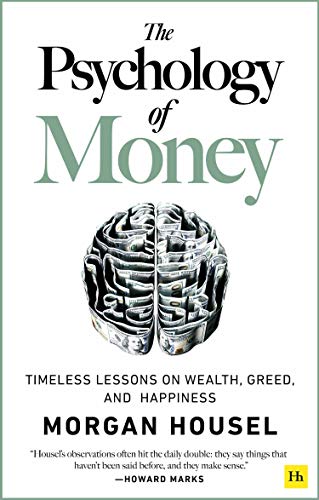
The Big Idea
The central idea of this book is deceptively simple: doing well with money has less to do with what you know and more to do with how you behave. This book has a lot to say, thus I have a lot of angles to cover. Prepare for a detailed opinion as I liked what I read.
You can understand financial markets, build sophisticated valuation models, study economics, and have access to more information than most investors. None of that guarantees that you will make good financial decisions when fear, greed, ego, or uncertainty enter the equation.
Unlike engineering, where a problem can often be broken down into measurable variables and solved systematically, financial decisions are shaped by personal experiences, emotions, expectations, and circumstances that rarely fit neatly into a spreadsheet.
Through 20 short chapters, Morgan Housel explores the relationship between money and human behavior, using historical events, personal stories, and financial examples to explain why some people build and preserve wealth while others, despite having intelligence, opportunities, and resources, fail to do so.
https://www.youtube.com/@Morgan-Housel
For someone interested in investing, trading, and understanding how financial markets work, this matters because having an intellectual advantage is not the same as having a behavioral advantage.
And sometimes, the second one matters considerably more.
Why I Picked This Book
I discovered The Psychology of Money through LinkedIn, where several people I followed recommended it at different points in time. Eventually, curiosity won, and I decided to give it a try.
As always, I also spent some time reading the reviews on Goodreads. The overwhelmingly positive reception made me curious about what differentiated this book from the hundreds of others covering personal finance and investing.
I am particularly interested in understanding not only how financial markets work, but also why people behave the way they do within them.
Why do intelligent people make irrational financial decisions? Why do investors abandon a strategy they spent months developing after a few weeks of poor performance? Why do we compare our financial progress with people whose circumstances, objectives, and risk tolerance are completely different from ours?
And perhaps most importantly, why is it so difficult to do nothing when doing nothing might be the most appropriate decision?
These are questions that cannot always be answered through financial models, historical data, or technical analysis.
Housel approaches them from a different direction, and that is what made the book interesting to me.
If you are looking for a book that will teach you how to value a company, identify a trading opportunity, construct a portfolio, or gain a measurable edge in the market, this is not that book.
But if you want to understand some of the reasons why you might fail even after learning all those things, it is certainly worth your time.
The Ideas That Resonated With Me
1. No One Is Crazy
One of the most interesting ideas appears right at the beginning of the book: people make financial decisions based on their own experiences.
Someone who grew up during the inflationary environment of the 1970s has a fundamentally different understanding of money from someone who entered the financial markets during the bull market of the 2010s.
Someone who experienced unemployment, economic collapse, or financial insecurity might perceive risk very differently from someone who grew up in a financially stable household.
Neither is necessarily irrational. They simply learned different lessons from different versions of the world.
Our personal experience represents only a tiny fraction of everything that has happened throughout economic history, yet it has an enormous influence on how we believe the world works.
I find this particularly relevant when discussing investing with other people. Two individuals can look at exactly the same company, the same financial statements, and the same economic environment and reach completely different conclusions.
Sometimes the disagreement is not about the numbers it is about the experiences each person brings to those numbers.
Understanding this does not mean accepting every financial decision as reasonable. It means recognizing that what appears irrational from our perspective might make perfect sense from someone else’s.
2. Luck and Risk: Two Sides of the Same Coin
We like to attribute success to intelligence, discipline, and hard work. When it comes to failure, however, we are often much quicker to identify incompetence, poor judgment, or a lack of effort (reading this chapter, I immediately recalled Daniel Kahneman’s Thinking, Fast and Slow, where he explores our tendency to construct coherent explanations for past events while systematically underestimating the role of luck).
Reality is considerably more complicated.
Housel illustrates this through the story of Bill Gates and Kent Evans. Gates attended one of the relatively few schools in the world where students had access to a computer at the time. His friend Kent Evans, another exceptionally talented young man, died in a mountaineering accident before graduating.
Two people with enormous potential, exposed to circumstances beyond their control, experienced radically different outcomes. This does not diminish what Bill Gates accomplished. It simply acknowledges that individual effort is never the only variable determining the outcome and the same applies to investing.
A profitable trade does not necessarily mean it was a good trade. A losing trade does not necessarily mean it was a bad one.
The quality of a decision and the quality of its outcome are two different things.
This distinction is particularly important because financial markets provide us with immediate feedback in the form of profit and loss, but that feedback does not always tell us whether our reasoning was correct.
A bad process can produce excellent results for a while. A good process can produce disappointing results for equally long periods. The lesson I take from this chapter is to spend more time evaluating the process behind an outcome and less time judging the outcome in isolation.
Be humble about your successes and careful about drawing conclusions from other people’s failures.
3. Compounding: The Eighth Wonder of the World
Housel uses Warren Buffett as an example, as almost everyone writing about investing eventually does.
At the time of writing the book, Housel calculated that $81.5 billion of Buffett’s $84.5 billion fortune had been accumulated after his 65th birthday. These are historical figures, but the underlying lesson remains relevant.
Buffett’s extraordinary wealth is not only a consequence of his investing ability. It is also a consequence of how long he has been investing. Compounding is mathematically simple but psychologically difficult to appreciate.
Our intuition tends to be linear. We expect effort and results to have a relatively predictable relationship. Exponential growth does not behave that way. For a long time, the results might appear insignificant. Eventually, the accumulated growth becomes larger than the original contributions themselves.
The problem is that many people abandon the process before reaching that point. We get impatient, change strategies, chase higher returns, compare ourselves with others, or convince ourselves that something else must work better.
The challenge is not merely understanding compounding. It is developing the patience and financial resilience necessary to benefit from it.
I have explored this idea separately in my own article, The Eighth Wonder: How Compounding Builds Wealth Slowly, because I believe it is one of the most underestimated concepts in personal finance.
Compounding needs time, but it also needs survival.
Without the second, the first becomes irrelevant.
4. Getting Wealthy and Staying Wealthy Are Different Skills
Building wealth often requires optimism, risk-taking, ambition, and a willingness to expose yourself to uncertainty.
Preserving wealth requires a somewhat different temperament: humility, discipline, caution, and an awareness of how quickly circumstances can change.
Housel uses the story of Jesse Livermore, one of history’s most famous traders, to illustrate this distinction.
Livermore accumulated an enormous fortune during his trading career, only to eventually lose it. The ability to make money did not automatically give him the ability to keep them. I find this distinction particularly interesting because the very characteristics that help someone achieve financial success can eventually become the source of their failure.
Confidence becomes overconfidence > Risk-taking becomes excessive risk-taking > Ambition becomes an inability to recognize when enough is enough.
Success can reinforce the belief that we understand more than we actually do.
The ideal financial temperament, according to Housel, combines optimism about the long-term future with caution about anything that could prevent us from reaching it. You can believe that the world will progress while simultaneously acknowledging that your own financial position is vulnerable and there is no contradiction between the two.
5. Tails Drive Everything
One of the more interesting observations in the book is that a relatively small number of events can account for a disproportionately large share of the results. This is visible across investing, entrepreneurship, technology, and many other areas of life.
A venture capital portfolio might contain dozens of unsuccessful investments, while one extraordinary company generates most of its returns. A stock market index might contain hundreds of companies, while a relatively small group accounts for a significant portion of its performance over a particular period.
An investor does not necessarily need to be right all the time to achieve good results.
What matters is the relationship between the magnitude of the gains, the magnitude of the losses, and the probability of each outcome.
For traders, this should sound familiar. A high win rate does not automatically make a strategy profitable, just as a low win rate does not automatically make it unprofitable.
However, there is another question here that I would have liked Housel to explore in greater depth.
If a small number of exceptional outcomes drive most of the returns, should an investor own the entire market to increase the probability of capturing those outcomes, or should they attempt to identify the exceptional opportunities and concentrate their capital accordingly?
There are valid arguments for both approaches, but they require fundamentally different assumptions about skill, uncertainty, diversification, and risk. Housel favors broad market exposure. I understand the reasoning, particularly given the difficulty of identifying exceptional companies in advance, but I would have enjoyed a deeper exploration of this trade-off from his side.
6. Room for Error: Plan for Your Plan Not Going to Plan
If I had to choose the most important chapter in the entire book, this would probably be it.
We tend to build financial plans based on what we expect to happen. Expected income, expected expenses, expected returns, expected inflation, expected retirement age. Everything looks beautiful in a spreadsheet until reality decides to introduce a variable we did not account for.
Housel’s argument is that room for error is not a sign of poor planning. It is an acknowledgment that the future is inherently uncertain. You cannot predict every possible outcome, but you can prepare yourself to withstand a broader range of outcomes.
This applies to emergency savings, portfolio diversification, debt, position sizing, leverage, and almost every other aspect of financial decision-making. For me, this principle extends well beyond finance.
Coming from a technical background, I see a clear parallel with system architecture. We design systems with redundancy, spare capacity, and failover mechanisms precisely because we know that components will fail, even if we do not know exactly when or how.
We do not design critical infrastructure under the assumption that everything will work perfectly so why should we approach our personal finances differently?
Having spare capacity might appear inefficient when everything is going well. Its value becomes apparent precisely when things stop going according to plan.
A financial strategy should not be evaluated only by how much it can make under favorable conditions, but also by whether it can survive unfavorable ones.
7. Wealth Is What You Don’t See
Housel makes an important distinction between being rich and being wealthy. Being rich is often visible through income, expensive cars, luxury holidays, or impressive houses. Wealth is considerably less visible. It consists of financial assets, savings, investments, and resources that have not been converted into consumption.
The story of Ronald Read, a janitor who accumulated an estate worth approximately $8 million, illustrates this beautifully. What makes his story remarkable is the contrast between how society might have perceived his financial position and what his actual financial position was.
We often evaluate other people’s wealth based on what they spend, even though spending tells us very little about their net worth. An expensive car tells me that someone has acquired an expensive car. It tells me nothing about their savings, investments, debt, or financial independence.
This connects nicely with another chapter in the book, The Man in the Car Paradox. When we see someone driving an impressive car, we rarely spend much time admiring the person driving it. More often, we imagine ourselves driving that car.
Yet people frequently purchase these things hoping to receive the admiration that they themselves rarely give to others.
Quite an interesting paradox, isn’t it?
There is absolutely nothing wrong with spending money on things you genuinely enjoy. The problem begins when consumption becomes a way of purchasing other people’s approval.
8. Freedom: The Ultimate Dividend
One of Housel’s most compelling ideas is that the highest dividend money can pay is control over your time. The ability to decide what you do, when you do it, and with whom you spend your time. This changes the way we think about wealth accumulation.
If the ultimate objective is simply to have more money, there is no natural finish line. There will always be someone wealthier, another investment opportunity, another financial milestone, or another possibility to earn more.
But if money is a tool for creating freedom, the objective becomes considerably more personal.
Having enough financial flexibility to decline a project, spend more time with the people you care about, pursue an interest, travel, or simply take a break without worrying about the financial consequences has a value that is difficult to capture in a spreadsheet.
This does not mean that everyone should aspire to retire early or stop working. Freedom can also mean having the ability to choose the work you do instead of being forced to accept whatever work pays the bills.
Money is a means to an end. The personal question is whether we have actually defined what that end is.
9. The Seduction of Pessimism
Pessimism often sounds more intelligent than optimism.
Someone predicting an economic collapse appears cautious, analytical, and sophisticated. Someone arguing that the world will continue to improve over the next several decades can easily be dismissed as naive.
While reading this chapter, again I immediately thought about Daniel Kahneman’s Thinking, Fast and Slow. Kahneman explores loss aversion, our tendency to experience losses more intensely than equivalent gains, and the various psychological mechanisms that influence how we perceive threats, uncertainty, and opportunities.
There is an interesting connection between the two books. Negative information demands our attention. Potential threats feel urgent. Positive developments, particularly those that happen gradually, are much easier to overlook.
A financial market can lose a substantial percentage of its value in a matter of days. The economic progress that eventually supports its recovery might take years. One generates headlines, the other rarely does. This creates a distorted perception of reality, especially in an environment where social media, financial commentators, and news organizations compete for our attention.
Housel is not arguing that we should ignore risks or blindly assume that everything will work out. Rather, he encourages us to distinguish between short-term setbacks and long-term progress. I would describe this as informed optimism: recognizing the potential for progress without underestimating the uncertainty involved in getting there.
10. Understand Which Game You Are Playing
This is probably one of the most underrated chapters in the entire book, particularly for anyone involved in financial markets. A day trader, a long-term investor, a pension fund, a market maker, and a hedge fund can all purchase the same security at the same price while having completely different objectives.
What represents an attractive price for one participant might be completely irrelevant to another.
Their time horizons, liquidity requirements, risk tolerance, portfolio construction, and reasons for entering or exiting a position are fundamentally different. Yet we constantly take financial cues from people whose game we do not understand. We see someone posting extraordinary returns on social media and immediately begin wondering whether we should adopt their strategy. What we rarely see is the risk they took, their previous losses, their leverage, the size of their overall portfolio, or whether those returns are sustainable.
We look at the scoreboard without understanding the rules of the game.
As someone interested in both trading and long-term investing, I find this distinction particularly important. The same company can represent an attractive long-term investment and a poor short-term trading opportunity, or vice versa. There is no contradiction there.
The problem begins when we enter a position with one objective and start managing it according to another.
A failed short-term trade does not become a long-term investment simply because we are unwilling to recognize a loss. Before entering any financial position, it is worth understanding not only what we are buying, but also why we are buying it, what would invalidate our reasoning, and which game we are actually playing.
What I Can Actually Apply
What I appreciate about this book is that its lessons are not necessarily complicated to understand. The difficulty lies in applying them consistently.
These are the principles I would take from it:
- Evaluate decisions separately from outcomes. A profitable outcome does not automatically validate the process that produced it.
- Leave room for error. Financial plans should accommodate uncertainty rather than depend on everything working perfectly.
- Give compounding enough time. Constantly changing strategies can interrupt the very process we are trying to benefit from.
- Separate investing from trading. Different objectives require different processes, expectations, and risk management frameworks.
- Recognize the influence of emotions. Fear, greed, envy, and overconfidence are variables in financial decision-making, even when they do not appear in our models.
- Understand what enough means. Without some definition of enough, financial success can become an endless competition.
- Protect the ability to continue. No individual financial opportunity should be more important than the ability to participate in future opportunities.
None of these principles will tell me which stock to buy tomorrow. But they might help me avoid making a decision tomorrow that compromises everything I am trying to accomplish over the next 3-5+ years, and that is a different kind of value.
What This Book Means for Me as an Investor and Trader
I think the book is considerably more challenging for active investors and traders than it initially appears.
It is very easy to read about patience, humility, risk management, and the importance of survival, agree with every chapter, and then return to the market behaving exactly as before. There is a difference between intellectually agreeing with a principle and building it into your decision-making process.
Consider leverage.
Leverage does not simply amplify potential returns and losses. Depending on the instrument and financing arrangements, it can transform temporary volatility into permanent capital loss through forced liquidation. You can be fundamentally correct about an investment and still lose money because your financial structure does not allow you to wait long enough for your thesis to materialize. Being right eventually is not particularly useful if you cannot survive until eventually arrives. This is why position sizing, liquidity, exposure, and risk management deserve at least as much attention as identifying opportunities.
Another important aspect is the distinction between a repeatable process and a favorable outcome.
Financial markets are noisy environments. Individual results contain a combination of skill, randomness, market conditions, and circumstances outside our control. Without a documented process and a sufficiently large sample of decisions, it is difficult to distinguish between an actual edge and a favorable sequence of random events.
This is where I think Housel’s philosophy connects particularly well with systematic investing and trading.
A well-defined process cannot eliminate uncertainty, but it can reduce the number of decisions we make impulsively in response to it. For me, the book reinforces an idea I increasingly appreciate:
The objective is not to maximize every individual opportunity. It is to build a process that can survive enough opportunities for any genuine advantage to become meaningful.
What the Book Gets Right
Housel is an exceptionally good storyteller.
The chapters are short, accessible, and generally built around one memorable idea. He manages to discuss financial concepts without making the reader feel that they are studying finance. That is more difficult than it sounds. Many finance books either oversimplify their subject or bury it beneath terminology, mathematical formulas, and unnecessary complexity. Housel finds a comfortable middle ground.
I also appreciate his willingness to acknowledge uncertainty. He does not pretend that historical data provides a complete map of the future or that financial success can be reduced to a universally applicable formula. His chapter about his own financial decisions is particularly interesting. For example, he discusses paying off his mortgage despite acknowledging that keeping the money invested could have been financially more rewarding.
For him, the psychological comfort and independence associated with owning his home were worth the potential opportunity cost. This is an example of the distinction between being rational and being reasonable.
A financially optimal decision on paper might not necessarily be the decision someone can comfortably live with for decades. There is value in choosing a strategy that is sustainable not only mathematically but also psychologically.
Where I Think the Book Falls Short
As much as I enjoyed reading it, there are several areas where I think the book deserves some criticism.
Stories Are Not Evidence
There is a certain irony in Housel warning readers against drawing broad conclusions from individual success stories while relying extensively on individual stories throughout the book.
Ronald Read, Bill Gates, Warren Buffett, and Jesse Livermore are memorable examples, but their experiences illustrate principles rather than scientifically establish them.
For readers interested in the underlying research, books such as Kahneman’s Thinking, Fast and Slow or Nassim Nicholas Taleb’s Fooled by Randomness provide a more extensive exploration of several of these subjects.
Housel excels at framing the ideas. He is less interested in demonstrating them through empirical evidence. That is perfectly acceptable for the type of book he intended to write, but it is a limitation worth acknowledging.
Excellent Philosophy, Limited Methodology
This is probably my biggest criticism.
The book provides an excellent framework for thinking about money but relatively little guidance on translating that framework into a concrete financial or investment process.
How do we determine an appropriate level of risk? How do we distinguish a genuinely attractive investment from a speculative narrative? How do we measure whether our strategy has an edge? How do we construct a portfolio around our financial objectives?
The book does not attempt to answer these questions in much detail.
Two investors with fundamentally different strategies could finish reading it and both conclude that Housel supports their approach. I do not necessarily consider this a failure. It becomes a problem only when readers expect the book to provide something it was never designed to deliver.
Reasonable Does Not Always Mean Right
I appreciate the distinction between rational and reasonable decisions, but I think it can easily be taken too far.
There is a difference between acknowledging the psychological limitations of a strategy and using those limitations as a justification for avoiding uncomfortable decisions. A decision can make us feel comfortable while still being objectively poor.
Holding an excessively large amount of cash, refusing to recognize a losing investment thesis, or avoiding every investment that involves uncertainty might feel reasonable to a particular individual.
That does not automatically make those decisions financially sound.
I would have liked Housel to explore where reasonable financial behavior ends and costly psychological bias begins.
Not Everyone Has the Luxury of Saving
Many of the book’s principles assume that a person earns more than they need to cover their essential expenses.
Saving, investing, maintaining a financial buffer, and choosing how much risk to take are considerably easier when there is already a financial surplus. For people struggling to cover basic living costs, the problem is not necessarily a lack of financial discipline, patience, or knowledge. Sometimes it is simply a lack of income.
Financial behavior matters, but so do economic circumstances and opportunities.
It is important not to confuse the ability to save with the willingness to save.
Some Repetition, but With a Purpose
As always, I spent some time reading other people’s reviews, and one recurring criticism is that the book could have been considerably shorter.
There is some truth to this. Compounding, humility, survival, and room for error appear repeatedly throughout the chapters.
However, I do not entirely agree that this makes the stories unnecessary. Just read my opinion and notice how much valuable information I managed to extract from the book.
I have read books where a relatively simple idea is stretched across hundreds of pages without providing much additional value, Simon Sinek’s Start with Why is probably one of the better examples of this for me (boring as hell too).
I did not have the same experience with Housel. While some of the underlying principles overlap, true, the different stories provide different contexts in which those principles become relevant.
The repetition also serves a purpose in his case. The book is not particularly concerned with teaching us things we have never heard before. It is concerned with making us remember things we already know but frequently fail to apply.
How It Compares With Other Books
I would not consider The Psychology of Money a replacement for other books about finance, investing, or behavioral psychology. I would consider it an excellent complement to them.
| Book | What It Adds |
|---|---|
| Thinking, Fast and Slow by Daniel Kahneman | A deeper, research-oriented understanding of cognitive biases and decision-making. |
| Fooled by Randomness by Nassim Nicholas Taleb | A more challenging exploration of randomness, luck, uncertainty, and the tendency to confuse skill with favorable outcomes. |
| The Millionaire Next Door by Thomas J. Stanley and William D. Danko | Empirical observations about wealth accumulation, spending habits, and the difference between appearing wealthy and actually being wealthy. |
| Same as Ever by Morgan Housel | An extension of Housel’s approach to enduring patterns of human behavior beyond personal finance. |
Housel is probably the most accessible of these authors.
Kahneman provides greater psychological depth (have to admin was a hard book). Taleb challenges our understanding of uncertainty more aggressively. Stanley and Danko bring more data to the discussion of wealth accumulation.
They approach overlapping subjects from different directions, which makes them particularly interesting to read together.
Who Should Read This Book?
I would recommend it to anyone interested in improving their relationship with money, regardless of their experience with investing.
It is particularly relevant for:
- People beginning their financial education.
- Investors who struggle with patience or market volatility.
- Traders who focus heavily on returns while underestimating the importance of survival.
- High earners who want to understand why income does not necessarily translate into wealth.
- Anyone who frequently compares their financial progress with that of other people.
- Parents who want to discuss money, spending, and financial independence with their children.
You do not need a financial background to understand this book. In fact, that is one of its greatest strengths.
However, if your primary objective is learning how to analyze businesses, construct portfolios, manage trading positions, or develop an investment strategy, you will need complementary reading.
Final Verdict
My Rating: 4/5
One-line verdict: The Psychology of Money is one of the best books for teaching people how to think about money, but it is not a book that teaches them how to invest it.
I enjoyed the book considerably. It is accessible, entertaining, thoughtfully written, and filled with observations that extend well beyond personal finance. It did not fundamentally change my understanding of financial markets, nor did it introduce a revolutionary investment philosophy. What it did was reinforce the importance of several principles that are remarkably easy to understand and remarkably difficult to follow.
I think that is also why this is the kind of book worth revisiting every few years. Not necessarily because you will discover something new, but because your own circumstances, financial position, and experiences will have changed. You might find yourself interpreting the very same chapter differently.
And if you don’t have the time, I think this is a good place which you can visit.
One thing I keep coming back to: Knowing what to do with money and having the discipline to actually do it are two entirely different skills.
We spend considerable time trying to improve our ability to analyze companies, understand markets, forecast economic developments, and identify investment opportunities.
All of that matters.
But perhaps we should spend equally as much time understanding the person responsible for making those decisions.
After all, the most sophisticated financial model in the world is only as useful as the judgment of the person acting on it, and that is what makes this book worth reading.
Comments
0