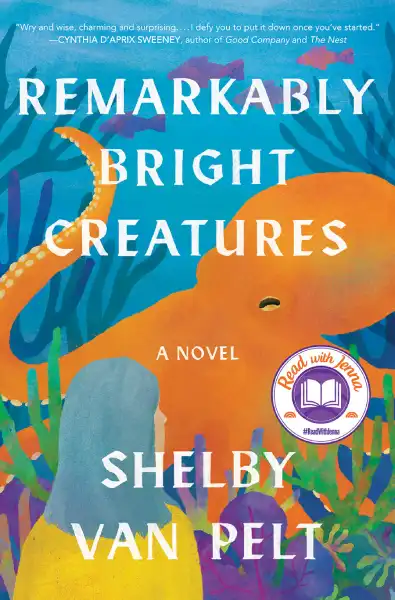
There is something wonderfully absurd about picking up a novel in which one of the central characters is an octopus and discovering that he might be the wisest character in the entire story.
And yet, that is precisely what Shelby Van Pelt achieves in Remarkably Bright Creatures.
I went into this book expecting something charming, perhaps a little quirky, maybe even funny. What I found was a much more thoughtful story about loneliness, grief, the weight of unanswered questions, and our remarkable ability to find meaning in the most unexpected relationships.
It is a book that seems simple on the surface but carries considerably more emotional depth than its unusual premise suggests.
An Unlikely Friendship
At the center of the novel is Tova Sullivan, a seventy-year-old widow who works nights cleaning the Sowell Bay Aquarium.
Tova has experienced the kind of loss that changes the architecture of a person’s life, as she shared, you never get over it, you just find the power to move on… Her son disappeared decades earlier, and her husband has since passed away. What remains is a carefully maintained routine, a strong sense of responsibility, and a quiet determination to keep moving forward.
Then there is Marcellus.
Marcellus is a giant Pacific octopus living at the aquarium. He is intelligent, observant, sarcastic, and not particularly impressed by humanity.
He also happens to be one of the most memorable narrators I’ve encountered in fiction.
What makes their relationship fascinating is that neither Tova nor Marcellus is especially interested in being rescued. Both live within their own forms of confinement: Marcellus behind the glass of his tank, Tova behind the invisible walls of her memories and routines.
And somehow, they recognize something in each other.
The Loneliness We Learn to Live With
One of the things I appreciated most about this novel is how quietly it explores loneliness.
Tova is not portrayed as someone constantly overwhelmed by sadness. She functions. She works. She has friends. She maintains her home and follows her routines.
From the outside, she seems perfectly capable of managing her life.
But there is a difference between living a life and simply maintaining one.
I think that distinction is something many of us recognize, whether in ourselves or in people we know.
We become very good at building routines around our disappointments. We fill our days with responsibilities, work, familiar conversations, and small obligations. Sometimes those routines are what keep us going. Other times, they become a way of avoiding the questions we are afraid to confront.
Tova’s story made me think about how easily independence can become isolation, and how difficult it can be to admit that we still need other people, regardless of our age or how much life has taught us.
Marcellus and the Strange Behavior of Humans
There is a wonderful irony in having an octopus observe human beings.
Marcellus sees patterns that people fail to recognize. He notices what is hidden in plain sight. He is often frustrated by how complicated humans make things that appear obvious to him.
His observations are funny, but they also serve a deeper purpose.
We like to think of ourselves as rational creatures. We believe we understand our motivations, that our decisions make sense, and that we generally know what is best for us.
Yet so much of our behavior is driven by fear, pride, regret, and the stories we tell ourselves.
Sometimes we hold on to pain because it has become familiar. Sometimes we refuse help because accepting it would mean admitting vulnerability. And sometimes the truth is right in front of us, but we are too emotionally invested in our assumptions to recognize it.
Marcellus offers a perspective that is both detached and strangely compassionate.
He has every reason to distrust humans, and yet he chooses to care.
Perhaps that is what makes him such a remarkable character. His intelligence is not simply about solving problems. It is about paying attention.
And paying attention, truly paying attention, is something humans often forget to do.
Grief Is Not Something We Finish
Another aspect of the novel that stayed with me is its treatment of grief.
We often speak about grief as though it were a process with a destination. We imagine that enough time, acceptance, or understanding will eventually allow us to leave it behind.
But loss rarely works that way.
Some absences become part of who we are. They influence our decisions, our relationships, and the way we interpret the world, even decades later.
Tova’s grief is not dramatic. It is persistent.
It exists in the spaces between her daily activities, in memories that never quite settle, and in questions that have remained unanswered for most of her life.
What I found moving is that the novel does not suggest we must forget the people we have lost in order to move forward.
Instead, it asks whether we can make room for something new without betraying what came before.
That is a much more meaningful question.
Because perhaps healing is not about closing a chapter. Perhaps it is about realizing that the story is still being written.
The People Who Enter Our Lives Unexpectedly
The novel also explores how lives that appear unrelated can become connected in ways nobody could have anticipated.
We tend to imagine that the important people in our lives will arrive through familiar channels: family, old friendships, shared interests, or carefully cultivated relationships.
But life is rarely that predictable.
Sometimes a stranger changes how we see ourselves. Sometimes an unlikely friendship brings us back to a part of ourselves we thought we had lost.
And sometimes the people who help us most are not the ones who have known us longest, but those who encounter us at precisely the moment we are ready to change.
I liked that Remarkably Bright Creatures does not turn this idea into a grand philosophical lesson. It simply allows its characters to stumble into each other’s lives, make mistakes, and gradually discover that they are less alone than they believed.
There is something reassuring about that.
What Didn’t Work Quite as Well
Not everything in the novel is equally convincing.
Some coincidences are rather convenient, and a few developments are easy to anticipate well before the characters arrive at their own conclusions.
Cameron, in particular, can be frustrating. His impulsiveness and lack of direction sometimes make it difficult to sympathize with him as easily as with Tova.
And while Marcellus is an extraordinary character, his almost magical ability to understand the human world requires a generous suspension of disbelief.
But I found these weaknesses relatively easy to forgive.
This is not a novel that depends on shocking revelations or intricate plot mechanics. Its strength lies in its characters and the emotional significance of their relationships.
Sometimes knowing where a story is heading does not diminish the pleasure of watching its characters find their way there.
Final Thoughts
What stayed with me after finishing Remarkably Bright Creatures was not the mystery at the center of the story, but the quiet idea that we are often far less alone than we think.
We may not always recognize the people who care about us. We may be too busy protecting ourselves to notice an opportunity for connection. And we may convince ourselves that certain chapters of our lives are already finished.
But life has a strange habit of challenging those conclusions.
Tova reminds us that it is never too late to let someone into our lives.
Cameron reminds us that being lost does not mean we are beyond finding our way.
And Marcellus, perhaps the most human character in a story full of humans, reminds us that intelligence without empathy is not nearly as remarkable as we imagine.
I closed this book with a smile, a little sadness, and an unexpected affection for a fictional octopus. And somewhere in that fictional ocean, I like to imagine Marcellus found the deep, quiet crevice he had been longing for; a place where he could spend his final moments free, on his own terms, exactly as he wished.
Maybe that is the real beauty of this story: sometimes it takes a creature with eight arms and three hearts to remind us what matters most about having just one.
Remarkably Bright Creatures is a warm, gentle, occasionally predictable, but deeply moving novel about grief, belonging, second chances, and the extraordinary connections hidden inside ordinary lives.
My rating: 5/5 — A beautiful reminder that even when life seems settled into its final shape, there may still be room for something wonderful.
Comments
0