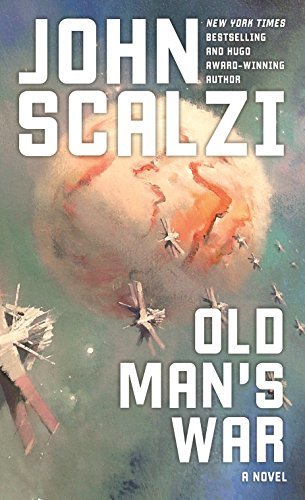
The Series at a Glance
| # | Title | Year | Pages | My take |
|---|---|---|---|---|
| 1 | Old Man’s War | 2005 | 320 | A brilliant, funny, surprisingly emotional opener |
| 2 | The Ghost Brigades | 2006 | 320 | The series turns philosophical |
| 3 | The Last Colony | 2007 | 320 | The Colonial Union stops looking like the good guys |
| 4 | Zoe’s Tale | 2008 | 336 | Same events, new eyes; the most repetitive entry |
| 5 | The Human Division | 2013 | 432 | Diplomats instead of soldiers; episodic |
| 6 | The End of All Things | 2015 | 384 | Political conspiracy told in four parts |
| 7 | The Shattering Peace | 2025 | 288 | A brilliant strong return after ten years |
I recommend to read them in publication order. That’s also the story’s chronological order.
The Big Idea
Imagine you’re 75 years old. You’ve lived your life, made your mistakes, lost people you loved, and accepted that your best years are behind you. Then someone offers you a deal: join the army, leave Earth forever, and get a new, genetically engineered body that is young, strong, green, fast and built for combat.
The catch is that humanity has expanded into the universe, and practically everyone out there wants to kill us. It’s a very old human fear, the same one Liu Cixin turned into the “dark forest” theory in The Dark Forest, the sequel to The Three-Body Problem: every civilization is a hunter hiding among the trees, and any other civilization it spots is a threat to eliminate before it strikes first. Scalzi’s version is way louder. Nobody hides; everyone just fights openly over the same scarce habitable planets.
That’s where John Scalzi begins Old Man’s War. What I found brilliant about the series is that the premise is only the starting point. Across seven books, the story grows from military adventure into an exploration of identity, consciousness, political power, propaganda, diplomacy, and the absurdity of civilizations that keep finding reasons to fight one another.
The first book asks what happens when an old man gets a second life. By the seventh, the questions are much bigger: who decides the future of entire civilizations, what happens when supposedly rational governments act out of fear, and whether humanity can live peacefully with anyone, including itself.
What starts as a war for survival gradually becomes a story about whether survival requires war at all. That transition is what makes the series worth reading in its entirety, … oh boy loved the journey!
Why I Picked Up This Series
I love science fiction that takes a simple idea and follows its consequences somewhere unexpected. Advanced technology, interstellar travel, alien civilizations, military strategy and political intrigue will always get my attention. But technology alone won’t hold me for seven books. There has to be something underneath that makes me think about the world we actually live in.
Scalzi manages both. His universe is enormous and full of species with different technologies, cultures and ideas about life itself, yet the conflicts feel familiar. Governments manipulate information. Military institutions justify terrible decisions in the name of security. Alliances shift when interests change. Powerful civilizations assume they know what’s best for everyone else. And through all of it, Scalzi keeps a wonderfully irreverent sense of humor.
I expected an entertaining space adventure. More than 2,000 pages later, I got considerably more than that.
Seven Books, and a Universe That Keeps Getting Bigger
1. Old Man’s War (2005): A Brilliant Beginning
This is one of the most entertaining introductions to a science-fiction universe I’ve read.
John Perry joins the Colonial Defense Forces on his 75th birthday, and everything he thinks he knows about humanity’s place in the universe falls apart within weeks. The enemies are wildly inventive: the Rraey, who consider humans a delicacy; the Covandu, a civilization of people about an inch tall; and the Consu, so far beyond us that they treat battle as a religious ritual. The fights are imaginative, sometimes brutal, and frequently absurd.
What makes the book work, though, is Perry himself. He isn’t a young idealist discovering adulthood through war. He’s an old man who has already lived a full life. His body is young again, but his mind carries decades of experience, loss and regret, and that contrast gives the story a surprising emotional weight. His relationship with Jane Sagan adds another layer, raising uncomfortable questions about identity, love, memory, and what makes someone the person they are.
I enjoyed the action, but it was the human element that made me want to continue.
2. The Ghost Brigades (2006): What Makes Us Human?
This is where the series becomes philosophical.
The Ghost Brigades are Special Forces soldiers grown as adults, with no childhoods or personal histories, designed to fight and follow orders. Jared Dirac is one of them, with a twist: he was built to carry the memories of a scientist who betrayed humanity, in the hope those memories reveal what the traitor is planning.
Through Jared, Scalzi explores memory, consciousness and free will. If you can build a body and construct a mind, what have you created? A human being, a weapon, or property belonging to the institution that built it? And who gets to decide?
Scalzi avoids turning these questions into philosophical lectures. He builds them into the characters and their decisions and lets the consequences do the talking.
3. The Last Colony (2007): The Enemy Isn’t Always Alien
This is where the political side of the series takes over.
Perry and Sagan try to build a new life as colonists, only to discover that interstellar politics has other plans. The focus shifts from soldiers fighting wars to ordinary people trying to survive decisions made far above their heads, and suddenly the Colonial Union doesn’t look as heroic as it once did.
Scalzi challenges a view the earlier books encourage us to accept: humanity is surrounded by enemies, so humanity’s military actions must be necessary. Necessary according to whom? When a government controls the information its citizens receive, the line between defense, expansion and manipulation gets very thin.
One of the best things Scalzi does is make you question the institutions you’ve spent two books rooting for.
4. Zoe’s Tale (2008): The Same War, a Different Life
Retelling the events of The Last Colony from Zoe’s perspective initially felt like an odd choice. We’ve already lived this story, so why tell it again?
The idea behind it is worthwhile: the same event looks completely different depending on who experiences it. Perry sees the colony as a soldier, father and leader. Zoe sees it as a teenager whose existence carries extraordinary significance for an entire alien species. Her relationship with the Obin, a species wrestling with the very nature of consciousness, adds a dimension the previous book couldn’t explore, and the book fills in events that happened outside Perry’s view.
Still, this is where I felt the most repetition, and it does little to advance the overall timeline. If you’re in a hurry, it’s the one book you can skip without losing the main plot, personally I’m glad I didn’t.
5. The Human Division (2013): From Soldiers to Diplomats
Here the series makes another significant turn.
The Colonial Union’s relationship with Earth is falling apart, the Conclave has become a major political force, and humanity’s usual military advantages are no longer enough. Enter Harry Wilson and the diplomatic team of Ambassador Ode Abumwe, a “B-team” that gets the jobs nobody else wants.
I loved this change of perspective. Instead of solving problems with enhanced soldiers and better weapons, the characters have to navigate negotiations, political traps, institutional incompetence and conflicting interests. Scalzi understands that diplomacy can be as dangerous as warfare, even if the weapons are different. His humor is at its best here, aimed at bureaucracy, diplomatic absurdity, and people who take themselves far too seriously.
The book was originally released as 13 weekly e-book episodes, and it shows. It reads like a set of connected incidents inside a larger crisis rather than one continuous novel. Sometimes that works brilliantly. Sometimes it interrupts the momentum.
6. The End of All Things (2015): Who Benefits From Chaos?
By the sixth book, the political situation is extraordinarily complicated. Human factions, alien alliances, military interests and hidden agendas overlap until it’s hard to tell friend from enemy, and that’s exactly what makes it interesting.
The question I kept coming back to was simple: when everyone claims to act in the name of peace and security, who actually benefits from keeping the conflict alive? Scalzi explores manipulation, manufactured crises, and how a small group can push a much larger population toward catastrophic decisions.
Like its predecessor, the book was first published in parts, here as four connected novellas, each from a different perspective. The fragmented structure isn’t as satisfying as following one protagonist through a continuous story, but it suits the political complexity the series has built.
By this point, the series has traveled a very long way from its original premise. That’s one of its greatest achievements.
7. The Shattering Peace (2025): A Universe That Still Has Lessons to Learn
Ten years after The End of All Things, Scalzi returned to this universe, and a decade has also passed inside the story.
A fragile peace holds between Earth, the Colonial Union and the Conclave. Then a colony the three founded together disappears, and the likely culprits are the Consu, the most technologically advanced civilization in the series and one that barely considers other species sentient. Gretchen Trujillo, a Colonial Union diplomat, is sent to find out what happened.
What I like about this premise is how it changes the balance of power. For six books, humanity survived among competing civilizations by using whatever military, technological and political advantages it could assemble. But what happens when one civilization is so far ahead that the usual balance of power becomes meaningless?
The Consu show that intelligence and technological superiority don’t imply wisdom, responsibility or moral superiority. For all their advancement, they can still create chaos on an enormous scale. That feels especially relevant now, as we pour extraordinary resources into AI and other powerful technologies while still struggling with some very old human problems.
I also appreciate that Scalzi doesn’t simply bring back John Perry for a nostalgic adventure. Gretchen offers a new perspective and lets the universe grow beyond its original heroes. The book brings back the series’ humor, alien intrigue and inventive problem-solving without pretending the political and moral problems of the earlier novels have gone away.
That seems appropriate. Peace isn’t a permanent achievement, it’s something civilizations have to keep choosing.
What Makes This Series Brilliant
Humanity Isn’t the Center of the Universe
We’re just another civilization trying to survive, expand, negotiate, and occasionally make a complete mess of things. The aliens aren’t interchangeable enemies waiting to be defeated. They have their own histories, political structures, values and interpretations of reality. The Conclave in particular challenges the assumption that interstellar politics has to mean endless independent civilizations fighting over planets.
The further I read, the more I appreciated that each alien civilization also offers a different way of looking at humanity.
The Politics Are More Interesting Than the Battles
The military science fiction is excellent. But the longer the series runs, the more compelling the politics behind the wars become. Wars don’t happen in isolation. They come from interests, assumptions, competition, fear, and failed diplomacy, and Scalzi gradually exposes that machinery. Who controls information? Who benefits from expansion? Who pays for decisions made by powerful institutions?
What I enjoyed most was watching characters who began by accepting the system start to question it. The real journey in this series isn’t toward better technology. It’s from certainty to doubt.
The Humor Makes Everything Better
Scalzi has a talent for making serious situations genuinely god damm funny. There’s a lot of death, violence, manipulation and existential danger in these books, but they rarely become exhausting because he knows when to drop in a joke. Sometimes the universe is absurd, people are god damm huge idiots, and the best response is a well-timed comeback. It’s a big reason all seven books stay so readable.
The Characters Stay Human, Even When They Technically Aren’t
The thread running through all seven books is personhood. The series starts with human minds moved into engineered bodies, then adds soldiers grown as adults, aliens struggling with consciousness, and civilizations with radically different ideas of life. Underneath all of it, the characters want the same things we do: belonging, freedom, love, purpose, and some control over their own lives.
Technology can transform the body, extend life and expand intelligence. It doesn’t solve the basic problems of being a person. That’s a much more interesting idea than better, fancier spaceships.
What Didn’t Work Quite as Well
The series isn’t perfect.
The dialogue is too consistently witty. Almost everyone has the perfect sarcastic response ready, regardless of background, personality or circumstances. It’s entertaining, but the characters sometimes sound more alike than they should.
The pacing varies a lot. The first three novels have a conventional structure. Zoe’s Tale retells familiar events, and The Human Division and The End of All Things are episodic because of how they were first published. These experiments serve a purpose, but they don’t build the same momentum as the opening trilogy.
Some problems are solved too conveniently. Scalzi is very good at building clever situations and finding inventive ways out of them. Occasionally I wanted the consequences to stay, well … messier.
None of this seriously reduced my enjoyment, but it’s worth knowing before committing to all seven books rather than just the first.
What Stayed With Me
After seven books, it isn’t the engineered bodies, BrainPals, spaceships or alien weapons I’ll remember most. It’s the way Scalzi gradually takes apart the idea that technological progress makes a civilization wise. Just look at us: we build billion-dollar data centers, and a good share of that computing power goes to generating memes and cat pictures 😄.
Humanity reaches the stars, gains extraordinary capabilities, and meets intelligent species across the galaxy, yet carries its oldest problems along: fear, tribalism, ambition, distrust, manipulation, and the conviction that our interests justify whatever we do to protect them.
The uncomfortable part is that the aliens aren’t necessarily any better. Some are more advanced, some are much older, some understand parts of reality we can barely grasp. But intelligence, knowledge and power don’t automatically produce good judgment.
We can become extraordinarily good at solving technical problems while staying remarkably primitive at solving the problems we create between ourselves.
That idea stayed with me far longer than any battle.
Final Verdict
My rating: 5/5 for the complete series.
Not because every book is equally strong or every plot decision works. But taken together, these seven books deliver something rare: an entertaining, expansive science-fiction universe that keeps developing its ideas instead of repeating its original formula. Scalzi combines military action, humor, alien civilizations, political intrigue and philosophical questions without ever making it feel like homework.
I laughed, I questioned characters I’d previously trusted, and most of all I wanted to know what happened next. For all its political complexity, this is still a tremendously entertaining adventure.
One-line verdict: A seven-book journey that starts with an old man joining a space army and grows into a thoughtful exploration of war, power, intelligence, and what it means to be human.
What I’m taking away: Technological progress can make civilizations more powerful. It doesn’t necessarily make them wiser.
More than 2,000 pages, seven books, and twenty years of storytelling. What a ride.
If you enjoy science fiction that makes you laugh, keeps you turning pages, and occasionally forces you to reconsider what you thought you understood, I couldn’t recommend this series more. Is committing to all seven books worth it? Absolutely.
Comments
0