The Big Idea
The most important technology in the modern economy is also one of its most concentrated vulnerabilities.
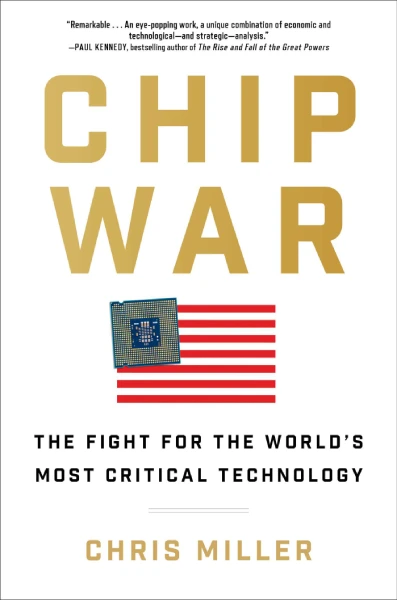
That is the central argument of Chip War. Chris Miller traces how semiconductors went from an American scientific breakthrough to the foundation of global computing, military power, and economic competition. What looks like a tiny component inside a phone or a server is actually the outcome of an extraordinarily specialized international system—one that no single country can reproduce easily or quickly.
The book changed the way I think about the phrase technological leadership; it is not enough to invent a better chip. Someone must design it, manufacture it at scale, supply the machines and materials, package it, and make the economics work. Each step depends on expertise accumulated over decades.
For me, the most interesting question is not simply who has the best technology today. It is who controls the bottlenecks, who depends on whom, and what happens when economics and national security pull in different directions.
Chip War was more than just an interesting read. It was the catalyst that pushed me to dive deeper into an industry that had fascinated me for years. What started as intellectual curiosity eventually evolved into one of the most extensive independent research projects I have ever undertaken.
I wanted to understand the entire semiconductor ecosystem not just the companies making headlines, but also the less visible players, the technological dependencies, the barriers to entry, the competitive advantages, and, ultimately, who captures the economic value along the supply chain.
Perhaps that is the greatest compliment I can give a book: I finished reading it almost in a day, but I never stopped exploring the subject. It didn’t simply answer my questions; it gave me many more worth pursuing.
Why I Picked This Book
I wanted to understand the semiconductor industry beyond headlines about NVIDIA, TSMC, AI chips, and restrictions on exports to China. Those stories are easy to follow individually and much harder to understand as parts of one system.
As someone interested in technology, software, markets, and investing, I was looking for a clearer mental model: What’s the story, Where does the real value sit? Why are certain companies so difficult to replace? How did manufacturing become concentrated in a few places? And why has an industry built on global cooperation become a source of geopolitical confrontation?
Chip War is not a stock-picking guide, and I am glad it is not. It is something more fundamental: a history of how the present system was built, and why it cannot be rearranged overnight.
Top 3 Takeaways
1. The semiconductor industry is a network of bottlenecks, not one industry
Before reading about the sector in depth, it is tempting to imagine the competition as a race between famous chip brands. Miller makes that picture look painfully incomplete.
The semiconductor supply chain includes design tools, chip architectures, foundries, fabrication equipment, chemicals, materials, packaging, memory, and specialized manufacturing know-how. American firms play crucial roles in design and equipment; the Netherlands is central to advanced lithography through ASML; Taiwan, particularly TSMC, is crucial to leading-edge contract manufacturing; South Korea and Japan are important in different stages of the ecosystem.
These capabilities are connected, but they are not interchangeable. Having the money to build a fabrication plant does not automatically give you the experience to run it competitively. Owning a promising design does not mean you can manufacture it at the required yield and volume.
This is the insight I find most useful for understanding businesses: look for the constraint that is hardest to replicate, not just the product getting the most attention. A famous chip designer may capture enormous value, but its success still depends on less visible suppliers whose capabilities are scarce.
2. Efficiency created an extraordinary system—and a strategic vulnerability
One of the book’s most fascinating tensions is that global specialization was economically rational. Companies and countries focused on what they did best. Over decades, that produced better chips, lower costs, more innovation, and enormous growth in computing power.
But the same specialization created dependence. Advanced chipmaking capacity became geographically concentrated, and Taiwan acquired an importance far beyond its size. A serious disruption there would not simply affect one manufacturer. It could ripple through customers, suppliers, equipment makers, and entire industries.
What stood with me is that the most efficient supply chain is not necessarily the most resilient one. Redundancy costs money; concentration can reduce costs while increasing exposure to rare but catastrophic disruptions.
I find this especially relevant when thinking about AI infrastructure. A data center is not just GPUs. It depends on memory, networking, power, storage, and physical supply chains. A weak link can become the binding constraint on the entire system.
3. Technology policy can reshape the competitive landscape, but not without trade-offs
Miller’s history makes clear that semiconductors have never been purely a commercial business. Governments, defense needs, research funding, alliances, and export policy have influenced the industry from its early years.
The modern US–China competition is therefore not an unexpected departure from history. What is different is the scale of global interdependence. Efforts to restrict access to advanced technology may preserve an advantage in certain capabilities, but they can also encourage domestic substitution, impose costs on suppliers, and fragment markets.
The important lesson for me is to resist easy narratives. It is too simple to say that export controls will permanently stop a competitor. It is equally simple to assume that throwing money at domestic manufacturing can reproduce decades of accumulated expertise.
When evaluating a technology thesis, I want to distinguish what a government wants to achieve from what the industrial system can actually deliver and over what timeframe.
The “Hero” Critique
My main reservation is that the book’s geopolitical framing can sometimes be stronger than its treatment of economic trade-offs. Its account is compelling, but its focus on strategic rivalry can encourage readers to see every technological advance as a national win or loss.
The semiconductor ecosystem is more complicated than a contest in which one country simply controls the chips. American, Taiwanese, Korean, Japanese, Dutch, and other companies have different incentives, and their success rests heavily on international cooperation. I would have liked more exploration of those tensions—and of how export restrictions can generate unintended consequences, but in the end its 1 book and that has physical limits.
The second limitation is time. The book first appeared in 2022. Its historical sections remain valuable, but the industry has moved rapidly since then, particularly in AI accelerators, high-bandwidth memory, advanced packaging, industrial policy, and export controls. Its analysis of the present should be read as a strong foundation, not as a current industry map.
Finally, this is a sweeping history, not a detailed semiconductor engineering textbook or a financial valuation manual. Readers looking for a technical explanation of every manufacturing step, or for a ranking of today’s best semiconductor investments, will need other sources.
Those limitations matter, but they do not take away what the book does exceptionally well: tells the story, connect decades of invention, business decisions, industrial specialization, and geopolitical risk into one coherent story … loved it.
Best Quote or Idea
What I find most fascinating: The power to shape the digital world depends on a surprisingly small number of highly specialized capabilities.
That is my paraphrase of the book’s central argument, not a direct quotation.
What makes the idea powerful is that it changes where I look. Instead of asking only who sells the finished chip, I want to understand who makes the chip possible and whether that capability can be replaced.
Who Should Read This Book?
Read this if you are:
- Interested in technology, AI, semiconductors, or the history of Silicon Valley.
- Trying to understand the economic and geopolitical significance of Taiwan and global chip supply chains.
- An investor or business analyst who wants industry structure before company valuations.
- Curious about how innovation, manufacturing, and government policy interact.
Skip this if you are:
- Looking for a step-by-step guide to semiconductor engineering.
- Expecting an up-to-date 2026 market report or a list of stocks to buy.
- Uninterested in the historical and geopolitical context behind technology.
Final Verdict
One-line verdict: Chip War is an essential introduction to the history and strategic economics of semiconductors because it reveals that modern computing depends on a fragile, deeply specialized global network.
Actionable Step: When I research an AI or semiconductor company, I want to map its position in the value chain first: its suppliers, customers, technological bottlenecks, switching costs, geopolitical exposure, and dependence on capabilities outside its control. Only then does a financial forecast begin to mean something.
My biggest takeaway is that technology leadership is not a single product, a single company, or even a single country. It is a system of hard-won capabilities. Understanding that system is far more valuable than reacting to the latest chip headline.
Comments
0